
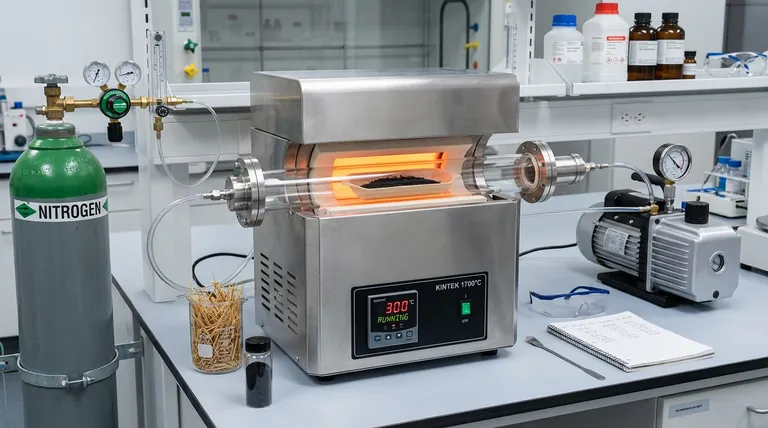
The vacuum tube furnace functions as the primary reactor for the thermal decomposition of wheat straw, specifically designed to create a strictly controlled, high-temperature environment. By utilizing a high-purity nitrogen flow to displace oxygen, it ensures the biomass undergoes pyrolysis rather than combustion, effectively preventing the material from burning to ash.
Core Takeaway The vacuum tube furnace is the vessel that guarantees the transition from raw biomass to stable biochar by physically isolating the wheat straw from oxidation. Its value lies in the precise regulation of heating rates and dwell times—specifically holding at 300 °C—to lock in the carbon structure without material loss.
The Mechanics of Controlled Pyrolysis
Establishing an Anaerobic Atmosphere
The fundamental role of the vacuum tube furnace is to eliminate oxygen. The system uses a high-purity nitrogen flow to purge the reaction chamber.
By maintaining this inert atmosphere, the furnace prevents the oxidative loss of the raw material. If oxygen were present at these temperatures, the wheat straw would simply burn away; under nitrogen, it chemically reorganizes into carbon.
Facilitating Thermal Decomposition
Inside the furnace, the wheat straw undergoes pyrolysis. This is the thermochemical decomposition of organic material at elevated temperatures in the absence of oxygen.
The furnace acts as a stabilizer, allowing the biomass to release volatile components while retaining a solid carbon skeleton.
Critical Parameters for Wheat Straw
The effectiveness of the vacuum tube furnace depends entirely on the specific parameters programmed into it. For wheat straw, the primary reference dictates a precise recipe for stability.
Controlled Heating Rate
The furnace must be set to increase temperature at a rate of 10 °C per minute.
This controlled ramp-up is crucial. It ensures the heat penetrates the biomass particles evenly, preventing thermal shock or uneven carbonization that could compromise the final structure.
Specific Temperature and Dwell Time
For the preparation of wheat straw biochar, the furnace creates a constant temperature environment of 300 °C.
It maintains this temperature for exactly 2 hours. This duration allows for the complete conversion of the biomass, ensuring the resulting biochar is chemically stable and uniform.
Understanding the Trade-offs
The Risk of Atmosphere Breach
The system relies entirely on the integrity of the seal and the continuity of the nitrogen flow.
If the nitrogen supply fluctuates or the tube seal fails, oxygen will enter the chamber. Even a small amount of oxygen at 300 °C will degrade the biochar, leading to lower yields and higher ash content.
Sensitivity to Temperature Deviations
The specific instruction of 300 °C is a lower-temperature pyrolysis (compared to the 500-600 °C range often used for other materials like peanut shells or date stones).
Operating significantly higher than this creates a trade-off. While higher temperatures might increase porosity, they often reduce the total yield of the biochar. Adhering to the specific 300 °C limit prioritizes the stability and retention of the wheat straw material over maximum surface area development.
Making the Right Choice for Your Goal
When configuring a vacuum tube furnace for wheat straw, your settings determine the material's final properties.
- If your primary focus is material stability and yield: Adhere strictly to the 300 °C temperature and 2-hour dwell time to prevent excessive mass loss.
- If your primary focus is preventing oxidation: Ensure the high-purity nitrogen flow is active before heating begins and continues until the furnace has cooled down.
The vacuum tube furnace is not just a heater; it is a precision instrument that dictates the chemical destiny of your biomass.
Summary Table:
| Process Parameter | Specification | Purpose |
|---|---|---|
| Atmosphere Control | High-purity Nitrogen Flow | Prevents oxidation and material combustion |
| Heating Rate | 10 °C / minute | Ensures uniform heat penetration and structural integrity |
| Target Temperature | 300 °C | Optimizes carbonization stability for wheat straw |
| Dwell Time | 2 Hours | Guarantees complete thermochemical conversion |
Elevate Your Biomass Research with KINTEK
Unlock the full potential of your carbon materials with KINTEK’s precision thermal solutions. Backed by expert R&D and manufacturing, we provide high-performance Muffle, Tube, Rotary, Vacuum, and CVD systems tailored for specific research needs like wheat straw pyrolysis.
Whether you need a specialized atmosphere or a customizable lab high-temp furnace, our equipment ensures the stable, repeatable results your laboratory demands. Contact KINTEK today to discuss your unique requirements and see how our customizable systems can streamline your production process.
Visual Guide

References
- Yunfeng Tan, Yinchun Gong. Removal of Cr(VI) from aqueous solution using ball mill modified biochar: multivariate modeling, optimization and experimental study. DOI: 10.1038/s41598-024-55520-9
This article is also based on technical information from Kintek Furnace Knowledge Base .
Related Products
- Vacuum Hot Press Furnace Machine Heated Vacuum Press Tube Furnace
- Vacuum Sealed Continuous Working Rotary Tube Furnace Rotating Tube Furnace
- High Pressure Laboratory Vacuum Tube Furnace
- Laboratory Vacuum Tilt Rotary Tube Furnace Rotating Tube Furnace
- Magnesium Extraction and Purification Condensing Tube Furnace
People Also Ask
- Why use Vacuum Hot Press (VHP) for ZnS Ceramics? Achieve Superior IR Transparency and Mechanical Strength
- What safety features are incorporated in vacuum hot press furnaces? Ensure Operator and Equipment Protection
- What are the benefits of the vacuum environment system in a vacuum hot press furnace? Unlock High-Density Sintering
- What is the significance of the vacuum environment for sintering stainless steel? Unlock High-Density Purity
- What considerations guide the selection of heating elements and pressurization methods for a vacuum hot press furnace?



















