
The primary purpose of an industrial-grade vertical tube furnace in this context is to act as a high-fidelity simulator for industrial refining. By establishing a stable thermal field capable of reaching temperatures between 1500°C and 1600°C, this equipment allows researchers to replicate the harsh reduction environments found in full-scale operations. It enables the precise treatment of small-scale samples (specifically 40g) to evaluate the efficiency of phosphorus recovery before attempting larger production runs.
The core value of this furnace lies in its ability to isolate variables. By providing a consistent high-temperature environment, it generates the essential data needed to quantify how basicity and temperature impact slag-metal distribution, serving as a critical checkpoint for industrial scaling.
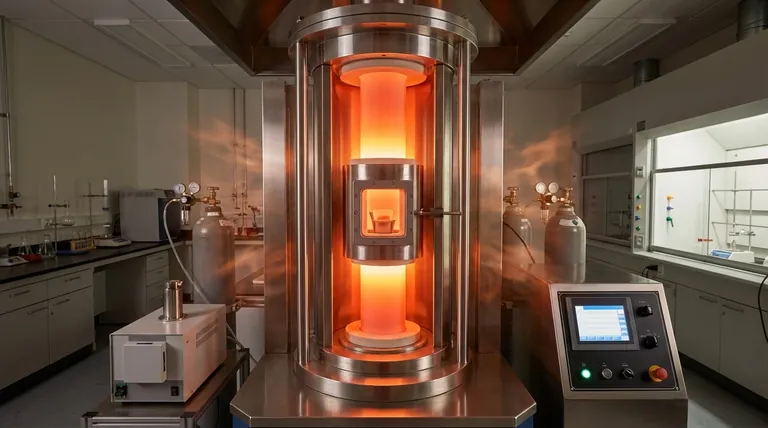
Simulating the Industrial Environment
Replicating Refining Conditions
To accurately evaluate phosphorus recovery, you must mimic the extreme environment of a refining furnace.
The vertical tube furnace is designed to simulate this high-temperature reduction environment. It ensures that the chemical reactions observed in the lab are comparable to those that will occur in a manufacturing plant.
Achieving Essential Temperatures
Phosphorus recovery processes often require intense heat to facilitate phase separation.
This specific furnace equipment allows researchers to operate between 1500°C and 1600°C. Maintaining this range is critical for ensuring the materials reach the necessary state for analysis.
Ensuring Thermal Stability
Inconsistent heating can lead to flawed data and unreliable conclusions.
The vertical tube design provides a stable and consistent thermal field around the sample. This control eliminates temperature fluctuations as a variable, ensuring that observed changes are due to process parameters, not equipment error.
Quantifying Critical Process Variables
Measuring the Impact of Basicity
One of the main goals of this evaluation is to understand how chemical composition affects results.
Researchers use the furnace to quantify how different basicity levels influence the recovery process. This data helps identify the optimal chemical balance required for maximum efficiency.
Analyzing Slag-Metal Distribution
Successful phosphorus recovery depends on understanding where the element migrates during heating.
The furnace facilitates the study of slag-metal distribution within the 40g samples. Accurately mapping this distribution is the key to calculating precise recovery rates.
Understanding the Trade-offs
Sample Size Limitations
While the furnace is excellent for establishing chemical principles, it operates on a micro-scale.
The process relies on treating small 40g samples. While this provides essential data for scaling, it cannot perfectly model the mass transfer and physical dynamics of multi-ton industrial batches.
Static vs. Dynamic Testing
Laboratory furnaces typically provide a static environment for the sample.
Real-world refining often involves dynamic movement and continuous flow. Users must account for this difference when extrapolating laboratory data to live industrial processes.
Making the Right Choice for Your Goal
To maximize the value of your evaluation, align your usage with your specific research objectives.
- If your primary focus is Process Scalability: Use the furnace to generate the "essential data" required to prove the process is viable for industrial application.
- If your primary focus is Chemical Optimization: Leverage the stable thermal field to isolate exactly how changes in basicity alter the phosphorus recovery rate.
This equipment serves as the bridge between theoretical chemistry and practical, industrial reality.
Summary Table:
| Feature | Industrial-Grade Vertical Tube Furnace Specification |
|---|---|
| Temperature Range | 1500°C to 1600°C |
| Sample Capacity | 40g (Precision Small-Scale) |
| Core Function | High-fidelity industrial refining simulation |
| Key Variables | Basicity, Temperature, Slag-Metal Distribution |
| Primary Goal | Process scalability and chemical optimization |
Scale Your Phosphorus Recovery Process with Confidence
Transitioning from laboratory evaluation to industrial production requires precision and reliability. Backed by expert R&D and manufacturing, KINTEK offers high-performance Tube, Muffle, Rotary, Vacuum, and CVD systems, all fully customizable to meet your unique thermal processing needs. Our industrial-grade vertical tube furnaces provide the stable thermal environment and precise control necessary to quantify critical variables and optimize your chemical recovery rates.
Ready to bridge the gap between theory and industrial reality? Contact KINTEK today to discover how our advanced lab furnaces can enhance your research efficiency.
Visual Guide

References
- Antoinette Kotzé, Sander Arnout. Thermochemical evaluation of elemental phosphorus recovery from sewage sludge. DOI: 10.17159/2411-9717/3556/2025
This article is also based on technical information from Kintek Furnace Knowledge Base .
Related Products
- Vertical Laboratory Quartz Tube Furnace Tubular Furnace
- Custom Made Versatile CVD Tube Furnace Chemical Vapor Deposition CVD Equipment Machine
- Vacuum Sealed Continuous Working Rotary Tube Furnace Rotating Tube Furnace
- Slide PECVD Tube Furnace with Liquid Gasifier PECVD Machine
- Split Chamber CVD Tube Furnace with Vacuum Station CVD Machine
People Also Ask
- What are the key differences between single-zone and multi-zone vertical tube furnaces? Choose the Right Furnace for Your Lab
- How do heat treatment processes influence the configuration of a vertical tube furnace? Optimize for Quenching, Annealing, and More
- What is a vertical tube furnace and how does it function? Optimize Material Processing with Precision
- How are wafers loaded and unloaded in a vertical tube furnace? Achieve Precision and Purity in Wafer Processing
- Why is a vertical tube furnace preferred for quenching tests? Achieve Rapid, Repeatable Cooling for Accurate Results



















