Knowledge What is unique about the heating mechanism of a Spark Plasma Sintering (SPS) furnace when preparing nanostructured h-BN ceramics? Achieve Ultra-Fast Densification and Suppress Grain Growth
Author avatar

Tech Team · Kintek Furnace

Updated 1 day ago

What is unique about the heating mechanism of a Spark Plasma Sintering (SPS) furnace when preparing nanostructured h-BN ceramics? Achieve Ultra-Fast Densification and Suppress Grain Growth


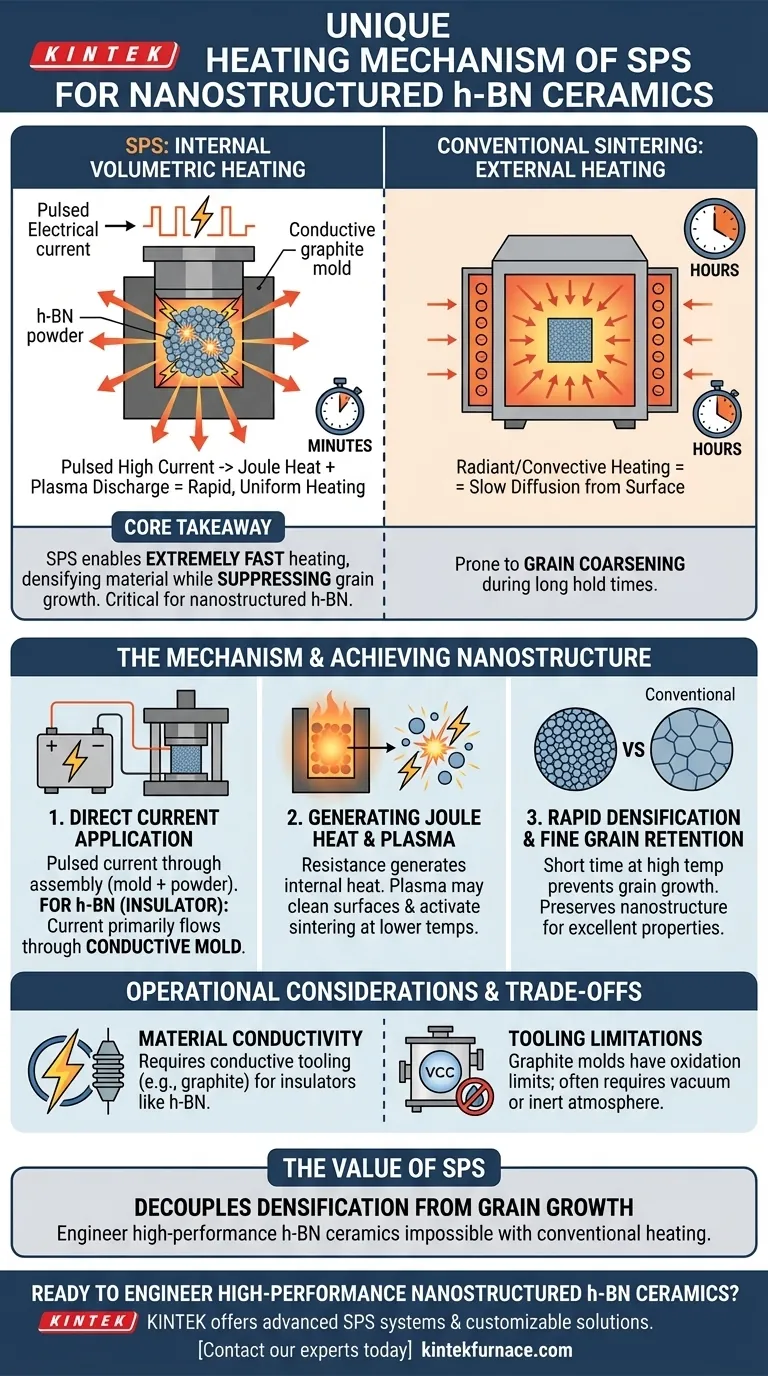
The unique characteristic of the heating mechanism in Spark Plasma Sintering (SPS) is the application of a pulsed high current directly through a conductive mold or the powder itself. This process generates internal volumetric heat via Joule heating and potential plasma discharges between particles, distinct from the radiant or convective heating used in conventional furnaces.

Core Takeaway Conventional sintering heats materials from the outside in, often leading to grain coarsening during long hold times. SPS solves this by generating heat internally, allowing for extremely fast heating rates that densify the material while suppressing grain growth, which is critical for maintaining nanostructured h-BN.
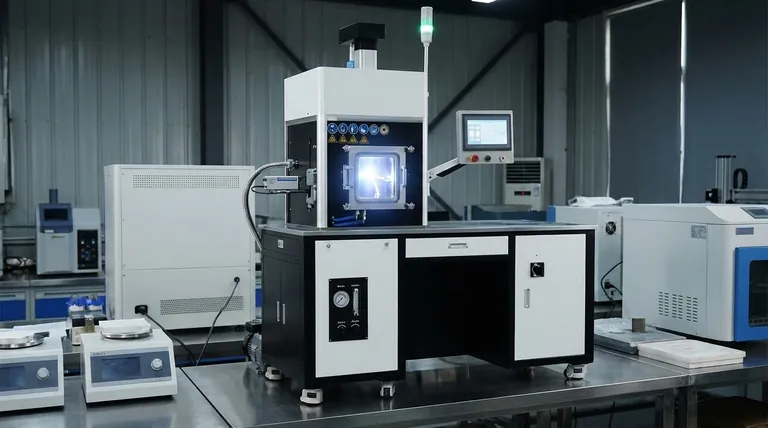
What is unique about the heating mechanism of a Spark Plasma Sintering (SPS) furnace when preparing nanostructured h-BN ceramics? Achieve Ultra-Fast Densification and Suppress Grain Growth

The Mechanism: Internal Volumetric Heating

Direct Current Application

Unlike traditional methods that rely on external heating elements, SPS utilizes pulsed high current.

This current is passed directly through the sintering assembly, which typically consists of the powder and a conductive mold (often graphite).

Generating Joule Heat

Because the current passes through the assembly, the electrical resistance of the mold and powder generates Joule heat.

This results in a "volumetric" heating effect, where the material is heated uniformly from within rather than waiting for heat to diffuse from the surface to the core.

The Role of Plasma Discharge

The mechanism may also involve the generation of plasma discharge between particles.

This phenomenon helps clean particle surfaces and activate sintering at lower temperatures, further enhancing the efficiency of the process.

Achieving Nanostructure through Speed

Rapid Heating Rates

The primary advantage of internal volumetric heating is the ability to achieve extremely fast heating rates.

The system can ramp up to high temperatures in minutes rather than the hours required by conventional sintering.

Suppressing Grain Growth

For nanostructured h-BN ceramics, the critical challenge is densifying the material without allowing the microscopic grains to grow larger (coarsen).

SPS addresses this by minimizing the time the material spends at high temperatures.

Fine Grain Retention

By completing the sintering process in a short time, SPS effectively suppresses grain growth.

This preserves the fine grain structure of the starting powder, resulting in ceramics with excellent mechanical properties.

Operational Considerations and Trade-offs

Material Conductivity

A key constraint is the requirement for electrical conductivity in the tooling or material.

Since h-BN is typically an electrical insulator, the pulsed current primarily flows through the conductive mold to generate the necessary heat, rather than through the powder itself.

Tooling Limitations

The conductive molds used in SPS (typically graphite) have oxidation limits.

This often necessitates sintering in a vacuum or inert atmosphere, which adds complexity compared to air-sintering furnaces.

Making the Right Choice for Your Goal

While SPS offers distinct advantages for nanostructured materials, understanding your specific requirements is essential.

  • If your primary focus is maintaining nanostructure: Use SPS to leverage rapid heating rates that densify the ceramic before grains have time to coarsen.
  • If your primary focus is process speed: Rely on the internal volumetric heating of SPS to significantly reduce cycle times compared to conventional hot pressing.

Ultimately, the value of SPS lies in its ability to decouple densification from grain growth, allowing you to engineer high-performance h-BN ceramics that are impossible to produce via conventional heating.

Summary Table:

Feature Spark Plasma Sintering (SPS) Conventional Sintering
Heating Mechanism Internal volumetric heating via pulsed current External radiant/convective heating
Heating Rate Extremely fast (minutes) Slow (hours)
Grain Growth Control Excellent suppression of grain growth Prone to grain coarsening
Primary Advantage Decouples densification from grain growth Simpler tooling, can sinter in air

Ready to Engineer High-Performance Nanostructured h-BN Ceramics?

Conventional furnaces struggle to densify materials without sacrificing nanostructure. The unique internal heating of Spark Plasma Sintering is the key to achieving ultra-fast densification while effectively suppressing grain growth.

Backed by expert R&D and manufacturing, KINTEK offers advanced SPS systems, alongside our Muffle, Tube, Rotary, Vacuum, and CVD furnaces. Our solutions are fully customizable to meet your unique research and production needs, empowering you to create materials with impossible properties.

Contact our experts today to discuss how an SPS furnace can unlock the next level of performance for your ceramics!

Visual Guide
What is unique about the heating mechanism of a Spark Plasma Sintering (SPS) furnace when preparing nanostructured h-BN ceramics? Achieve Ultra-Fast Densification and Suppress Grain Growth Visual Guide

Related Products

People Also Ask

Related Products

Spark Plasma Sintering SPS Furnace

Spark Plasma Sintering SPS Furnace

Discover KINTEK's advanced Spark Plasma Sintering (SPS) Furnace for rapid, precise material processing. Customizable solutions for research and production.

9MPa Air Pressure Vacuum Heat Treat and Sintering Furnace

9MPa Air Pressure Vacuum Heat Treat and Sintering Furnace

Achieve superior ceramic densification with KINTEK's advanced air pressure sintering furnace. High-pressure up to 9MPa, precise 2200℃ control.

Vacuum Heat Treat Sintering Furnace with Pressure for Vacuum Sintering

Vacuum Heat Treat Sintering Furnace with Pressure for Vacuum Sintering

KINTEK's Vacuum Pressure Sintering Furnace offers 2100℃ precision for ceramics, metals, and composites. Customizable, high-performance, and contamination-free. Get a quote now!

Vacuum Dental Porcelain Sintering Furnace for Dental Laboratories

Vacuum Dental Porcelain Sintering Furnace for Dental Laboratories

KinTek Vacuum Porcelain Furnace: Precision dental lab equipment for high-quality ceramic restorations. Advanced firing control & user-friendly operation.

1700℃ High Temperature Laboratory Tube Furnace with Quartz or Alumina Tube

1700℃ High Temperature Laboratory Tube Furnace with Quartz or Alumina Tube

KINTEK's Tube Furnace with Alumina Tube: Precision heating up to 1700°C for material synthesis, CVD, and sintering. Compact, customizable, and vacuum-ready. Explore now!

Mesh Belt Controlled Atmosphere Furnace Inert Nitrogen Atmosphere Furnace

Mesh Belt Controlled Atmosphere Furnace Inert Nitrogen Atmosphere Furnace

KINTEK Mesh Belt Furnace: High-performance controlled atmosphere furnace for sintering, hardening & heat treatment. Customizable, energy-efficient, precise temperature control. Get a quote now!

600T Vacuum Induction Hot Press Vacuum Heat Treat and Sintering Furnace

600T Vacuum Induction Hot Press Vacuum Heat Treat and Sintering Furnace

600T Vacuum Induction Hot Press Furnace for precise sintering. Advanced 600T pressure, 2200°C heating, vacuum/atmosphere control. Ideal for research & production.

Vacuum Heat Treat Sintering Furnace Molybdenum Wire Vacuum Sintering Furnace

Vacuum Heat Treat Sintering Furnace Molybdenum Wire Vacuum Sintering Furnace

KINTEK's Vacuum Molybdenum Wire Sintering Furnace excels in high-temperature, high-vacuum processes for sintering, annealing, and material research. Achieve precise 1700°C heating with uniform results. Custom solutions available.

Vacuum Heat Treat Sintering and Brazing Furnace

Vacuum Heat Treat Sintering and Brazing Furnace

KINTEK Vacuum Brazing Furnaces deliver precision, clean joints with superior temperature control. Customizable for diverse metals, ideal for aerospace, medical, and thermal applications. Get a quote!

1700℃ Controlled Inert Nitrogen Atmosphere Furnace

1700℃ Controlled Inert Nitrogen Atmosphere Furnace

KT-17A Controlled Atmosphere Furnace: Precise 1700°C heating with vacuum & gas control. Ideal for sintering, research & material processing. Explore now!

Dental Porcelain Zirconia Sintering Ceramic Vacuum Press Furnace

Dental Porcelain Zirconia Sintering Ceramic Vacuum Press Furnace

Precision Vacuum Press Furnace for labs: ±1°C accuracy, 1200°C max, customizable solutions. Boost research efficiency today!

Chairside Dental Porcelain Zirconia Sintering Furnace with Transformer for Ceramic Restorations

Chairside Dental Porcelain Zirconia Sintering Furnace with Transformer for Ceramic Restorations

Dental Porcelain Speedy Sintering Furnace: Fast 9-minute zirconia sintering, 1530°C precision, SiC heaters for dental labs. Boost productivity today!

High Temperature Muffle Oven Furnace for Laboratory Debinding and Pre Sintering

High Temperature Muffle Oven Furnace for Laboratory Debinding and Pre Sintering

KT-MD Debinding & Pre-Sintering Furnace for ceramics - precise temperature control, energy-efficient design, customizable sizes. Boost your lab efficiency today!

Laboratory Quartz Tube Furnace RTP Heating Tubular Furnace

Laboratory Quartz Tube Furnace RTP Heating Tubular Furnace

KINTEK's RTP Rapid Heating Tube Furnace delivers precise temperature control, rapid heating up to 100°C/sec, and versatile atmosphere options for advanced lab applications.

1700℃ High Temperature Muffle Oven Furnace for Laboratory

1700℃ High Temperature Muffle Oven Furnace for Laboratory

KT-17M Muffle Furnace: High-precision 1700°C lab furnace with PID control, energy efficiency, and customizable sizes for industrial & research applications.

1200℃ Split Tube Furnace Laboratory Quartz Tube Furnace with Quartz Tube

1200℃ Split Tube Furnace Laboratory Quartz Tube Furnace with Quartz Tube

Discover KINTEK's 1200℃ Split Tube Furnace with quartz tube for precise high-temperature lab applications. Customizable, durable, and efficient. Get yours now!

Laboratory Muffle Oven Furnace with Bottom Lifting

Laboratory Muffle Oven Furnace with Bottom Lifting

Boost lab efficiency with KT-BL Bottom Lifting Furnace: precise 1600℃ control, superior uniformity, and enhanced productivity for material science and R&D.

1400℃ Muffle Oven Furnace for Laboratory

1400℃ Muffle Oven Furnace for Laboratory

KT-14M Muffle Furnace: Precision 1400°C heating with SiC elements, PID control, and energy-efficient design. Ideal for labs.

Controlled Inert Nitrogen Hydrogen Atmosphere Furnace

Controlled Inert Nitrogen Hydrogen Atmosphere Furnace

Discover KINTEK's Hydrogen Atmosphere Furnace for precise sintering & annealing in controlled environments. Up to 1600°C, safety features, customizable.

1400℃ High Temperature Laboratory Tube Furnace with Quartz and Alumina Tube

1400℃ High Temperature Laboratory Tube Furnace with Quartz and Alumina Tube

KINTEK's Tube Furnace with Alumina Tube: Precision high-temperature processing up to 2000°C for labs. Ideal for material synthesis, CVD, and sintering. Customizable options available.


Leave Your Message
















