
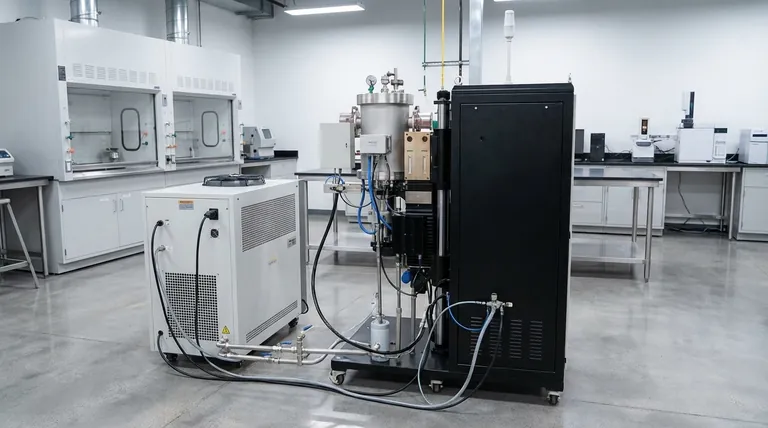
High-temperature vacuum sintering serves as the definitive processing step in transforming opaque powder compacts into transparent Sm:YAG ceramic bodies. By maintaining a stable thermal field exceeding 1750°C and an ultra-high vacuum environment of $10^{-3}$ Pa, the furnace creates the precise conditions required to eliminate microscopic defects and crystallize the material.
Core Takeaway The furnace performs two simultaneous, critical functions: driving the solid-state reaction to fully form the garnet phase and utilizing high vacuum to evacuate residual pores from grain boundaries. This dual process is the primary determinant of the ceramic's final infrared transmittance and optical quality.
Driving the Solid-State Reaction
Reaching Critical Temperatures
To prepare Sm:YAG ceramics, the material must undergo a specific chemical phase transformation. The furnace provides the extreme thermal energy—specifically temperatures exceeding 1750°C—necessary to drive this solid-state reaction.
Forming the Garnet Phase
Precise temperature control is not just about heating; it is about sustaining the environment where the garnet phase can form completely. This phase formation is essential for the material's chemical stability and fundamental optical properties.
The Mechanism of Densification
Eliminating Gas Interference
The vacuum environment, maintained at approximately $10^{-3}$ Pa, is arguably the most vital factor for transparency. It effectively removes gases trapped within the tiny pores of the green body.
Closing the Grain Boundaries
By removing the internal gas atmosphere, the furnace allows grain boundaries to diffuse and close without resistance. This eliminates the residual pores that would otherwise act as light scattering centers, which destroy transparency in optical ceramics.
Understanding the Trade-offs
Process Duration vs. Grain Growth
While high temperatures facilitate densification, they must be balanced with holding times (often prolonged periods, such as 16 hours). Extended exposure ensures complete pore removal but requires careful control to prevent abnormal grain growth, which can degrade mechanical strength.
Impurity Management
The extreme environment required for Sm:YAG sintering makes the material susceptible to contamination. High-quality vacuum furnaces often utilize specific heating elements, such as tungsten, to prevent impurities from the furnace itself from contaminating the ceramic matrix during the heating cycle.
Making the Right Choice for Your Goal
To optimize the preparation of Sm:YAG transparent ceramics, align your furnace parameters with your specific quality targets:
- If your primary focus is Optical Clarity: Prioritize maintaining a vacuum level better than $10^{-3}$ Pa to ensure the absolute removal of pore-related scattering centers.
- If your primary focus is Phase Purity: Ensure the furnace provides precise thermal stability above 1750°C to guarantee the complete formation of the garnet phase.
- If your primary focus is Material Purity: Verify the furnace utilizes contamination-resistant heating elements (like tungsten) to prevent foreign atoms from degrading the ceramic's lattice.
Success in sintering Sm:YAG lies in the precise balance between thermal energy for reaction and vacuum pressure for defect elimination.
Summary Table:
| Feature | Parameter/Requirement | Impact on Sm:YAG Quality |
|---|---|---|
| Sintering Temperature | > 1750°C | Drives solid-state reaction and garnet phase formation |
| Vacuum Level | $10^{-3}$ Pa | Removes trapped gases and eliminates light scattering pores |
| Heating Elements | Tungsten or similar | Prevents impurity contamination during high-temp cycles |
| Hold Time | Up to 16 Hours | Ensures full densification and complete pore removal |
| Primary Goal | Densification | Transforms opaque powder into optical-grade transparency |
Elevate Your Advanced Ceramic Production with KINTEK
Achieving the perfect balance of $10^{-3}$ Pa vacuum and 1750°C+ stability requires precision engineering. KINTEK provides industry-leading Vacuum, CVD, and High-Temperature Muffle systems specifically designed for demanding materials like Sm:YAG.
Backed by expert R&D and manufacturing, our furnaces are fully customizable to meet your unique sintering profiles, ensuring maximum optical clarity and phase purity for your lab or production line.
Ready to optimize your sintering process? Contact our technical experts today to find the perfect solution.
References
- Lahbib Abbas, Zahra Ramzi. Graphite Carbone Structure. DOI: 10.4236/csta.2024.121001
This article is also based on technical information from Kintek Furnace Knowledge Base .
Related Products
- 2200 ℃ Tungsten Vacuum Heat Treat and Sintering Furnace
- 2200 ℃ Graphite Vacuum Heat Treat Furnace
- Vacuum Heat Treat Sintering Furnace Molybdenum Wire Vacuum Sintering Furnace
- Molybdenum Vacuum Heat Treat Furnace
- High Temperature Muffle Oven Furnace for Laboratory Debinding and Pre Sintering
People Also Ask
- How does a tungsten-heated vacuum sintering furnace prepare (TbxY1-x)2O3 ceramics? Achieve 99%+ Density & Purity
- What wear-resistance enhancements are achieved by powder coating? The Role of Vacuum Sintering Furnaces
- How do compaction pressure and vacuum sintering optimize porous ceramics? Maximize Density & Toughness
- What role does a high-temperature vacuum sintering furnace play in the densification of WC-10(Ni, Ni/Co) alloys?
- How does high-temp vacuum sintering influence Y-TZP mechanical properties? Achieve Max Toughness



















