
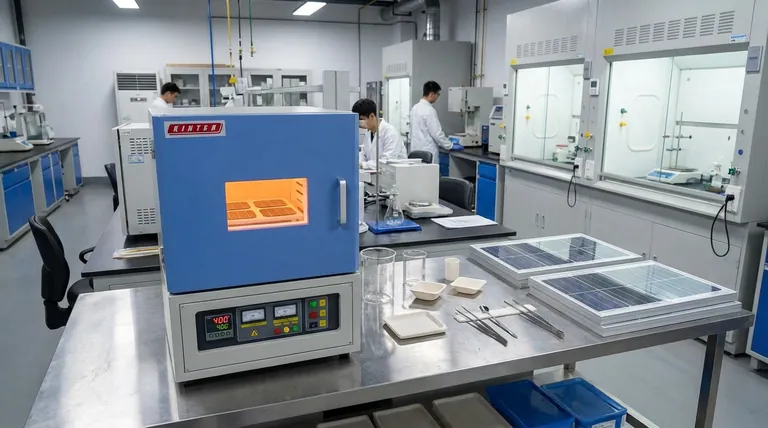
A Muffle Furnace serves as the primary high-temperature annealing chamber in the fabrication of multifunctional protective coatings for solar cells. Specifically, it creates a stable thermal environment, typically around 400 °C, which is required to transform sol-gel precursors (such as AZO and ZnO thin films) into hardened, crystallized layers.
Core Takeaway The muffle furnace is not merely a heater; it is the environment where the coating's physical structure is defined. By driving the transition from a wet sol-gel state to a crystallized "wurtzite" structure, the furnace unlocks the critical properties of the coating: high transparency for energy generation, UV shielding for protection, and mechanical hardness for durability.
The Mechanism of Structural Transformation
Facilitating High-Temperature Annealing
The primary role of the muffle furnace is to execute the annealing process.
For solar cell coatings like Zinc Oxide (ZnO) or Aluminum-doped Zinc Oxide (AZO), this involves maintaining a consistent temperature of approximately 400 °C.
This stable heat is necessary to drive the chemical and physical changes required to solidify the thin film.
Removal of Impurities
Before crystallization is complete, the coating often contains organic residues from the sol-gel process.
The high-temperature oxidative environment within the furnace helps burn off organic ligands and other volatile impurities.
Eliminating these obstacles is a prerequisite for forming a pure, dense coating layer.
Driving Crystallization
The most critical function of this thermal treatment is crystallization.
The heat supplied by the muffle furnace facilitates the arrangement of atoms into a highly ordered wurtzite crystal structure.
Without this specific structural organization, the coating would remain amorphous and lack the necessary protective qualities.
Enhancing Critical Performance Metrics
Maximizing Light Transmittance
For a solar cell, the protective coating must be optically transparent to allow sunlight to reach the photovoltaic material.
The annealing process in the muffle furnace clarifies the film structure, significantly improving light transmittance.
Boosting UV Absorption
While letting visible light pass, the coating must also filter harmful radiation.
The crystallized structure formed during furnace treatment enhances the layer's ultraviolet (UV) absorption capacity.
This protects the underlying solar cell components from UV-induced degradation.
Ensuring Mechanical Reliability
A solar cell is exposed to environmental stress, requiring a physically robust surface.
The furnace treatment increases the hardness and scratch resistance of the coating.
This ensures the protective layer can withstand abrasion and maintain its integrity over the device's lifespan.
Understanding the Trade-offs
Temperature Sensitivity
While high heat is necessary for crystallization, excessive temperatures can damage the substrate.
If the furnace temperature drifts too high, it may compromise the underlying solar cell structure before the coating is fully set.
Process Time vs. Coating Quality
There is a delicate balance between the duration of annealing and production throughput.
Insufficient time in the furnace leads to incomplete crystallization, resulting in a coating that is mechanically weak and optically cloudy.
Conversely, excessively long cycles reduce manufacturing efficiency without yielding additional structural benefits.
Making the Right Choice for Your Goal
When configuring your muffle furnace parameters for solar coating applications, consider your specific performance priorities:
- If your primary focus is Optical Efficiency: Prioritize precise temperature control around 400 °C to maximize transmittance without clouding the crystal structure.
- If your primary focus is Mechanical Durability: Ensure the annealing duration is sufficient to fully burn off organics and achieve a complete wurtzite crystal lattice for maximum hardness.
The muffle furnace is the gatekeeper of quality, transforming a fragile chemical film into a robust, multifunctional shield that defines the longevity and efficiency of the solar module.
Summary Table:
| Function | Process Role | Key Benefit |
|---|---|---|
| High-Temp Annealing | Precise 400 °C thermal environment | Transforms sol-gel into hardened thin films |
| Impurity Removal | Oxidation of organic ligands | Creates pure, dense, and high-clarity layers |
| Crystallization | Atoms arranged into wurtzite structure | Enhances UV absorption and light transmittance |
| Mechanical Hardening | Controlled thermal solidification | Increases scratch resistance and surface durability |
Elevate Your Solar Coating Quality with KINTEK
Precise crystallization and structural integrity are essential for the next generation of solar cells. Backed by expert R&D and manufacturing, KINTEK offers high-performance Muffle, Tube, Rotary, Vacuum, and CVD systems—all fully customizable to meet your specific annealing protocols.
Whether you are scaling solar cell production or researching advanced multifunctional coatings, our lab high-temp furnaces provide the thermal stability required to maximize light transmittance and mechanical durability.
Ready to optimize your thin-film processing? Contact our engineering team today to find the perfect furnace solution for your unique laboratory needs.
References
- Seyyedeh Sedigheh Azad, Iraj Mohammadpoor‐Baltork. Stability enhancement of perovskite solar cells using multifunctional inorganic materials with UV protective, self cleaning, and high wear resistance properties. DOI: 10.1038/s41598-024-57133-8
This article is also based on technical information from Kintek Furnace Knowledge Base .
Related Products
- 1400℃ Muffle Oven Furnace for Laboratory
- 1700℃ High Temperature Muffle Oven Furnace for Laboratory
- 1800℃ High Temperature Muffle Oven Furnace for Laboratory
- 1200℃ Muffle Oven Furnace for Laboratory
- High Temperature Muffle Oven Furnace for Laboratory Debinding and Pre Sintering
People Also Ask
- What is the primary function of a high-temperature laboratory muffle furnace in chemical synthesis? Achieve Precision.
- How does a high-temperature laboratory muffle furnace affect material properties? Transform Anodic Oxide Films Fast
- How does a laboratory high-temperature muffle furnace facilitate the homogenization of borosilicate glass samples? Expert Insights
- How is a laboratory high-temperature muffle furnace utilized to achieve the specific crystalline structure of LaFeO3 catalysts?
- What role does a laboratory high-temperature muffle furnace play in the treatment of highly contaminated waste glass?



















