
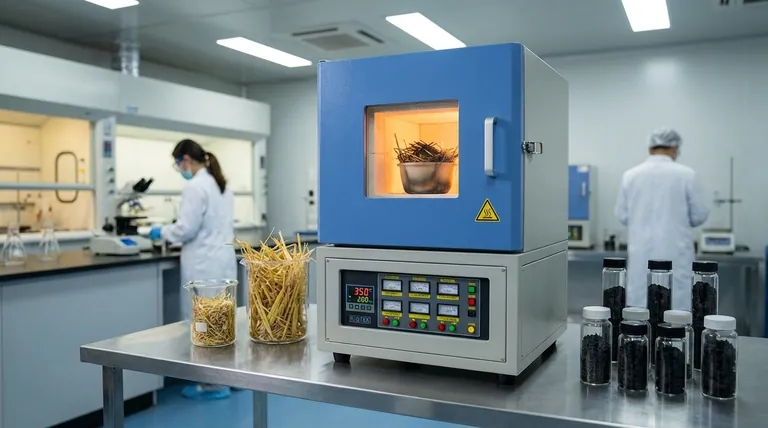
The primary role of a muffle furnace in corn straw biochar preparation is to provide a precise, oxygen-limited environment essential for pyrolysis. Specifically, it subjects pre-treated corn straw to a constant temperature of 350 °C for 2 hours, facilitating partial thermal decomposition. This process converts the raw biomass into a stable carbon material with an initial pore structure, distinct from simple combustion ash.
Core Takeaway A muffle furnace acts as a controlled pyrolysis chamber, not merely a heater. By strictly isolating the corn straw in an anaerobic or oxygen-limited atmosphere, it prevents the material from burning to ash, forcing it instead to undergo thermochemical changes that lock carbon into a stable, porous framework.
Creating the Pyrolysis Environment
Oxygen Limitation is Critical
The defining feature of the muffle furnace in this context is its ability to maintain an anaerobic or oxygen-limited atmosphere.
If oxygen were freely available, the high temperatures would cause the corn straw to combust, leaving behind only mineral ash.
The muffle furnace prevents this combustion, ensuring the process remains strictly pyrolysis (thermal decomposition in the absence of oxygen).
Controlled Thermal Decomposition
The furnace provides the energy required to break down the complex chemical bonds within the corn straw.
This creates a "reductive" environment where the biomass degrades chemically.
This thermal stress drives off volatile components while retaining the carbon content in a solid form.
Specific Parameters for Corn Straw
The 350 °C Threshold
For corn straw specifically, the muffle furnace is set to maintain a temperature of 350 °C.
This temperature is sufficient to initiate partial thermal decomposition without destroying the carbon skeleton.
It represents a specific balance point optimized for this particular type of biomass.
Duration and Consistency
The process requires a sustained heating period of 2 hours.
The muffle furnace ensures this heat is applied evenly and consistently throughout the duration.
This consistency is vital for ensuring the entire batch of corn straw transforms uniformly, avoiding distinct pockets of raw or over-charred material.
The Impact on Material Structure
Formation of Pore Structure
The primary output of this furnace treatment is the creation of an initial pore structure.
As volatiles are expelled by the heat, they leave behind voids in the material.
These voids become the pores that define the biochar's surface area and potential utility in adsorption applications.
Chemical Stabilization
The treatment results in a carbon material with stable chemical properties.
By fixing the carbon skeleton, the furnace transforms rapidly degradable organic matter into a persistent form.
This stability is the fundamental characteristic that distinguishes high-quality biochar from raw crop residue.
Understanding the Trade-offs
Temperature Sensitivity
While 350 °C is the standard for this specific process, deviations can drastically alter results.
Temperatures that are too low may result in incomplete carbonization, leaving unstable biomass behind.
Conversely, excessive temperatures (e.g., those used for rice straw or mineral activation) could collapse the specific pore structure desired for corn straw.
Batch Processing Limits
Most laboratory muffle furnaces operate as batch processors rather than continuous flow systems.
This allows for high precision and control over small quantities of corn straw.
However, it limits throughput speed compared to industrial continuous pyrolysis reactors.
Making the Right Choice for Your Goal
To maximize the utility of your muffle furnace for biochar production, consider your specific end-goals:
- If your primary focus is standard corn straw biochar: strict adherence to 350 °C for 2 hours is necessary to achieve the baseline pore structure and chemical stability described.
- If your primary focus is surface area activation: you may need to view the 350 °C phase as a preliminary step, potentially requiring higher temperatures (e.g., 600 °C) or chemical agents in subsequent stages to deepen pore modifications.
The muffle furnace is the tool that transforms biological waste into a chemically stable, porous carbon resource through precise thermal control.
Summary Table:
| Parameter | Specification | Role in Biochar Preparation |
|---|---|---|
| Temperature | 350 °C | Facilitates partial thermal decomposition without destroying carbon skeleton |
| Residence Time | 2 Hours | Ensures uniform transformation and consistent chemical stabilization |
| Atmosphere | Oxygen-limited | Prevents combustion into ash; maintains strict anaerobic pyrolysis |
| Key Outcome | Initial Pore Structure | Drives off volatiles to create voids for adsorption applications |
Elevate Your Biochar Research with KINTEK
Ready to achieve the precision required for high-quality carbon materials? Backed by expert R&D and manufacturing, KINTEK offers high-performance Muffle, Tube, Rotary, Vacuum, and CVD systems designed for the rigorous demands of material science. Whether you are processing corn straw at 350°C or performing high-temp mineral activation, our lab furnaces are fully customizable for your unique research needs.
Maximize your lab's efficiency and ensure reproducible results.
Visual Guide

References
- Yiping Guo, Guoting Li. Coadsorption of Tetracycline and Copper(II) by KOH-Modified biomass and biochar Derived from Corn Straw in aqueous Solution. DOI: 10.3390/w17020284
This article is also based on technical information from Kintek Furnace Knowledge Base .
Related Products
- 1400℃ Muffle Oven Furnace for Laboratory
- 1700℃ High Temperature Muffle Oven Furnace for Laboratory
- 1800℃ High Temperature Muffle Oven Furnace for Laboratory
- 1200℃ Muffle Oven Furnace for Laboratory
- High Temperature Muffle Oven Furnace for Laboratory Debinding and Pre Sintering
People Also Ask
- What is the primary function of a high-temperature laboratory muffle furnace in chemical synthesis? Achieve Precision.
- How does a high-temperature laboratory muffle furnace affect material properties? Transform Anodic Oxide Films Fast
- How does a muffle furnace facilitate Ag/ATP catalyst preparation? Optimize Calcination for Superior Performance
- What role does a laboratory high-temperature muffle furnace play in the treatment of highly contaminated waste glass?
- What is the function of a muffle furnace in MOF-derived zirconia conversion? Optimize Phase & Pore Engineering



















