
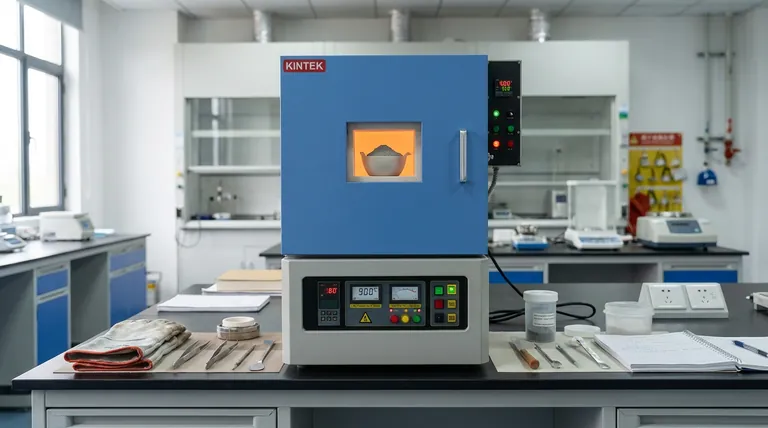
The significance of using a box resistance furnace lies in its ability to provide a precisely controlled, stable thermal environment that transforms loose powder into a unified solid. Specifically, at 900 °C, this furnace creates the conditions necessary for atomic migration, which drives the diffusion bonding of alloy powders, eliminates internal stresses, and significantly enhances material density.
The core value of this process is the transition from a mechanical mixture to a chemically bonded material. The furnace's programmed heat application facilitates the formation of complex phase structures, such as Face-Centered Cubic (FCC) and Body-Centered Cubic (BCC) lattices, which are defined by the high-entropy alloy's unique composition.
Establishing a Stable Thermal Field
Programmed Temperature Control
The primary function of a box resistance furnace is to deliver programmed temperature control. Unlike simple heating elements, this system follows a specific heating curve to reach and maintain 900 °C. This precision is critical because high-entropy alloys require a specific thermal history to initiate the correct bonding mechanisms between different elemental powders.
Uniformity Across the Workpiece
Achieving a stable thermal field helps mitigate the natural physics of heating. Heat radiates from furnace walls, meaning the edges of a workpiece naturally absorb heat faster than the center. A high-quality box furnace minimizes this temperature gradient, ensuring that the core of the material reaches the requisite 900 °C without overheating the exterior surfaces.
Driving Microstructural Transformation
Atomic Migration and Diffusion Bonding
At 900 °C, the thermal energy supplied by the furnace encourages atomic migration. This is the mechanism where atoms move across the boundaries of the pressed powder particles. This diffusion bonding is what physically fuses separate powder grains into a single, cohesive solid, moving beyond simple mechanical interlocking.
Formation of Complex Phase Structures
The heat treatment drives a chemical evolution. It transforms the initial mechanical powder mixture into complex phase structures, specifically FCC and BCC phases. These phases are essential characteristics of high-entropy alloys, determining the final mechanical properties of the material.
Densification and Stress Relief
As atomic diffusion progresses, the material's porosity decreases. The 900 °C sintering process significantly improves the overall density of the alloy. Simultaneously, the sustained heat acts as an annealing agent, eliminating internal stresses that may have accumulated during the initial pressing of the powders.
Understanding the Trade-offs
Thermal Lag and Equilibrium Time
While the furnace provides a stable field, there is an inherent time delay for heat to conduct from the outer layers to the center of the workpiece. If the heating ramp is too aggressive, substantial thermal gradients can occur. The "soak time" (e.g., 2 hours) is not just for reaction kinetics; it is also to allow the center of the material to reach thermal equilibrium with the surface.
Sensitivity to Duration
The effectiveness of the phase transformation is time-dependent. Shortening the process duration below the recommended two hours may result in incomplete diffusion. This leaves the material with a heterogeneous microstructure where the desired FCC or BCC phases have not fully established, compromising the alloy's structural integrity.
Making the Right Choice for Your Goal
To maximize the effectiveness of your sintering process, align your furnace settings with your specific material objectives:
- If your primary focus is Structural Integrity: Ensure the dwell time at 900 °C is sufficient (typically 2 hours) to maximize atomic migration and achieve peak density.
- If your primary focus is Phase Stability: Prioritize the precision of the temperature control program to prevent thermal gradients that could lead to uneven phase distribution (FCC vs. BCC) throughout the sample.
By leveraging the stable thermal field of a box resistance furnace, you ensure that your high-entropy alloy evolves from a simple powder mix into a dense, stress-free, and structurally advanced material.
Summary Table:
| Feature | Role in 900°C Sintering | Key Benefit for High-Entropy Alloys |
|---|---|---|
| Programmed Heating | Precise ramp to 900°C | Initiates correct bonding mechanisms and thermal history |
| Thermal Uniformity | Minimizes temperature gradients | Ensures consistent core-to-surface material density |
| Diffusion Control | Drives atomic migration | Fuses powder grains into a cohesive, solid structure |
| Phase Evolution | Facilitates FCC/BCC formation | Develops the advanced mechanical properties of the alloy |
| Stress Relief | Sustained heat (Annealing) | Eliminates internal stresses from initial powder pressing |
Optimize Your High-Entropy Alloy Sintering with KINTEK
Precision at 900°C is non-negotiable for superior material densification and phase stability. At KINTEK, we understand the complexities of atomic migration and thermal equilibrium in advanced material science.
Backed by expert R&D and manufacturing, KINTEK offers high-performance Muffle, Tube, Rotary, Vacuum, and CVD systems. Our lab high-temp furnaces are fully customizable to meet your unique sintering profiles, ensuring uniform thermal fields and precise programmed control for your most demanding research.
Ready to elevate your lab's thermal processing? Contact us today to discover how our tailored solutions can enhance your alloy development.
References
- Ángelo Oñate, Víctor Tuninetti. Sigma Phase Stabilization by Nb Doping in a New High-Entropy Alloy in the FeCrMnNiCu System: A Study of Phase Prediction and Nanomechanical Response. DOI: 10.3390/met14010074
This article is also based on technical information from Kintek Furnace Knowledge Base .
Related Products
- Mesh Belt Controlled Atmosphere Furnace Inert Nitrogen Atmosphere Furnace
- 1200℃ Controlled Inert Nitrogen Atmosphere Furnace
- High Pressure Laboratory Vacuum Tube Furnace
- Multi Zone Laboratory Quartz Tube Furnace Tubular Furnace
- 1700℃ Controlled Inert Nitrogen Atmosphere Furnace
People Also Ask
- What are the two main purposes of controlled atmosphere conditions in furnaces? Protect or Transform Materials for Peak Performance
- How is a controlled atmosphere furnace used in material research? Achieve Precise Material Synthesis and Heat Treatment
- What types of gases can a controlled atmosphere furnace handle? Master Inert and Reactive Gases for Your Lab
- What types of furnaces have controlled atmosphere furnaces largely replaced? Boost Metallurgical Precision & Safety
- How does a controlled atmosphere furnace improve product quality and consistency? Master Precise Heat Treatment for Superior Results











