
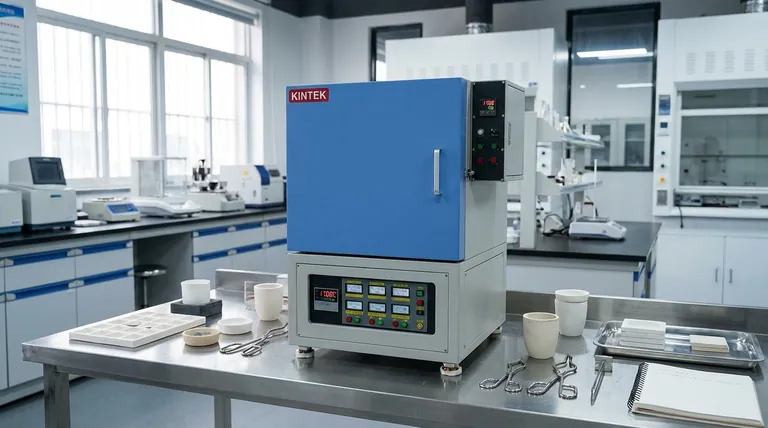
High-performance heating is the critical variable in solid-state synthesis success. A muffle furnace ensures quality by providing precise temperature programming and a strictly uniform thermal field. This controlled environment enables complete physical and chemical reactions while preventing micro-defects often caused by thermal fluctuations during sintering.
Success in solid-state synthesis relies on the ability to facilitate atomic diffusion without introducing structural faults. High-quality heating equipment ensures this by maintaining rigorous control over the heating curve and the reaction atmosphere, resulting in materials with high crystallinity and phase purity.
The Role of Thermal Consistency
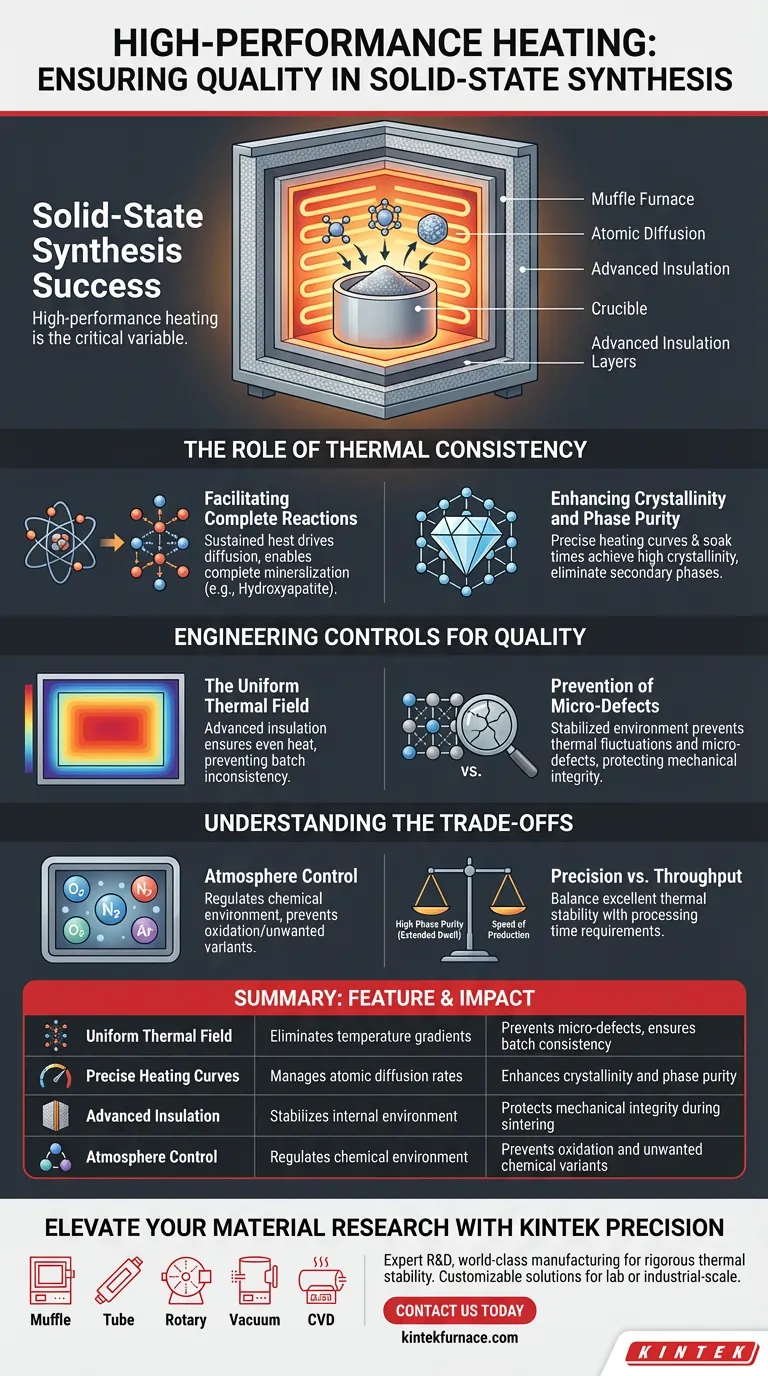
Facilitating Complete Reactions
Solid-state synthesis relies heavily on sustained heat to drive diffusion between solid precursors. By maintaining a continuous high-temperature environment, furnaces facilitate the necessary chemical interaction between elements. For example, in hydroxyapatite synthesis, this consistent heat drives the reaction between calcium and phosphorus sources to achieve complete mineralization.
Enhancing Crystallinity and Phase Purity
The quality of the final crystal structure depends on how the heat is applied over time. High-performance equipment allows for the precise setting of heating curves and constant temperature durations. This controlled soak time is essential for achieving high crystallinity and eliminating unwanted secondary phases.
Engineering Controls for Quality
The Uniform Thermal Field
Temperature gradients within a furnace chamber can be disastrous for batch consistency. High-performance equipment uses advanced insulation to ensure the heat is distributed evenly throughout the chamber. This uniformity ensures that every part of the material undergoes the same thermal history.
Prevention of Micro-Defects
Fluctuations in temperature can cause physical stress and inconsistencies in the material. By stabilizing the environment during sintering or calcination, muffle furnaces prevent micro-defects. This strict regulation protects the mechanical integrity of the synthesized solid.
Understanding the Trade-offs
The Necessity of Atmosphere Control
While temperature is critical, thermal precision alone cannot guarantee quality if the chemical environment is ignored. Advanced muffle furnaces often include atmosphere control features. Without proper regulation of the atmosphere, materials may suffer from oxidation or unexpected chemical variants despite perfect temperature settings.
Precision vs. Throughput
Achieving high phase purity often requires extended dwell times and slow ramp rates. While this ensures a defect-free structure, it inherently limits the speed of production. Users must balance the need for excellent thermal stability with the practical requirements of processing time.
Making the Right Choice for Your Goal
To maximize the quality of your solid-state synthesis, align your equipment capabilities with your specific material requirements:
- If your primary focus is Phase Purity: Prioritize equipment with programmable heating curves to strictly control ramp rates and soak times for complete diffusion.
- If your primary focus is Structural Integrity: Ensure your furnace utilizes advanced insulation to maintain a uniform thermal field, minimizing the risk of micro-defects.
By mastering the thermal environment, you transform the furnace from a simple heating tool into an instrument of precise material engineering.
Summary Table:
| Feature | Impact on Synthesis | Key Benefit |
|---|---|---|
| Uniform Thermal Field | Eliminates temperature gradients | Prevents micro-defects & ensures batch consistency |
| Precise Heating Curves | Manages atomic diffusion rates | Enhances crystallinity and phase purity |
| Advanced Insulation | Stabilizes the internal environment | Protects mechanical integrity during sintering |
| Atmosphere Control | Regulates chemical environment | Prevents oxidation and unwanted chemical variants |
Elevate Your Material Research with KINTEK Precision
Don't let thermal fluctuations compromise your phase purity. At KINTEK, we understand that high-performance heating is the backbone of successful solid-state synthesis. Backed by expert R&D and world-class manufacturing, we provide high-precision Muffle, Tube, Rotary, Vacuum, and CVD systems designed to deliver the rigorous thermal stability your materials demand.
Whether you require customizable heating curves for specialized lab work or industrial-scale sintering, our high-temperature furnaces are engineered for your unique needs. Contact us today to discover how KINTEK’s customizable thermal solutions can optimize your synthesis process and ensure defect-free structural integrity.
Visual Guide
References
- Enhancing Vinyl Acetate Hydroformylation with La‐Decorated Rh/TiO<sub>2</sub> Nanotubes Catalysts. DOI: 10.1002/cphc.202401016
This article is also based on technical information from Kintek Furnace Knowledge Base .
Related Products
- 1400℃ Muffle Oven Furnace for Laboratory
- 1700℃ High Temperature Muffle Oven Furnace for Laboratory
- 1800℃ High Temperature Muffle Oven Furnace for Laboratory
- 1200℃ Muffle Oven Furnace for Laboratory
- High Temperature Muffle Oven Furnace for Laboratory Debinding and Pre Sintering
People Also Ask
- How does a high-temperature laboratory muffle furnace affect material properties? Transform Anodic Oxide Films Fast
- What is the primary function of a high-temperature laboratory muffle furnace in chemical synthesis? Achieve Precision.
- What is the purpose of using a laboratory high-temperature muffle furnace for drying Fe-Ni-Co catalysts? Boost Purity
- What is the muffle furnace function in ilmenite oxidative roasting? Enhance Phase Change & Magnetic Separation
- What role does a muffle furnace play in refractory bricks? Enhance Performance and Durability Testing



















