
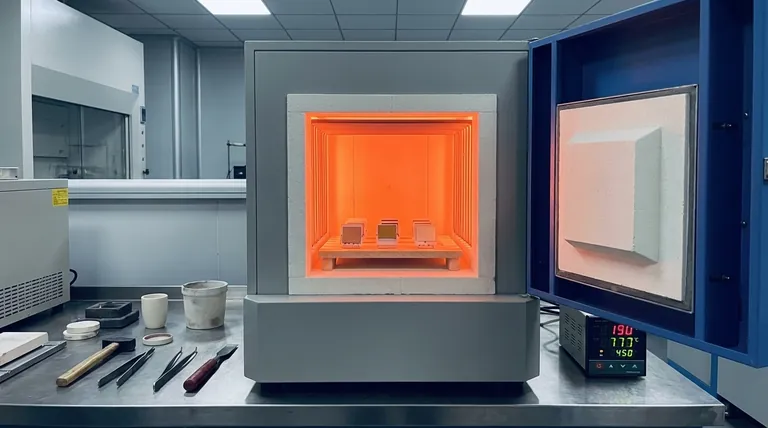
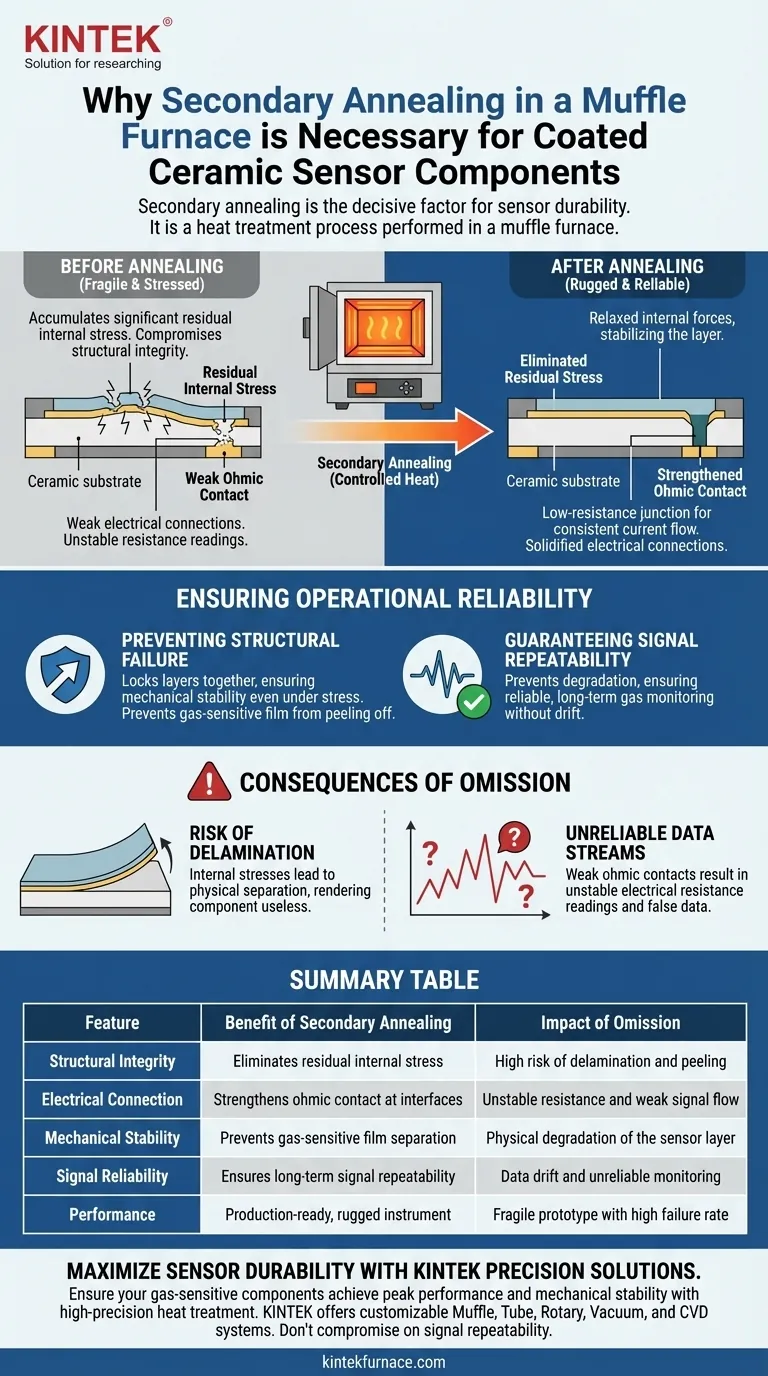
Secondary annealing is the decisive factor for sensor durability. It is a heat treatment process performed in a muffle furnace to eliminate residual internal stresses within the gas-sensitive layer of coated ceramic components. Furthermore, it is essential for strengthening the ohmic contact between the sensitive material, the ceramic substrate, and the electrodes.
Secondary annealing serves a dual purpose: it relaxes internal structural tension and solidifies electrical connections. This ensures the sensor remains mechanically stable and delivers repeatable signals during long-term monitoring.
Addressing the Physical Challenges
To understand the necessity of this treatment, one must look at the physical state of the sensor immediately after coating.
Eliminating Internal Stress
During the initial coating process, the gas-sensitive layer often accumulates significant residual internal stress.
If left untreated, this tension compromises the structural integrity of the material. Secondary annealing uses controlled heat to relax these internal forces, stabilizing the layer.
Strengthening Ohmic Contact
A sensor's accuracy relies heavily on how well its components connect electrically.
The annealing process strengthens the ohmic contact—the low-resistance junction essential for current flow.
This bonding occurs at the critical interface between the sensitive material, the ceramic substrate, and the electrodes.
Ensuring Operational Reliability
Beyond the physical structure, secondary annealing directly impacts how the sensor performs in real-world applications.
Preventing Structural Failure
The primary risk for untreated sensors is mechanical degradation.
Without annealing, the gas-sensitive film is prone to peeling off the substrate.
The heat treatment locks the layers together, ensuring mechanical stability even under stress.
Guaranteeing Signal Repeatability
For a sensor to be useful, it must provide consistent data over time.
By preventing degradation and film detachment, annealing ensures signal repeatability.
This allows for reliable, long-term gas monitoring without the drift caused by physical deterioration.
The Consequences of Omission
While adding a secondary heat treatment step requires time and energy resources, the trade-off of skipping it is severe.
Risk of Delamination
Omitting this step leaves the internal stresses active within the coating.
This inevitably leads to delamination, where the sensitive layer physically separates from the ceramic base, rendering the component useless.
Unreliable Data Streams
Weak ohmic contacts result in unstable electrical resistance readings.
Without the solidification provided by annealing, the sensor cannot maintain the precision required for accurate monitoring, leading to false data and unreliable performance.
Applying This to Your Process
The decision to anneal is ultimately about the difference between a prototype and a production-ready device.
- If your primary focus is mechanical durability: Prioritize annealing to relieve stress and prevent the gas-sensitive film from peeling.
- If your primary focus is data precision: Ensure the heat treatment is sufficient to solidify the ohmic contact for consistent signal repeatability.
This process transforms a coated ceramic component from a fragile part into a rugged, reliable instrument capable of long-term operation.
Summary Table:
| Feature | Benefit of Secondary Annealing | Impact of Omission |
|---|---|---|
| Structural Integrity | Eliminates residual internal stress | High risk of delamination and peeling |
| Electrical Connection | Strengthens ohmic contact at interfaces | Unstable resistance and weak signal flow |
| Mechanical Stability | Prevents gas-sensitive film separation | Physical degradation of the sensor layer |
| Signal Reliability | Ensures long-term signal repeatability | Data drift and unreliable monitoring |
| Performance | Production-ready, rugged instrument | Fragile prototype with high failure rate |
Maximize Sensor Durability with KINTEK Precision Solutions
Ensure your gas-sensitive components achieve peak performance and mechanical stability with high-precision heat treatment. KINTEK provides industry-leading muffle and vacuum furnaces specifically designed to eliminate internal stress and solidify critical ohmic contacts in ceramic sensors.
Backed by expert R&D and manufacturing, KINTEK offers Muffle, Tube, Rotary, Vacuum, and CVD systems—all fully customizable to meet your unique laboratory or production requirements. Don't compromise on signal repeatability; partner with a leader in high-temperature technology to deliver rugged, reliable instruments.
Contact KINTEK Today to Optimize Your Annealing Process
Visual Guide
References
- Peishuo Wang, Xueli Yang. Engineering Hierarchical CuO/WO3 Hollow Spheres with Flower-like Morphology for Ultra-Sensitive H2S Detection at ppb Level. DOI: 10.3390/chemosensors13070250
This article is also based on technical information from Kintek Furnace Knowledge Base .
Related Products
- 1400℃ Muffle Oven Furnace for Laboratory
- 1700℃ High Temperature Muffle Oven Furnace for Laboratory
- 1800℃ High Temperature Muffle Oven Furnace for Laboratory
- 1200℃ Muffle Oven Furnace for Laboratory
- High Temperature Muffle Oven Furnace for Laboratory Debinding and Pre Sintering
People Also Ask
- What is the primary function of a high-temperature laboratory muffle furnace in chemical synthesis? Achieve Precision.
- How does a high-temperature laboratory muffle furnace affect material properties? Transform Anodic Oxide Films Fast
- What are the primary objectives of using a muffle furnace in zirconia synthesis? Achieve precision phase control.
- What is the purpose of using a laboratory high-temperature muffle furnace for drying Fe-Ni-Co catalysts? Boost Purity
- How does a laboratory high-temperature muffle furnace facilitate the homogenization of borosilicate glass samples? Expert Insights



















