
An in-situ high-temperature heating stage is significant because it enables the continuous, real-time observation of a cathode material's internal structure as it is being synthesized. Instead of relying on static, post-production snapshots, this technology—when integrated with synchrotron X-ray diffraction (XRD)—allows researchers to monitor the dynamic phase evolution of materials from room temperature up to 900°C.
This setup provides a direct window into the actual sintering path of battery materials. It is the definitive method for identifying the precise temperature "nodes" where critical element diffusion and strain release mechanisms occur.
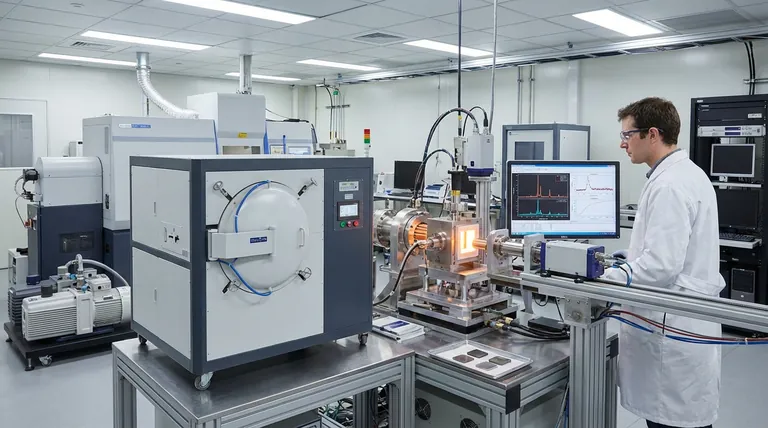
Simulating the Sintering Path
To truly understand how a cathode material forms, you must observe the process under conditions that mimic the manufacturing environment.
Dynamic Temperature Range
The heating stage is capable of operating from room temperature to 900°C.
This broad range allows for the simulation of the complete thermal treatment cycle. It ensures that no transient intermediate phases are missed during the heating process.
Capturing Real-Time Phase Changes
The primary value of this device is its ability to reveal the coexistence of different phases as they evolve.
For example, the reference highlights the ability to observe phases such as NMC111 and NMC622 simultaneously. This real-time data is essential for visualizing how elements diffuse and reorganize during synthesis.
Analyzing Structural Evolution Mechanisms
Beyond simply identifying phases, the in-situ stage allows for a deep mechanical analysis of the crystal lattice.
Monitoring Lattice Constants
As the temperature changes, the dimensions of the crystal unit cell (lattice constants) expand or contract.
In-situ analysis tracks these changes precisely as they happen. This data helps researchers understand the thermal stability and expansion behavior of the cathode material.
Pinpointing Strain Release
The heating stage is critical for identifying specific strain release processes.
By correlating these events with specific temperature nodes, researchers can determine the exact thermal conditions required to relieve internal stress within the material. This is vital for preventing cracking and degradation in the final battery cell.
Understanding the Requirements
While powerful, utilizing an in-situ high-temperature heating stage requires specific operational context.
Dependence on Synchrotron Radiation
The reference notes that this stage is integrated with synchrotron X-ray diffraction (XRD).
Standard laboratory XRD sources may lack the intensity or resolution required for such rapid, real-time data acquisition. Therefore, this level of analysis typically requires access to large-scale synchrotron facilities to achieve valid results.
Complexity of Element Diffusion
The data generated is complex, as it captures the active element diffusion mechanism.
Interpreting the simultaneous presence of multiple phases (like NMC111 and NMC622) requires advanced understanding of phase diagrams and diffusion kinetics. The "snapshot" is now a "movie," requiring more sophisticated analysis techniques.
Making the Right Choice for Your Goal
The use of in-situ heating stages transforms how we optimize cathode synthesis.
- If your primary focus is process optimization: Use the strain release data to refine your temperature ramp rates and hold times to minimize internal stress.
- If your primary focus is material design: Analyze the phase coexistence data to control element diffusion and ensure the correct final stoichiometry (e.g., transitioning from NMC111 to NMC622).
By pinpointing the exact temperature nodes where structural changes occur, you remove the guesswork from the sintering process.
Summary Table:
| Feature | Significance in Analysis |
|---|---|
| Real-Time Monitoring | Observes dynamic phase changes and element diffusion as they occur. |
| Temperature Range | Room temperature to 900°C; simulates full industrial sintering cycles. |
| Structural Insights | Tracks lattice constant variations and pinpoint exact strain release nodes. |
| Advanced Capability | Enables visualization of coexisting phases (e.g., NMC111 & NMC622). |
| Process Optimization | Identifies critical temperature nodes to prevent material degradation. |
Optimize Your Materials Synthesis with KINTEK Precision
Transition from static snapshots to dynamic discovery. KINTEK provides the advanced high-temperature solutions required to master crystal structure evolution and element diffusion.
Backed by expert R&D and manufacturing, we offer Muffle, Tube, Rotary, Vacuum, and CVD systems, as well as other lab high-temperature furnaces—all fully customizable to meet the rigorous demands of your battery material research.
Ready to refine your sintering path? Contact KINTEK today to consult with our experts on the perfect thermal treatment solution for your laboratory.
References
- Eva Michelle Allen, Albert L. Lipson. Cathode Upcycling for Direct Recycling of Lithium‐Ion Batteries Using a Precipitation Approach. DOI: 10.1002/aenm.202500699
This article is also based on technical information from Kintek Furnace Knowledge Base .
Related Products
- 2200 ℃ Tungsten Vacuum Heat Treat and Sintering Furnace
- 2200 ℃ Graphite Vacuum Heat Treat Furnace
- 1700℃ Controlled Inert Nitrogen Atmosphere Furnace
- 1400℃ High Temperature Laboratory Tube Furnace with Alumina Tube
- 1700℃ High Temperature Muffle Oven Furnace for Laboratory
People Also Ask
- How does a tungsten-heated vacuum sintering furnace prepare (TbxY1-x)2O3 ceramics? Achieve 99%+ Density & Purity
- What wear-resistance enhancements are achieved by powder coating? The Role of Vacuum Sintering Furnaces
- How do compaction pressure and vacuum sintering optimize porous ceramics? Maximize Density & Toughness
- What role does a high-temperature vacuum sintering furnace play in the densification of WC-10(Ni, Ni/Co) alloys?
- How does high-temp vacuum sintering influence Y-TZP mechanical properties? Achieve Max Toughness














