
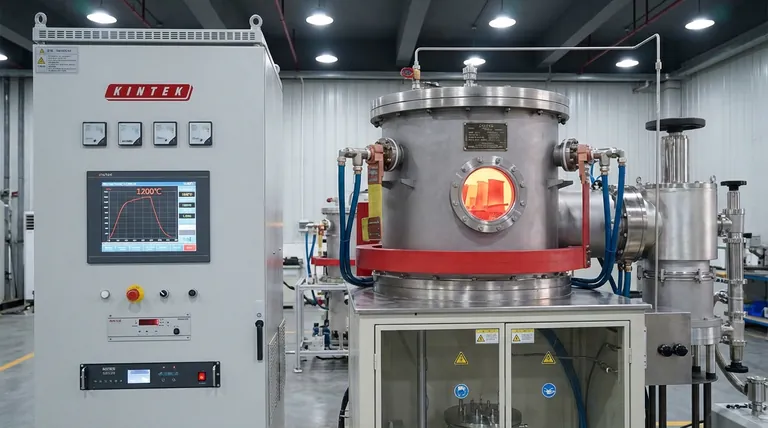
Industrial-grade vacuum and atmosphere furnaces act as the definitive mechanism for determining the final mechanical properties of Inconel 718 (IN718) components. They provide the rigorous environment necessary to execute specific thermal cycles—homogenization, solution treatment, and aging—that transform the "as-manufactured" material into a reliable, high-performance alloy.
Core Takeaway These furnaces do not merely heat the material; they fundamentally reconfigure the microstructure by dissolving harmful phases and relieving residual stress in a protected environment. This transformation is the primary driver for achieving the high fatigue strength, dimensional stability, and hardness required for industrial IN718 applications.
The Critical Role of Thermal Management
Executing Precise Temperature Cycles
The primary function of these furnaces is to deliver exact temperature profiles that standard ovens cannot maintain.
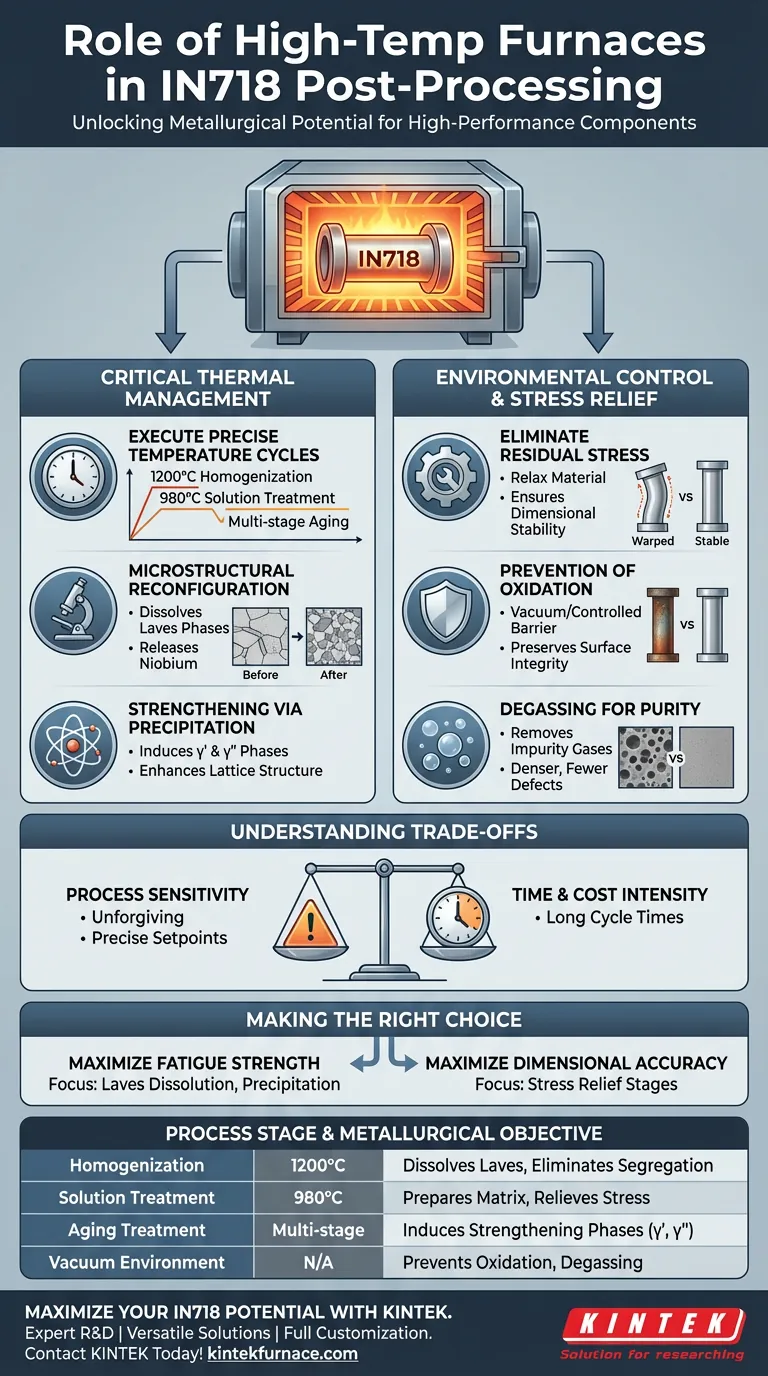
According to industry standards, this typically involves a homogenization cycle at 1200°C, followed by a solution treatment at 980°C, and concluding with multi-stage aging treatments.
Microstructural Reconfiguration
The high temperatures are not arbitrary; they are designed to repair the microstructure.
During fabrication, IN718 often develops harmful Laves phases. The furnace's ability to hold specific temperatures facilitates the dissolution of these phases.
Strengthening via Precipitation
Dissolving the Laves phases releases vital elements, specifically Niobium.
Once released, these elements are free to induce the precipitation of strengthening phases ($\gamma'$ and $\gamma''$) and grain boundary $\delta$ phases. This chemical reorganization significantly enhances the lattice structure's microhardness and compressive strength.
Environmental Control and Stress Relief
Eliminating Residual Stress
IN718 components, particularly those created via additive manufacturing, accumulate significant residual stress during formation.
The furnace cycles effectively relax the material, eliminating these internal forces. This ensures the component maintains its shape (dimensional stability) rather than warping or cracking under load.
Prevention of Oxidation
At temperatures exceeding 900°C, metals are highly reactive to oxygen.
Vacuum or controlled atmosphere furnaces create a barrier against the outside air. This prevents oxidation and decarburization, preserving the surface integrity and corrosion resistance of the component.
Degassing for Purity
Beyond preventing oxidation, a vacuum environment actively removes impurity gases trapped within the material.
This results in a denser, purer product with fewer internal defects, which is directly correlated to improved mechanical performance.
Understanding the Trade-offs
Process Sensitivity
While these furnaces offer superior control, the process is unforgiving.
Deviating from the precise temperature setpoints (e.g., missing the 980°C solution window) can result in incomplete phase transformation or grain growth, rendering the part out of spec.
Time and Cost Intensity
These are not rapid processes.
The requirement for multiple stages—heating, holding for dissolution, and controlled cooling rates—means cycle times are long. This makes the post-processing phase a significant factor in the total cost and lead time of IN718 components.
Making the Right Choice for Your Goal
To maximize the value of your heat treatment process, align your furnace operations with your specific engineering requirements:
- If your primary focus is Fatigue Strength: Prioritize cycles that ensure complete dissolution of Laves phases and precise precipitation of $\gamma''$ phases to maximize lattice durability.
- If your primary focus is Dimensional Accuracy: Ensure your cycle emphasizes the stress relief stages to prevent warping in complex geometries during subsequent machining or use.
Ultimately, the furnace is not just a heating tool, but a synthesis chamber that unlocks the full metallurgical potential of Inconel 718.
Summary Table:
| Process Stage | Typical Temperature | Primary Metallurgical Objective |
|---|---|---|
| Homogenization | 1200°C | Dissolves Laves phases & eliminates chemical segregation |
| Solution Treatment | 980°C | Prepares matrix for precipitation & relieves residual stress |
| Aging Treatment | Multi-stage | Induces strengthening phases (γ' and μ'') for hardness |
| Vacuum Environment | N/A | Prevents oxidation, decarburization, and ensures degassing |
Maximize the Potential of Your IN718 Components
Don't let improper thermal management compromise your material integrity. KINTEK provides industry-leading high-temperature vacuum and atmosphere furnaces specifically designed for the rigorous demands of superalloy post-processing.
Why partner with KINTEK?
- Expert R&D: Our systems are engineered to provide the precise temperature uniformity required to dissolve Laves phases and ensure dimensional stability.
- Versatile Solutions: Choose from Muffle, Tube, Rotary, Vacuum, and CVD systems tailored to your specific production scale.
- Full Customization: We adapt our technology to meet your unique metallurgical specifications and additive manufacturing workflows.
Ensure your components achieve maximum fatigue strength and purity. Contact KINTEK today to discuss your heat treatment needs!
Visual Guide
References
- Lakshmi Ramineni, Ala Qattawi. Residual Stress Mapping in Heat-Assisted Additive Manufacturing of IN 718: An X-Ray Diffraction Study. DOI: 10.1007/s11665-024-09269-x
This article is also based on technical information from Kintek Furnace Knowledge Base .
Related Products
- 2200 ℃ Graphite Vacuum Heat Treat Furnace
- Molybdenum Vacuum Heat Treat Furnace
- 1400℃ Controlled Inert Nitrogen Atmosphere Furnace
- 2200 ℃ Tungsten Vacuum Heat Treat and Sintering Furnace
- 1700℃ Controlled Inert Nitrogen Atmosphere Furnace
People Also Ask
- Why are vacuum heat treating furnaces essential for aerospace? Ensure Superior Material Integrity for High-Stakes Applications
- What is the primary application of vacuum heat treating furnaces in aerospace? Enhance Component Performance with Precision
- What is the process of vacuum heat treating? Achieve Superior Metallurgical Properties
- How does vacuum heat treating work in terms of temperature and time control? Master Precise Material Transformations
- How does a vacuum heat treating furnace improve the condition of metal alloys? Achieve Superior Metal Performance



















