
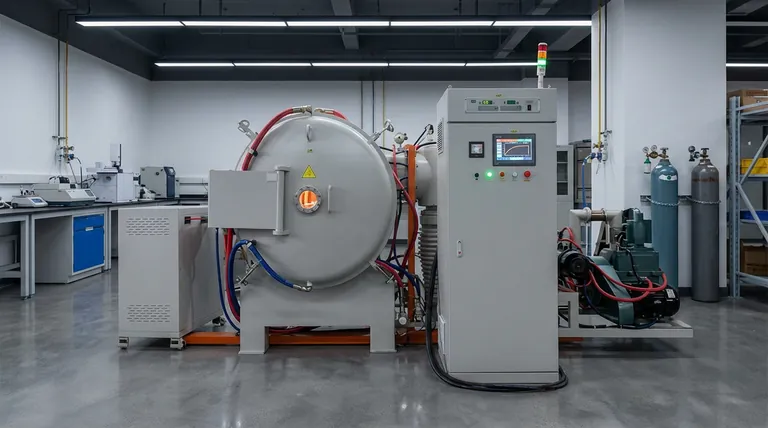
A vacuum diffusion furnace provides two critical environmental controls: precise thermal regulation at extreme temperatures and a chemically inert, high-vacuum atmosphere. Specifically, it maintains stable heat between 1050 and 1150 °C for extended durations of 300 to 500 hours, while simultaneously eliminating oxygen to prevent the degradation of reactive alloy elements.
The core value of this environment is its ability to facilitate deep atomic movement without surface contamination. By maintaining a high vacuum, the system allows elements like Niobium, Tantalum, and Zirconium to diffuse sufficiently within phases like $\alpha_2$-Ti$_3$Al to create measurable diffusion zones.
The Critical Role of Vacuum Atmosphere
Prevention of Alloy Oxidation
The primary environmental control in these furnaces is the creation of a high vacuum.
This is essential when treating diffusion couples containing reactive elements such as Niobium (Nb), Tantalum (Ta), and Zirconium (Zr).
Without this vacuum, these elements would rapidly oxidize at elevated temperatures, effectively ruining the experiment or material processing.
Ensuring Material Cleanliness
Vacuum heat treatment is widely regarded as the cleanest hardening method available.
By removing air and other gases, the furnace prevents unwanted chemical reactions that typically occur in standard atmospheric furnaces.
This ensures the purity of the diffusion couples, allowing for precise study of the interaction between materials without environmental interference.
Thermal Stability and Duration Control
Sustaining High Temperatures
Diffusion processes often require extreme heat to activate atomic movement.
These furnaces are engineered to provide a stable environment ranging strictly from 1050 to 1150 °C.
This stability is vital for ensuring that the diffusion rate remains constant and predictable throughout the treatment.
Extended Treatment Durations
Creating measurable diffusion zones is not an instant process; it requires significant time.
The furnace control systems are designed to run reliability for extended periods, typically between 300 and 500 hours.
This endurance capability ensures that the diffusion couple has enough time to develop the necessary phase interactions, such as those within the $\alpha_2$-Ti$_3$Al phase.
Precision Process Control
Modern systems utilize computerized controls to regulate not just the target temperature, but also the heating speed.
This precision ensures that the materials reach the processing temperature without experiencing thermal shock.
Cooling Mechanisms and Phase Control
Natural Cooling
Once the diffusion process is complete, the workpiece can be cooled using natural methods.
In this scenario, the heating element is deactivated, allowing the components to cool slowly within the vacuum environment.
Forced Cooling Options
For applications requiring specific microstructures, the cooling rate can be manipulated.
Furnaces may employ forced cooling by introducing an inert gas like nitrogen.
Alternatively, water cooling systems can be activated to significantly accelerate the temperature drop, locking in specific material properties.
Understanding the Trade-offs
Process Duration vs. Throughput
The specific diffusion process described requires immense time investments—up to 500 hours per cycle.
This limits the throughput of the furnace, making it a bottleneck for high-volume production schedules.
Complexity of Atmosphere Control
While the vacuum prevents oxidation, it requires rigorous maintenance of seals and pumps.
Any failure in the vacuum integrity over a 500-hour run can compromise the entire batch of diffusion couples.
Making the Right Choice for Your Goal
When selecting a furnace configuration for diffusion studies, consider your specific material constraints.
- If your primary focus is reactive alloy research: Prioritize a furnace with the highest vacuum integrity to protect elements like Nb and Ta from oxidation over long durations.
- If your primary focus is microstructural control: Select a system with advanced cooling capabilities (inert gas or water) to precisely manage the post-diffusion phase transformation.
By combining extreme thermal stability with a contaminant-free vacuum, you ensure that the resulting diffusion zones are a product of material science, not environmental error.
Summary Table:
| Environmental Control | Capability / Range | Key Benefit |
|---|---|---|
| Atmosphere | High Vacuum | Prevents oxidation of reactive elements (Nb, Ta, Zr) |
| Temperature Range | 1050 - 1150 °C | Sustains extreme heat for atomic activation |
| Process Duration | 300 - 500 Hours | Ensures development of measurable diffusion zones |
| Cooling Control | Natural or Forced (Gas/Water) | Manages post-diffusion microstructures and phases |
| Process Regulation | Computerized Precision | Prevents thermal shock and ensures repeatable results |
Precision diffusion research demands a contamination-free environment and unwavering thermal stability. KINTEK provides industry-leading vacuum, CVD, and high-temperature furnace systems tailored for complex metallurgical processes. Backed by expert R&D and manufacturing, our systems are fully customizable to handle reactive alloy treatments and extended durations. Enhance your material research—contact KINTEK today for a custom solution.
References
- Lukas Haußmann, Mathias Göken. Interdiffusion Coefficients and Strengthening Effects of Nb, Ta, and Zr in the α2-Ti3Al Phase. DOI: 10.1007/s11669-024-01105-y
This article is also based on technical information from Kintek Furnace Knowledge Base .
Related Products
- Split Chamber CVD Tube Furnace with Vacuum Station CVD Machine
- Vacuum Heat Treat Furnace with Ceramic Fiber Liner
- Vacuum Heat Treat Sintering and Brazing Furnace
- Vacuum Hot Press Furnace Machine Heated Vacuum Press
- Small Vacuum Heat Treat and Tungsten Wire Sintering Furnace
People Also Ask
- What role does a Tube Furnace play in the CVD growth of carbon nanotubes? Achieve High-Purity CNT Synthesis
- What are the advantages of using a CVD tube furnace for preparing gate dielectrics? Achieve High-Quality Thin Films for Transistors
- How does a CVD tube furnace achieve high purity in gate media preparation? Master Precision Control for Flawless Films
- What are the operational and maintenance requirements for a CVD tube furnace? Ensure Precision for Thin Film Deposition
- What are the key features of CVD tube furnaces for 2D material processing? Unlock Precision Synthesis for Superior Materials



















