
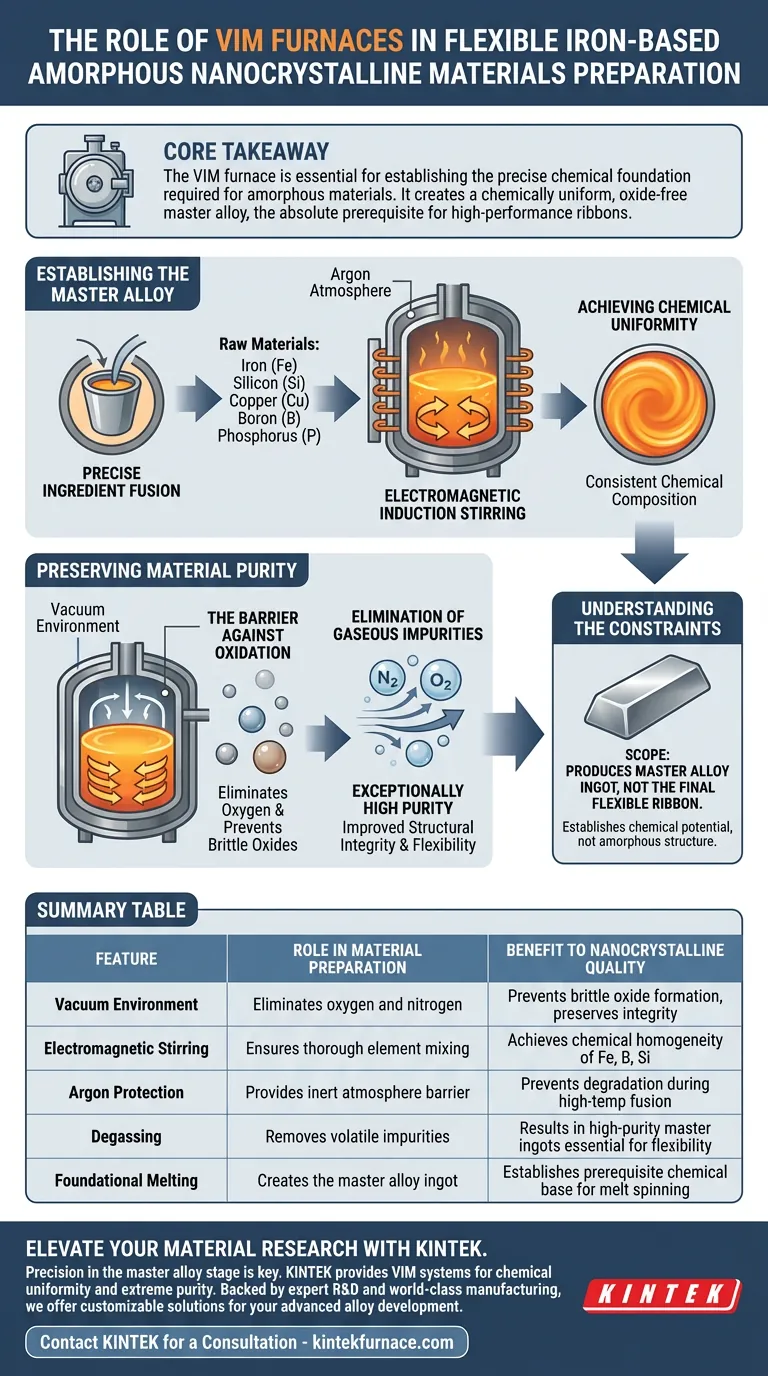
The Vacuum Induction Melting (VIM) furnace serves as the critical foundational step in the manufacturing of flexible iron-based amorphous nanocrystalline materials. Its primary role is to synthesize a high-purity master alloy ingot by melting specific raw materials—iron, silicon, copper, boron, and phosphorus—under a protective argon atmosphere.
Core Takeaway The VIM furnace is essential for establishing the precise chemical foundation required for amorphous materials. By utilizing electromagnetic stirring within a vacuum, it creates a chemically uniform, oxide-free master alloy, which is the absolute prerequisite for producing high-performance amorphous ribbons.
Establishing the Master Alloy
Precise Ingredient Fusion
The process begins with the introduction of high-purity raw materials into the furnace.
For flexible iron-based nanocrystalline materials, the specific charge typically includes iron, silicon, copper, boron, and phosphorus.
The VIM furnace melts these distinct elements together under a controlled argon protective atmosphere to prevent immediate degradation.
Achieving Chemical Uniformity
Mere melting is insufficient for high-performance materials; the mixture must be perfectly homogenous.
The VIM furnace utilizes electromagnetic induction stirring during the melting phase.
This mechanism constantly agitates the molten pool, ensuring that heavy and light elements mix thoroughly to create a master alloy with a consistent chemical composition throughout.
Preserving Material Purity
The Barrier Against Oxidation
At the high temperatures required for melting, elements like iron and silicon are highly susceptible to reacting with oxygen.
The VIM furnace creates a vacuum environment that acts as an absolute barrier against oxidation.
By eliminating oxygen from the chamber, the furnace ensures the raw materials retain their intended properties without forming brittle oxides that would degrade the final product.
Elimination of Gaseous Impurities
Beyond preventing new oxidation, the process actively refines the material.
The vacuum environment facilitates the removal of volatile impurities and dissolved gases, such as nitrogen and oxygen, from the molten metal.
This results in a master ingot of exceptionally high purity, a critical factor for the structural integrity and flexibility of the final nanocrystalline material.
Understanding the Constraints
The Scope of the VIM Process
It is vital to recognize that the VIM furnace produces the master alloy ingot, not the final flexible ribbon.
While it establishes the chemical potential of the material, it does not induce the amorphous (non-crystalline) structure itself.
The amorphous state is achieved in subsequent processing steps (such as melt spinning); the VIM furnace is solely responsible for providing the defect-free, chemically correct liquid or ingot required for those steps to succeed.
Ensuring Process Success
If your primary focus is Chemical Consistency:
- Rely on the electromagnetic stirring capabilities of the VIM to prevent segregation of lighter elements like boron and silicon within the iron matrix.
If your primary focus is Material Purity:
- Ensure the vacuum and argon systems are functioning optimally to effectively strip volatile impurities and prevent oxidation during the high-temperature melt.
The quality of your final flexible amorphous material is directly dictated by the purity and uniformity of the master ingot produced in the VIM furnace.
Summary Table:
| Feature | Role in Material Preparation | Benefit to Nanocrystalline Quality |
|---|---|---|
| Vacuum Environment | Eliminates oxygen and nitrogen | Prevents brittle oxide formation and preserves material integrity |
| Electromagnetic Stirring | Ensures thorough element mixing | Achieves chemical homogeneity of iron, boron, and silicon |
| Argon Protection | Provides inert atmosphere barrier | Prevents degradation of reactive elements during high-temp fusion |
| Degassing | Removes volatile impurities | Results in high-purity master ingots essential for flexibility |
| Foundational Melting | Creates the master alloy ingot | Establishes the prerequisite chemical base for melt spinning |
Elevate Your Material Research with KINTEK
Precision in the master alloy stage is the difference between a brittle failure and a high-performance flexible ribbon. KINTEK provides industry-leading Vacuum Induction Melting (VIM) systems designed to deliver the chemical uniformity and extreme purity your nanocrystalline materials demand.
Backed by expert R&D and world-class manufacturing, KINTEK offers customizable Muffle, Tube, Rotary, Vacuum, and CVD systems. Whether you are developing advanced amorphous alloys or scaling laboratory production, our high-temperature solutions are tailored to your unique specifications.
Ready to optimize your alloy synthesis? Contact KINTEK today for a consultation!
Visual Guide
References
- Ravi Gautam, H. Sepehri‐Amin. Creation of flexible spin-caloritronic material with giant transverse thermoelectric conversion by nanostructure engineering. DOI: 10.1038/s41467-024-46475-6
This article is also based on technical information from Kintek Furnace Knowledge Base .
Related Products
- Vacuum Induction Melting Furnace
- 600T Vacuum Induction Hot Press Vacuum Heat Treat and Sintering Furnace
- Small Vacuum Heat Treat and Tungsten Wire Sintering Furnace
- Vacuum Heat Treat Sintering and Brazing Furnace
- Vacuum Heat Treat Sintering Furnace Molybdenum Wire Vacuum Sintering Furnace
People Also Ask
- What are the core functions of the High Vacuum Induction Melting (VIM) furnace? Optimize DD5 Superalloy Purification
- What is the role of VIM and directional solidification in aero-engine blade substrates? Engineering Extreme Durability
- What are the advantages of using a VIM furnace to control residual oxygen pressure? Achieve Superior Metal Uniformity
- What role does a Vacuum Induction Melting furnace play in the production of high-aluminum nickel-based superalloys?
- Why is a Vacuum Induction Melting furnace (VIM) used for Cu-Zn-Al-Sn alloys? Achieve Precision Composition Control



















