
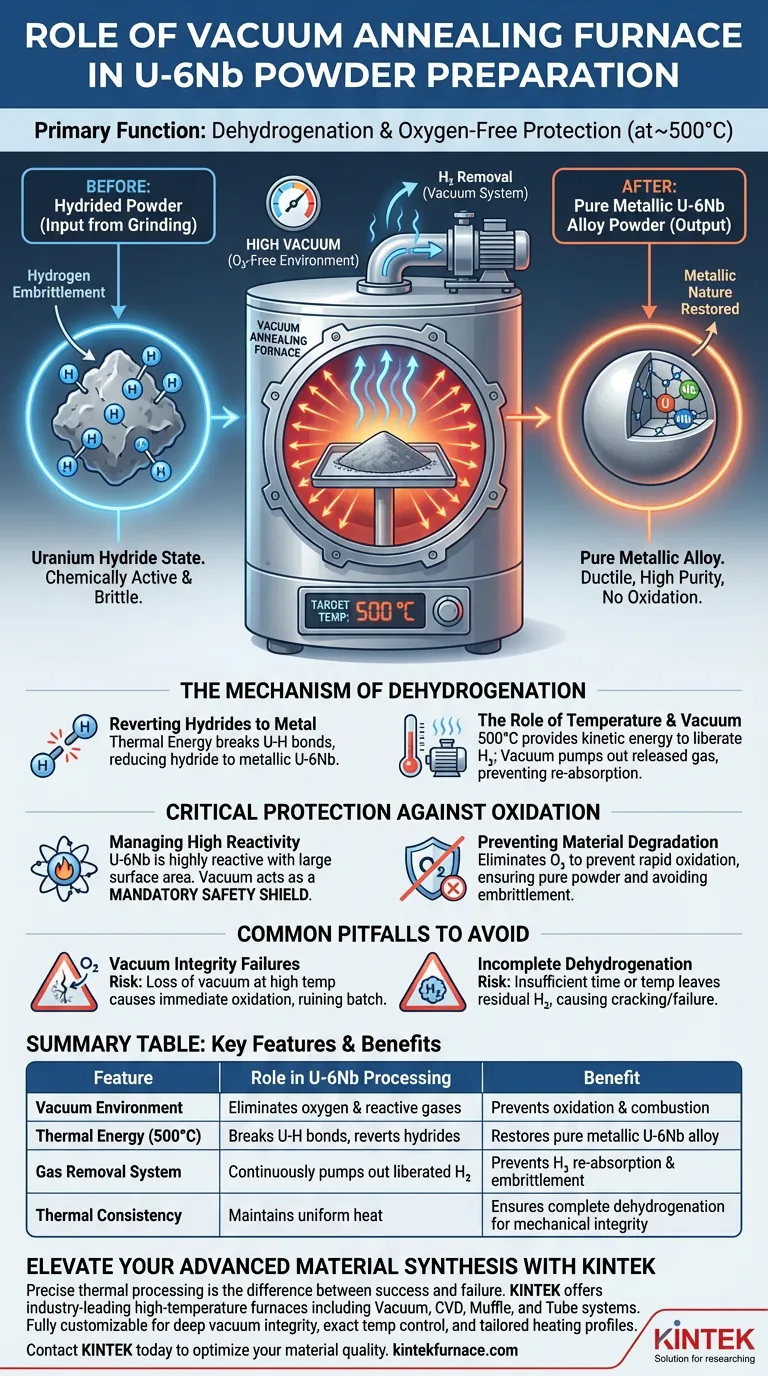
The primary role of a vacuum annealing furnace in Uranium-Niobium (U-6Nb) powder preparation is to perform dehydrogenation, converting the material from a hydride state back into a pure metallic alloy. Operating typically at 500 °C, the furnace drives off hydrogen while strictly maintaining an oxygen-free environment to prevent the combustion or degradation of the highly reactive powder.
The furnace acts as a chemical restoration stage, using thermal energy to release hydrogen introduced during grinding. It restores the metallic nature of the U-6Nb alloy without allowing the oxidation that would inevitably occur in a non-vacuum environment.
The Mechanism of Dehydrogenation
Reverting Hydrides to Metal
The powder entering the furnace is essentially a uranium hydride, often a result of the grinding process where hydrogen is used to embrittle the metal for easier comminution.
The vacuum annealing furnace reverses this process. By applying heat under vacuum, it breaks the chemical bond between the metal and the hydrogen, effectively reducing the hydride back into metallic Uranium-Niobium (U-6Nb) powder.
The Role of Temperature
This chemical reversion is driven by specific thermal conditions, typically around 500 °C.
At this temperature, the kinetic energy is sufficient to liberate the hydrogen atoms from the metal lattice. The vacuum system then continuously pumps this released hydrogen gas out of the chamber to prevent re-absorption.
Critical Protection Against Oxidation
Managing High Reactivity
U-6Nb powder is chemically "active," meaning it reacts aggressively with oxygen.
This reactivity is amplified because the powder has a large specific surface area compared to solid metal. The vacuum environment is not just a facilitator for hydrogen removal; it is a mandatory safety shield.
Preventing Material degradation
If this heating process occurred in air, the powder would oxidize rapidly, ruining the alloy.
By eliminating oxygen from the chamber, the furnace ensures the resulting powder remains pure. This prevents the formation of oxide layers that would lead to material embrittlement and poor performance in final applications.
Common Pitfalls to Avoid
Vacuum Integrity Failures
The most significant risk in this process is a loss of vacuum pressure at high temperatures.
Because the powder is heated to 500 °C, even a microscopic leak or insufficient vacuum level will cause immediate oxidation. This can render the entire batch usable and potentially hazardous.
Incomplete Dehydrogenation
There is a trade-off between cycle time and material purity.
If the furnace cycle is too short or the temperature fluctuates below the target, residual hydrogen may remain in the core of the particles. This residual hydrogen can cause cracking or failure in the final consolidated part.
Ensuring Quality in U-6Nb Preparation
To maximize the effectiveness of your annealing process, align your operational parameters with your specific quality targets:
- If your primary focus is Chemical Purity: Ensure your vacuum system is capable of maintaining deep vacuum levels to eliminate even trace amounts of oxygen during the heating ramp.
- If your primary focus is Mechanical Integrity: Verify that the hold time at 500 °C is sufficient to achieve complete dehydrogenation throughout the entire powder batch.
Successful U-6Nb preparation relies on the vacuum annealing furnace to simultaneously act as a chemical reactor for hydrogen removal and a protective vessel against oxidation.
Summary Table:
| Feature | Role in U-6Nb Processing | Benefit |
|---|---|---|
| Vacuum Environment | Eliminates oxygen and reactive gases | Prevents oxidation and combustion of reactive powder |
| Thermal Energy (500°C) | Breaks chemical bonds in uranium hydrides | Reverts hydrides back to pure metallic U-6Nb alloy |
| Gas Removal System | Continuously pumps out liberated hydrogen | Prevents hydrogen re-absorption and material embrittlement |
| Thermal Consistency | Maintains uniform heat across high surface area | Ensures complete dehydrogenation for mechanical integrity |
Elevate Your Advanced Material Synthesis with KINTEK
Precise thermal processing is the difference between high-performance alloys and material failure. KINTEK provides industry-leading laboratory high-temperature furnaces—including Vacuum, CVD, Muffle, and Tube systems—engineered to meet the rigorous demands of reactive metal processing like U-6Nb.
Backed by expert R&D and precision manufacturing, our systems are fully customizable to ensure your laboratory achieves:
- Deep vacuum integrity to eliminate oxidation risks.
- Exact temperature control for complete chemical restoration.
- Tailored heating profiles for unique alloy requirements.
Contact KINTEK today to discuss your specific research or production needs and discover how our specialized furnace technology can optimize your material quality.
Visual Guide
References
- Investigation of In Situ and Ex Situ Passivation of Pyrophoric Uranium–Niobium Alloy Powder. DOI: 10.3390/app15126431
This article is also based on technical information from Kintek Furnace Knowledge Base .
Related Products
- 1400℃ Controlled Inert Nitrogen Atmosphere Furnace
- Vacuum Heat Treat Sintering Furnace with Pressure for Vacuum Sintering
- Controlled Inert Nitrogen Hydrogen Atmosphere Furnace
- Vacuum Heat Treat Sintering Furnace Molybdenum Wire Vacuum Sintering Furnace
- Small Vacuum Heat Treat and Tungsten Wire Sintering Furnace
People Also Ask
- How does oxygen partial pressure control affect ceramic sintering? Master Defect Chemistry
- How do controlled-atmosphere furnaces support polymer pyrolysis? Master SiC & Si3N4 Ceramic Conversion
- Why is thorough binder burnout necessary before sintering advanced ceramics? Ensure Peak Density & Zero Defects
- Why is controlled-atmosphere heating required for functional ceramics and sensors? Master Defect Engineering
- How does real-time dilatometric analysis in a controlled-atmosphere furnace optimize PZT ceramic sintering?



















