
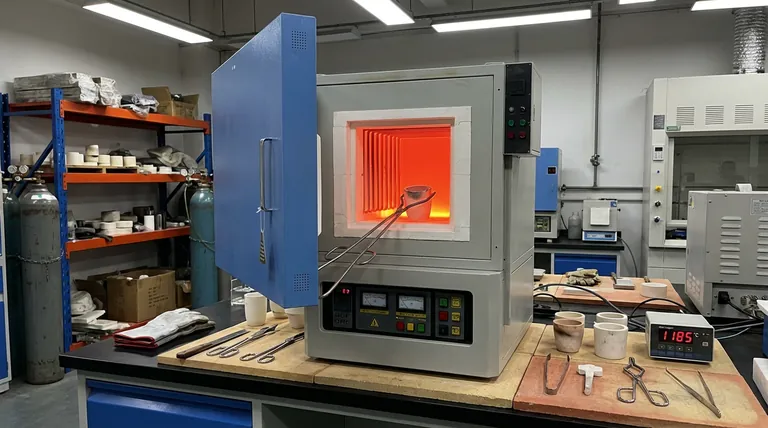
The high-temperature muffle furnace acts as the critical vessel for microstructural homogenization in MAR-M247 superalloys. Its primary role is to maintain a precise, stable thermal environment at a sub-solvus temperature of 1185 °C. This specific thermal exposure drives the complete dissolution of strengthening phases from the as-cast structure back into the matrix.
The furnace is not merely a heat source; it is a precision instrument for thermal field uniformity. Without the exacting stability provided by a high-quality muffle furnace, the dissolution of phases remains inconsistent, rendering subsequent cooling strengthening ineffective.
The Mechanism of Solution Treatment
Achieving the Sub-Solvus Threshold
For MAR-M247, the muffle furnace must target and hold a specific temperature of 1185 °C.
This is classified as a sub-solvus treatment. The furnace ensures the material reaches this energy level without exceeding the melting point of the alloy's secondary phases.
Dissolution of Strengthening Phases
The primary objective of this thermal dwell time is phase dissolution.
In the as-cast state, MAR-M247 contains segregated strengthening phases. The heat provided by the furnace supplies the kinetic energy required for these phases to dissolve fully into the alloy matrix.
The Critical Importance of Uniformity
Ensuring Thermal Field Consistency
The defining advantage of using a high-temperature muffle furnace is its excellent thermal field uniformity.
Inconsistent heating leads to a heterogeneous microstructure. The furnace chamber ensures that every part of the component experiences the exact same temperature profile, preventing localized weak spots.
The Foundation for Future Strengthening
This solution treatment is a critical prerequisite for the manufacturing steps that follow.
If the furnace fails to fully homogenize the structure, the subsequent cooling strengthening processes will fail to produce the desired mechanical properties. The matrix must be uniform before it can be strengthened.
Understanding the Operational Requirements
The Necessity of Precision
The "trade-off" in this process is the zero-tolerance for temperature deviation.
Because the target is a specific sub-solvus point (1185 °C), standard industrial ovens with wide thermal variances are unsuitable. The equipment must be capable of holding tight tolerances to avoid incomplete dissolution (too cold) or incipient melting (too hot).
Reliance on Atmospheric Control
While the primary focus is temperature, the "muffle" design implies isolation.
This design protects the superalloy from direct contact with heating elements and potential contaminants, ensuring that the structural chemistry remains pure during the high-heat cycle.
Optimizing Your Heat Treatment Strategy
To ensure the integrity of your MAR-M247 components, align your equipment capabilities with your metallurgical goals:
- If your primary focus is Microstructural Homogeneity: Ensure your furnace is calibrated to maintain thermal uniformity across the entire chamber volume at 1185 °C to prevent segregation.
- If your primary focus is Mechanical Performance: Verify that the strengthening phases have fully dissolved during the holding phase before proceeding to cooling, as this dictates final alloy strength.
The effectiveness of your solution treatment—and the final strength of the superalloy—relies entirely on the thermal precision of your furnace.
Summary Table:
| Feature | Role in MAR-M247 Solution Treatment |
|---|---|
| Target Temperature | Precise sub-solvus hold at 1185 °C |
| Primary Mechanism | Dissolution of segregated strengthening phases into the matrix |
| Thermal Uniformity | Ensures consistent microstructure and prevents localized weak spots |
| Atmospheric Control | Protects alloy chemistry from contaminants and heating elements |
| Process Impact | Prerequisite for effective cooling strengthening and homogeneity |
Elevate Your Superalloy Processing with KINTEK Precision
Achieving the perfect sub-solvus threshold for MAR-M247 requires uncompromising thermal stability. Backed by expert R&D and manufacturing, KINTEK offers high-performance Muffle, Tube, Rotary, and Vacuum furnaces specifically designed for the rigorous demands of aerospace and industrial metallurgy.
Our systems provide the thermal field uniformity and precise atmospheric control necessary to ensure complete phase dissolution and structural purity. Whether you need a standard solution or a system customizable for your unique research needs, KINTEK is your partner in advanced heat treatment.
Ready to optimize your microstructural homogenization? Contact our technical experts today to find your perfect furnace solution.
References
- Yue Wang, Xitao Wang. Effect of Cooling Rate on the Microstructure and Mechanical Property of Nickel-Based Superalloy MAR-M247. DOI: 10.3390/ma17050982
This article is also based on technical information from Kintek Furnace Knowledge Base .
Related Products
- 1700℃ High Temperature Muffle Oven Furnace for Laboratory
- 1800℃ High Temperature Muffle Oven Furnace for Laboratory
- 1200℃ Muffle Oven Furnace for Laboratory
- High Temperature Muffle Oven Furnace for Laboratory Debinding and Pre Sintering
- 1400℃ Muffle Oven Furnace for Laboratory
People Also Ask
- What is the primary function of a high-temperature laboratory muffle furnace in chemical synthesis? Achieve Precision.
- How does a high-temperature laboratory muffle furnace affect material properties? Transform Anodic Oxide Films Fast
- What role does a muffle furnace play in BCZY712 electrolyte powder production? Achieve Perfect Phase Purity
- What is the role of a high-temperature muffle furnace in guava leaf carbonization? Master Precise Pyrolysis Control
- How does the two-stage sintering process contribute to the synthesis of MeCuFeO3 perovskite? Optimize crystal purity.



















