
An industrial muffle furnace facilitates chemical activation by subjecting pretreated clay to intense, controlled thermal energy, typically reaching temperatures of 900°C for durations up to four hours. This sustained heating process fundamentally alters the clay’s mineralogical structure, transforming previously stable phases into a highly reactive state essential for synthesizing the core framework of zeolite catalysts.
The furnace acts as a thermal reactor that breaks down stable mineral bonds and reorganizes them into reactive structures, a prerequisite for creating the high-performance architecture of zeolite catalysts.
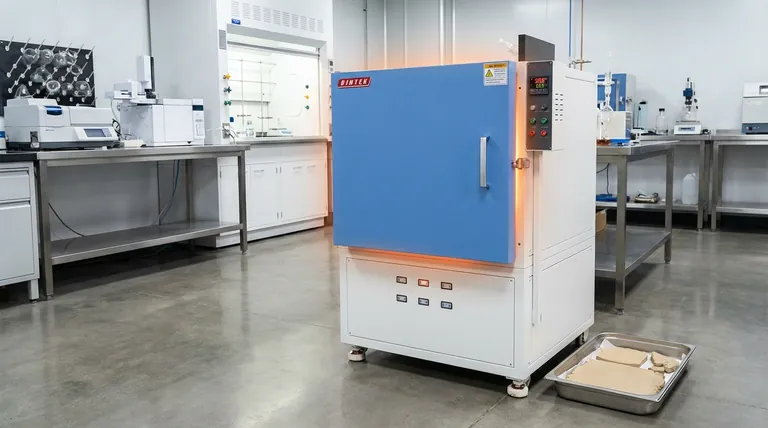
The Mechanism of Thermal Activation
Breaking Mineral Stability
The primary function of the furnace is to deliver sufficient energy to overcome the natural stability of the clay.
By maintaining a temperature of 900°C, the furnace forces a phase transformation. This converts the inert mineral components of the clay into a dynamic, reactive state.
Synthesizing the Catalyst Framework
This process is not merely about drying or dehydration; it is a chemical engineering step.
The intense heat triggers the reactivation of chemical components, allowing the clay to function as a precursor. This establishes the structural foundation required for the synthesis of high-performance zeolite catalysts.
Critical Operational Functions
Precise Thermal Stability
While the specific temperature for clay is high (900°C), the muffle furnace is valuable because of its ability to maintain a consistent thermal field.
As noted in broader catalyst applications, thermal field stability ensures that the chemical transformation is uniform throughout the material. This prevents inconsistencies between different batches of the treated clay.
Controlled Oxidative Environments
In many catalyst production processes, muffle furnaces provide a static, oxidative environment (often air).
This environment allows for the decomposition of organic residues or the conversion of salts into oxides. While clay activation focuses on phase change, the furnace's ability to regulate the atmosphere ensures that no unwanted reduction reactions compromise the material's purity.
Understanding the Trade-offs
Energy Intensity vs. Reactivity
The 900°C activation process is energy-intensive and time-consuming (often four hours).
Reducing the temperature or time to save energy often results in incomplete activation. This leaves the clay with stable mineral phases that cannot effectively form the zeolite framework, compromising the final product's performance.
Temperature Uniformity Risks
At such high temperatures, thermal gradients within the furnace can be detrimental.
If the temperature fluctuates significantly, portions of the clay may sinter (fuse) rather than activate. This underscores the need for industrial-grade precision in temperature control systems to maintain the narrow operating window required for optimal activation.
Making the Right Choice for Your Goal
To maximize the effectiveness of your activation process, consider the specific requirements of your precursor material.
- If your primary focus is clay activation: Prioritize a furnace capable of sustaining 900°C for extended periods (4+ hours) to ensure complete phase transformation from stable to reactive minerals.
- If your primary focus is general catalyst calcination: Select a unit with programmable temperature curves to manage lower-temperature tasks (500–600°C) like decomposing organic agents or creating Bronsted acid sites.
Successful zeolite production relies on the precise application of thermal energy to unlock the chemical potential within the raw clay.
Summary Table:
| Parameter | Specification | Impact on Clay Activation |
|---|---|---|
| Optimal Temperature | 900°C | Breaks stable mineral bonds & triggers phase transformation |
| Activation Duration | Up to 4 Hours | Ensures complete conversion to a highly reactive state |
| Thermal Stability | High Precision | Prevents material sintering and ensures batch uniformity |
| Atmosphere | Oxidative (Air) | Decomposes organic residues and prevents impurities |
Elevate Your Catalyst Synthesis with KINTEK
Precise clay activation requires more than just heat; it demands industrial-grade thermal stability. Backed by expert R&D and manufacturing, KINTEK offers high-performance Muffle, Tube, Rotary, Vacuum, and CVD systems designed to meet the rigorous 900°C demands of zeolite production. Whether you need a standard lab furnace or a fully customizable high-temperature system for unique chemical processing, our technology ensures uniform phase transformation and maximum reactivity for your materials.
Ready to optimize your activation process? Contact our technical experts today to find the perfect furnace solution for your lab.
References
- Princessruth Temidayo Temofeh, Bamidele Honesty Akpeji. Application of Zeolite in the Catalytic Cracking of Waste Vegetable Oil for the Production of highly Volatile Liquid Fuel. DOI: 10.37745/bjmas.2022.0467
This article is also based on technical information from Kintek Furnace Knowledge Base .
Related Products
- High Temperature Muffle Oven Furnace for Laboratory Debinding and Pre Sintering
- 1200℃ Muffle Oven Furnace for Laboratory
- 1400℃ Muffle Oven Furnace for Laboratory
- Laboratory Muffle Oven Furnace with Bottom Lifting
- 1700℃ High Temperature Muffle Oven Furnace for Laboratory
People Also Ask
- What thermal phenomena occur during polymer binder burnout in ceramic green bodies? Lab Furnace Guide
- What role does a high-temperature muffle furnace play in STFO synthesis? Achieve Pure Perovskite Results
- Why is controlled heat treatment in a muffle furnace necessary for calcined clay? Achieve Optimal Pozzolanic Activity
- How does a high-temperature muffle furnace facilitate the formation of LaNbxAl1−xO3+δ perovskite structures? Key Roles
- What role does a high-temperature muffle furnace play in the multi-stage synthesis of Li0.5MnFe1.5O4? Key to Pure Spinel












