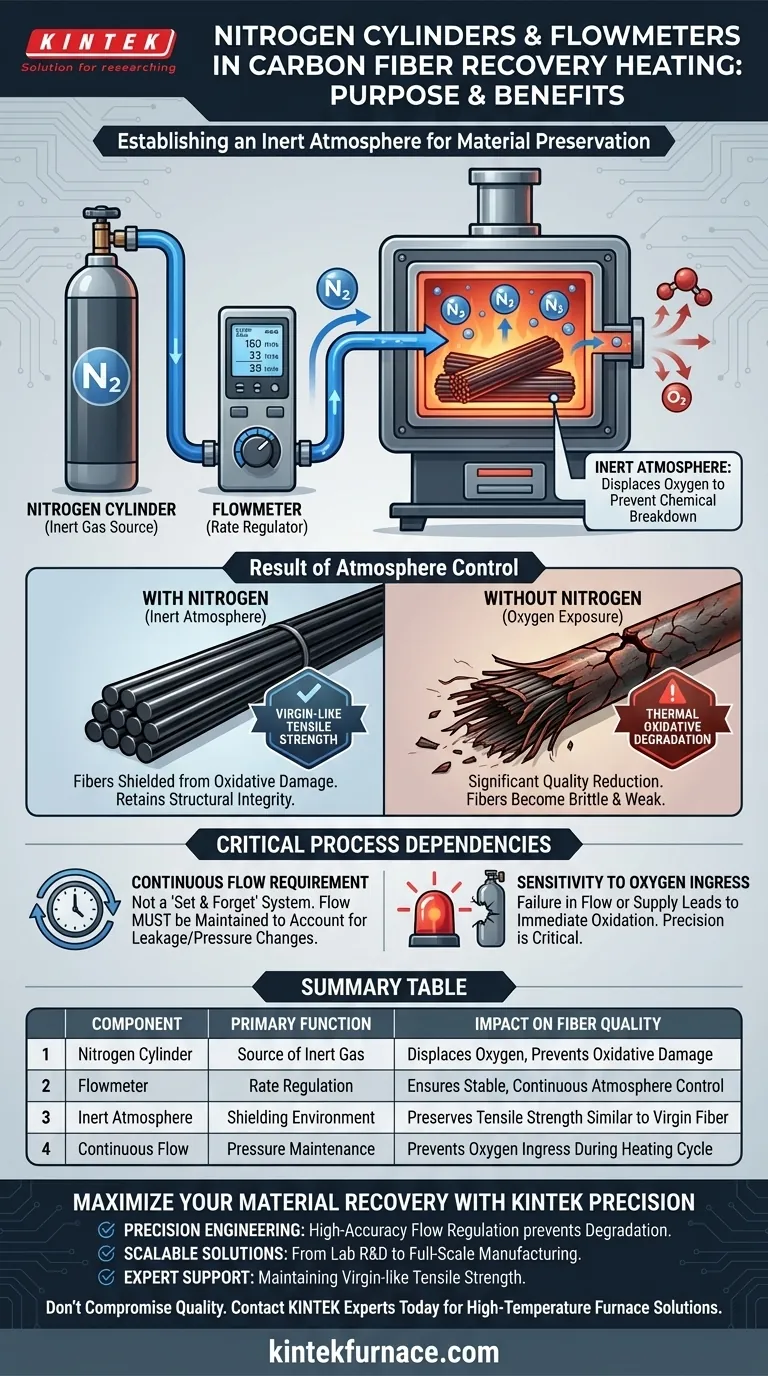
The primary function of nitrogen cylinders and flowmeters in this context is to establish and strictly regulate an inert atmosphere within the reaction chamber. These components work in tandem to continuously inject nitrogen, thereby displacing oxygen during the high-temperature decomposition process.
By excluding oxygen, this setup prevents the chemical breakdown of the fibers. The result is a recovered material that retains a tensile strength nearly identical to that of virgin carbon fibers.
The Mechanics of Atmosphere Control
Creating an Inert Environment
The nitrogen cylinders serve as the source of the inert gas, providing the necessary volume to fill the reaction chamber.
The flowmeters act as the regulatory mechanism, governing the rate at which nitrogen enters the system.
This combination ensures that the environment remains stable and consistent throughout the entire heating cycle.
Preventing Thermal Oxidative Degradation
When carbon fibers are exposed to high temperatures in the presence of oxygen, they undergo thermal oxidative degradation.
This chemical reaction damages the structural integrity of the fiber, significantly reducing its quality.
By continuously injecting nitrogen, the system removes the oxygen required for this degradation to occur.
Preserving Material Properties
The ultimate goal of using this equipment is the preservation of tensile strength.
Because the nitrogen atmosphere shields the fibers from oxidative damage, the recovered fibers do not become brittle or weak.
They emerge from the process with mechanical properties comparable to newly manufactured (virgin) fibers.
Critical Process Dependencies
The Requirement for Continuous Flow
The effectiveness of this system relies entirely on the continuous injection of nitrogen.
This is not a "set and forget" static environment; the flow must be maintained to account for any gas leakage or pressure changes during heating.
Sensitivity to Oxygen Ingress
Any failure in the flowmeters or depletion of the cylinders results in immediate oxygen exposure.
Even brief interruptions in the inert atmosphere during the high-heat stage can compromise the quality of the entire batch.
Therefore, the precision of the flowmeter is just as critical as the purity of the nitrogen source.
Ensuring High-Quality Recovery
To maximize the effectiveness of your carbon fiber recovery process, consider these operational priorities:
- If your primary focus is material strength: Maintain a consistent nitrogen overpressure to guarantee total oxygen exclusion and preserve virgin-like tensile properties.
- If your primary focus is process consistency: Use high-precision flowmeters to monitor the injection rate strictly, preventing fluctuations that could lead to partial degradation.
The successful recovery of carbon fiber is defined not just by the heat applied, but by the oxygen excluded.
Summary Table:
| Component | Primary Function | Impact on Fiber Quality |
|---|---|---|
| Nitrogen Cylinder | Source of inert gas | Displaces oxygen to prevent oxidative damage |
| Flowmeter | Rate regulation | Ensures stable, continuous atmosphere control |
| Inert Atmosphere | Shielding environment | Preserves tensile strength similar to virgin fiber |
| Continuous Flow | Pressure maintenance | Prevents oxygen ingress during the heating cycle |
Maximize Your Material Recovery with KINTEK Precision
Don't let oxygen exposure compromise the integrity of your recovered carbon fibers. At KINTEK, we understand that high-quality results demand rigorous atmosphere control. Backed by expert R&D and manufacturing, we offer advanced Muffle, Tube, Rotary, and Vacuum systems—all fully customizable to your specific carbon fiber processing needs.
Our value to you:
- Precision Engineering: High-accuracy flow regulation to prevent thermal oxidative degradation.
- Scalable Solutions: From lab-scale R&D to full-scale recovery manufacturing.
- Expert Support: Equipment designed to maintain virgin-like tensile strength in your materials.
Ready to enhance your lab's efficiency and material quality? Contact KINTEK experts today to find the perfect high-temperature furnace solution for your application.
Visual Guide
References
- Takaaki Wajima, K. Yamashita. Recovery of carbon fiber from carbon fiber reinforced plastics using alkali molten hydroxide. DOI: 10.1038/s41598-024-84293-4
This article is also based on technical information from Kintek Furnace Knowledge Base .
Related Products
People Also Ask
- How do the different types of silicon carbide heating elements compare in terms of applications? Find the Best Fit for Your High-Temp Needs
- What are the temperature capabilities and mounting options for silicon carbide heating elements? Unlock High-Temp Flexibility and Durability
- How do silicon carbide heating elements enhance the heat treatment of alloys? Achieve Superior Temperature Control
- What is the recommended surface load for silicon carbide heating elements at different furnace temperatures? Maximize Lifespan & Performance
- What are the advantages of using silicon carbide heating elements in industrial furnaces? Boost Efficiency and Durability