
The core advantage of microwave sintering lies in its ability to generate volumetric heating. Unlike traditional external heating sources, microwave energy couples directly with the material molecules of the Al2O3/TiC compound. This mechanism enables rapid densification from the inside out, significantly lowering the activation energy required for the process.
By bypassing the thermal lag of conventional heating, microwave sintering drastically shortens holding times and accelerates heating rates. This rapid kinetic environment effectively freezes the microstructure, preventing grain growth and yielding superhard ceramic tools with superior mechanical properties.
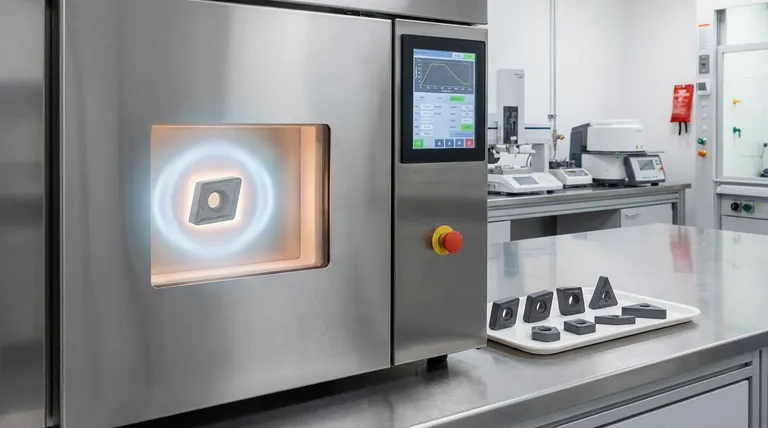
The Mechanism of Volumetric Heating
Direct Molecular Coupling
Traditional sintering relies on heat transfer from an external element to the surface of the material, and then slowly into the core.
In contrast, microwave sintering utilizes direct coupling between the microwave energy and the material molecules. This causes the material to generate heat internally, resulting in a volumetric heating profile that is uniform and immediate.
Reduced Activation Energy
The interaction between the microwave field and the ceramic material does more than just heat it.
This process effectively reduces the sintering activation energy. This reduction allows the diffusion processes necessary for densification to occur more readily than they would under conventional thermal conditions.
Impact on Microstructure and Performance
Inhibiting Grain Growth
One of the greatest challenges in producing superhard Al2O3/TiC ceramics is preventing the grains from growing too large during the heating process.
Because microwave sintering achieves densification in an extremely short period, there is insufficient time for significant grain coarsening. This "rapid kinetics" approach effectively inhibits grain growth, preserving a fine-grained microstructure.
Superior Hardness and Density
The combination of rapid heating and suppressed grain growth directly translates to material performance.
The process results in superhard ceramic materials that reach near-theoretical density. By maintaining a fine grain structure, the mechanical integrity and wear resistance of the final tool are significantly improved compared to those processed in traditional furnaces.
Dramatic Reduction in Process Time
Traditional sintering cycles can be incredibly long, often requiring extended holding times to ensure heat penetrates the core.
Microwave sintering can reduce these cycles by orders of magnitude (e.g., reducing processes from hours to a fraction of that time). This efficiency not only increases throughput but minimizes the exposure of the material to high temperatures, further protecting the material chemistry.
Understanding the Trade-offs
While microwave sintering offers superior microstructural control, it requires precise management to avoid defects.
Thermal Runaway Risks
Because the material heats internally, certain regions may absorb microwave energy more efficiently than others, potentially leading to localized overheating or "thermal runaway."
Complexity of Control
Unlike the straightforward application of heat in a resistance furnace, microwave sintering requires sophisticated monitoring.
Precise, non-contact temperature measurement is essential to ensure the heating rate (often 30 to 50°C per minute) remains stable and prevents performance fluctuations. The equipment must balance the electromagnetic field to ensure uniform heating across complex shapes.
Making the Right Choice for Your Goal
To determine if microwave sintering is the correct approach for your Al2O3/TiC production, consider your specific material targets.
- If your primary focus is maximum hardness: Microwave sintering is superior because it minimizes grain growth, creating a finer, harder microstructure.
- If your primary focus is process efficiency: The volumetric heating mechanism significantly shortens holding times and overall production cycles compared to traditional external heating.
- If your primary focus is complex shape consistency: Ensure your equipment has advanced field control to prevent localized hot spots, or consider traditional hot pressing for more predictable thermal gradients.
Microwave sintering transforms the production of ceramic tools by replacing slow thermal conduction with rapid, molecular-level energy transfer.
Summary Table:
| Feature | Traditional Sintering | Microwave Sintering |
|---|---|---|
| Heating Mechanism | External conduction (surface to core) | Volumetric coupling (internal generation) |
| Heating Rate | Relatively slow | Rapid (30-50°C per minute) |
| Grain Growth | Higher risk due to long cycles | Inhibited (preserves fine microstructure) |
| Energy Efficiency | High thermal lag | High (direct molecular interaction) |
| Process Time | Hours | Minutes to fractions of traditional time |
| Hardness/Density | Standard | Superior/Near-theoretical density |
Maximize Your Material Hardness with KINTEK
Elevate your ceramic tool production with KINTEK’s advanced heating solutions. Backed by expert R&D and manufacturing, KINTEK offers high-performance Muffle, Tube, Rotary, Vacuum, and CVD systems, all fully customizable for your unique laboratory and industrial needs. Whether you require precise grain growth control or rapid densification for superhard materials, our technical team is ready to deliver the perfect high-temp furnace for your application.
Ready to transform your throughput and material performance? Contact us today to find your custom solution!
References
- Samadar S. Majeed. Formulating Eco-Friendly Foamed Mortar by Incorporating Sawdust Ash as a Partial Cement Replacement. DOI: 10.3390/su16072612
This article is also based on technical information from Kintek Furnace Knowledge Base .
Related Products
- Chairside Dental Porcelain Zirconia Sintering Furnace with Transformer for Ceramic Restorations
- Dental Porcelain Zirconia Sintering Ceramic Vacuum Press Furnace
- Vacuum Dental Porcelain Sintering Furnace for Dental Laboratories
- High Temperature Muffle Oven Furnace for Laboratory Debinding and Pre Sintering
- Spark Plasma Sintering SPS Furnace
People Also Ask
- What factors determine the quality of sintered zirconia restorations? Master Material, Equipment, and Technique
- How do conventional vs rapid sintering in dental furnaces affect zirconia? Optimize Efficiency Without Sacrificing Strength
- What industries use zirconia sintering furnaces? Beyond Dental and Jewelry Applications
- Why is a zirconia sintering furnace considered essential for dental laboratories and clinics? Unlock Precision and Durability
- What are the key components of a zirconia sintering furnace? Unlock Precision for Superior Dental Restorations



















