
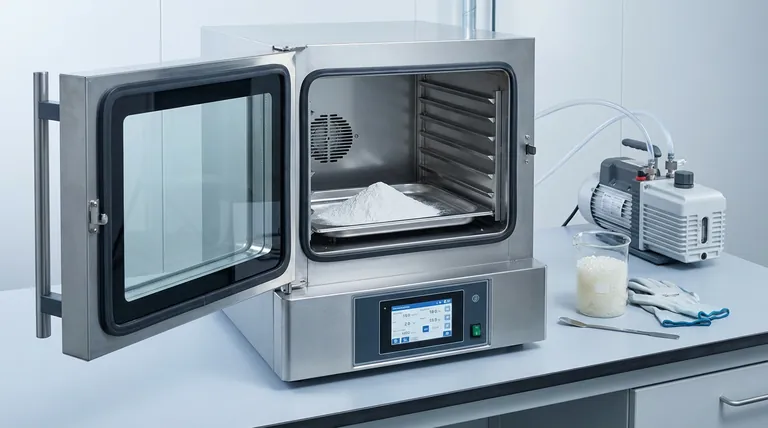
The primary purpose of using a vacuum drying oven is to rigorously eliminate adsorbed moisture from the surface of mineral powders before they are introduced to a polymer matrix. Operating at elevated temperatures, such as 120°C, this pretreatment is essential for establishing a robust interface between the inorganic filler and the organic polymer.
Removing surface moisture is the single most critical step in ensuring the integrity of polymer composites. Residual water acts as a barrier to bonding and a source of structural defects, directly compromising the density and mechanical strength of the final material.
The Critical Role of Moisture Removal
Ensuring Interfacial Bonding
Mineral powders naturally adsorb moisture from the atmosphere. If this water layer remains, it prevents the organic polymer matrix from wetting and bonding effectively with the inorganic filler surface.
Vacuum drying removes this barrier. By ensuring the surface is chemically dry, you facilitate strong adhesion between the two distinct materials.
Preventing Delamination
When moisture is trapped at the interface, it weakens the composite. Under stress, the material is liable to separate at the boundary between the powder and the polymer.
This separation is known as interfacial delamination. Thorough vacuum drying minimizes this risk, resulting in a cohesive, durable composite structure.
Preventing Structural Defects During Sintering
Eliminating Pore Formation
The production of polymer composites often involves high-temperature sintering or curing. If moisture or residual solvents remain in the powder, these volatile components will vaporize during heating.
This trapped vapor creates pores and voids within the material. These defects significantly reduce the density of the composite and act as stress concentrators that lead to premature failure.
Ensuring Uniform Density
A vacuum environment lowers the boiling point of liquids, allowing moisture and solvents to evaporate completely even from deep within the powder's pores.
This ensures the filler is uniformly dense and free of gas pockets. Consequently, the final composite achieves consistent mechanical strength and structural reliability.
Operational Advantages of Vacuum Drying
Preventing Oxidation
While the primary goal for minerals is moisture removal, the vacuum environment also lowers the oxygen content. This is particularly beneficial if the mineral powder or any pre-mixed additives are sensitive to oxidation.
By drying in a vacuum, you can apply heat to drive off moisture without exposing the material to reactive atmospheric oxygen, maintaining chemical purity.
Avoiding Agglomeration
Standard heat drying can sometimes cause fine particles to clump together due to capillary forces or sintering.
Vacuum drying accelerates evaporation at lower temperatures, which helps prevent the formation of hard agglomerates. This preserves the fine morphology of the powder, ensuring it disperses evenly throughout the polymer matrix during mixing.
Understanding the Trade-offs
Balancing Temperature and Vacuum
While high temperatures (e.g., 120°C) are effective for removing water, excessive heat can degrade certain surface treatments or extremely sensitive nanostructures.
The vacuum allows you to lower the boiling point of water. However, you must still select a temperature high enough to desorb bound water but low enough to prevent thermal degradation or unwanted particle growth.
Processing Time vs. Throughput
Vacuum drying is a batch process that can be time-consuming compared to continuous drying methods.
Achieving a completely dry state requires maintaining the vacuum and heat for a specific duration. Rushing this step to increase throughput will invariably lead to residual moisture, defeating the purpose of the process.
Optimizing Your Pretreatment Strategy
To ensure the highest quality polymer composite, align your drying parameters with your specific material needs:
- If your primary focus is Mechanical Strength: Prioritize higher temperatures (around 120°C) to ensure the absolute removal of water for maximum interfacial bonding.
- If your primary focus is Particle Dispersion: Utilize a deeper vacuum to allow for lower-temperature drying, which prevents agglomeration and ensures the powder mixes uniformly.
The success of your composite material relies not just on the quality of the polymer, but on the absolute dryness of the filler.
Summary Table:
| Goal | Mechanism | Impact on Composite Quality |
|---|---|---|
| Interfacial Bonding | Removes adsorbed water layers | Ensures the polymer wets and bonds to filler |
| Defect Prevention | Eliminates volatile vaporization | Prevents pores, voids, and internal delamination |
| Structural Integrity | Increases material density | Boosts mechanical strength and structural reliability |
| Chemical Purity | Lowers oxygen environment | Prevents oxidation of sensitive powders/additives |
| Dispersion | Low-temp evaporation | Prevents agglomeration for uniform mixing |
Elevate Your Material Integrity with KINTEK
Achieving the perfect composite requires absolute precision in pretreatment. KINTEK provides industry-leading vacuum drying solutions backed by expert R&D and manufacturing. Our systems ensure your mineral powders are perfectly dry, preventing defects and maximizing mechanical strength.
Why choose KINTEK?
- Comprehensive Range: We offer Muffle, Tube, Rotary, Vacuum, and CVD systems.
- Customizable Designs: Tailored lab high-temp furnaces to meet your unique mineral-polymer interface requirements.
- Proven Quality: Engineered for uniform density and consistent results.
Contact our experts today to optimize your lab's efficiency!
References
- Chen Wang, Zhimin Bai. Preparation and Tribological Behaviors of Antigorite and Wollastonite Mineral Dual-Phase-Reinforced Polytetrafluoroethylene Matrix Composites. DOI: 10.3390/lubricants12030074
This article is also based on technical information from Kintek Furnace Knowledge Base .
Related Products
- Vacuum Heat Treat Sintering and Brazing Furnace
- Vacuum Heat Treat Sintering Furnace Molybdenum Wire Vacuum Sintering Furnace
- Dental Porcelain Zirconia Sintering Ceramic Vacuum Press Furnace
- Molybdenum Vacuum Heat Treat Furnace
- Vacuum Hot Press Furnace Machine Heated Vacuum Press
People Also Ask
- What are the benefits of using vacuum heat treating furnaces for metal alloys? Achieve Superior Metal Properties and Performance
- How does vacuum heat treating affect the grain structure of metal alloys? Achieve Precise Microstructure Control
- What is one of the most important uses of vacuum heat treating furnaces in aerospace? Achieve Superior Strength in Aircraft Alloys
- What is the temperature of a vacuum furnace brazing? Optimize Your Joint Strength and Cleanliness
- What are the steps involved in a typical vacuum brazing treatment? Master the Process for Strong, Clean Joints












