
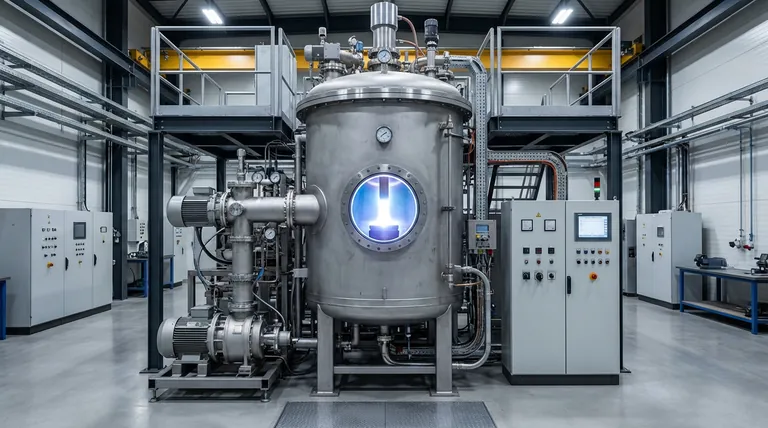
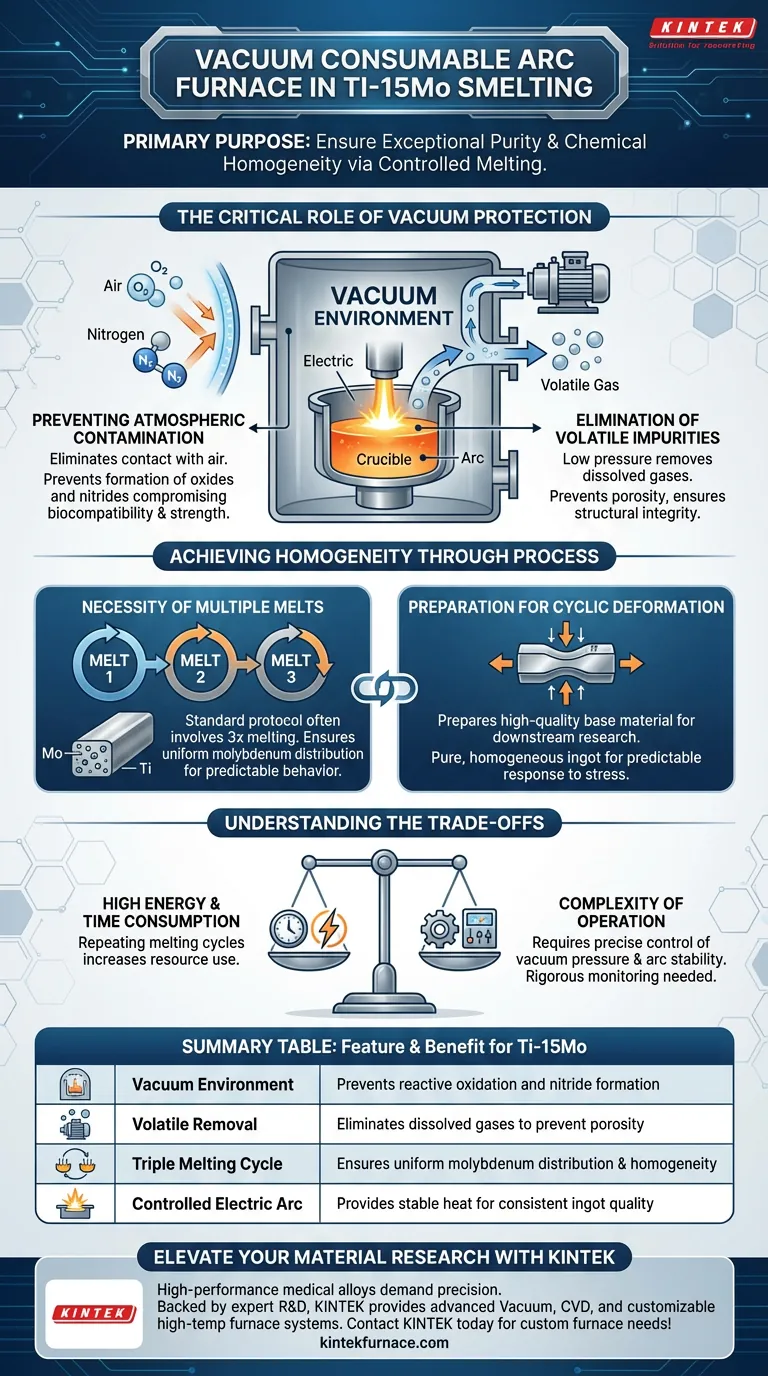
The primary purpose of using a Vacuum Consumable Arc Furnace in the production of Ti-15Mo medical alloys is to ensure exceptional purity and chemical homogeneity through a controlled melting process. By utilizing an electric arc within a vacuum, this equipment prevents the titanium from reacting with the atmosphere while actively removing volatile impurities, establishing a high-quality foundation for medical applications.
Medical-grade alloys require strict adherence to safety and performance standards. The Vacuum Consumable Arc Furnace addresses this by isolating the melt from atmospheric contamination and employing repeated melting cycles to guarantee a chemically uniform, defect-free material.
The Critical Role of Vacuum Protection
Preventing Atmospheric Contamination
Titanium and its alloys are highly reactive elements, particularly at the elevated temperatures required for smelting. Without protection, titanium can undergo violent reactions with oxygen and nitrogen in the air.
The Vacuum Consumable Arc Furnace operates in a strict vacuum environment. This eliminates contact with air, preventing the formation of oxides and nitrides that would otherwise compromise the alloy's biocompatibility and mechanical strength.
Elimination of Volatile Impurities
Beyond simply shielding the metal, the vacuum plays an active purification role. The low-pressure environment facilitates the removal of volatile impurity gases.
Under these conditions, dissolved gases are drawn out of the molten metal. This reduction in dissolved gas content is essential for preventing porosity and ensuring the structural integrity of the final ingot.
Achieving Homogeneity Through Process
The Necessity of Multiple Melts
A single melt is rarely sufficient to achieve the strict uniformity required for medical devices. The standard protocol for Ti-15Mo often involves repeating the melting process, typically three times.
This repetition ensures that the molybdenum is evenly distributed throughout the titanium matrix. High chemical uniformity is non-negotiable, as inconsistent composition can lead to unpredictable mechanical behavior in the human body.
Preparation for Cyclic Deformation
The ultimate goal of this smelting process is to produce a high-quality base material suitable for downstream processing. The primary reference highlights that this specific furnace prepares the alloy for subsequent cyclic deformation research.
By starting with a pure, homogeneous ingot, researchers and manufacturers ensure that the material responds predictably to physical stress and shaping.
Understanding the Trade-offs
High Energy and Time Consumption
While the Vacuum Consumable Arc Furnace yields superior results, it is a resource-intensive process. Repeating the melting cycle three times significantly increases energy consumption and processing time compared to single-melt methods.
Complexity of Operation
The equipment requires precise control over the vacuum pressure and the electric arc stability. Any fluctuation in the vacuum level can reintroduce contamination, meaning the process demands rigorous monitoring and maintenance of the vacuum seals and pumps.
Making the Right Choice for Your Goal
To maximize the quality of your Ti-15Mo alloy, align your processing steps with your specific material requirements:
- If your primary focus is Biocompatibility: Prioritize the vacuum integrity to ensure the complete removal of volatile gases and prevention of oxide inclusions.
- If your primary focus is Mechanical Consistency: Adhere strictly to the triple-melting protocol to guarantee the chemical uniformity required for predictable deformation.
The Vacuum Consumable Arc Furnace is not merely a melting tool; it is a purification system that transforms raw elements into a safe, reliable medical-grade material.
Summary Table:
| Feature | Benefit for Ti-15Mo Alloys |
|---|---|
| Vacuum Environment | Prevents reactive oxidation and nitride formation |
| Volatile Removal | Eliminates dissolved gases to prevent material porosity |
| Triple Melting Cycle | Ensures uniform molybdenum distribution and homogeneity |
| Controlled Electric Arc | Provides stable heat for consistent ingot quality |
Elevate Your Material Research with KINTEK
High-performance medical alloys like Ti-15Mo demand uncompromising precision. Backed by expert R&D and world-class manufacturing, KINTEK provides advanced Vacuum, CVD, and customizable high-temp furnace systems specifically designed to meet the rigorous standards of lab and industrial production. Whether you need a standard Muffle furnace or a specialized Vacuum system, our equipment ensures the chemical uniformity and purity your unique projects require.
Ready to optimize your smelting process? Contact KINTEK today to discuss your custom furnace needs!
Visual Guide
References
- Tiewei Xu, Bin-Jiang Lv. The {332}<113> Twinning Behavior of a Ti-15Mo Medical Alloy during Cyclic Deformation and Its Effect on Microstructure and Performance. DOI: 10.3390/ma17071462
This article is also based on technical information from Kintek Furnace Knowledge Base .
Related Products
- Vacuum Sealed Continuous Working Rotary Tube Furnace Rotating Tube Furnace
- 600T Vacuum Induction Hot Press Vacuum Heat Treat and Sintering Furnace
- Vacuum Hot Press Furnace Machine Heated Vacuum Press Tube Furnace
- Vacuum Heat Treat Sintering Furnace with Pressure for Vacuum Sintering
- Small Vacuum Heat Treat and Tungsten Wire Sintering Furnace
People Also Ask
- What is the purpose of rotary tube furnaces? Achieve Uniform Heat Treatment for Powders and Granules
- What are the key advantages of using a rotary tube furnace? Achieve Dynamic, Uniform Heating for Powders
- How does the amount of material processed vary between batch and continuous rotary tube furnaces? Scale Your Production Efficiently
- What are the advantages of rotary tube furnaces in fuel compatibility? Boost Efficiency and Cut Costs
- What is the temperature range of some rotary tube furnaces? Achieve Uniform Heating Up to 1200°C



















