Knowledge Why is a vacuum environment necessary for PBF-EB? Ensure Beam Precision & Material Purity
Author avatar

Tech Team · Kintek Furnace

Updated 1 day ago

Why is a vacuum environment necessary for PBF-EB? Ensure Beam Precision & Material Purity


A vacuum environment is strictly mandatory in Electron Beam Powder Bed Fusion (PBF-EB) to ensure the fundamental physics of the energy source function correctly. Without this vacuum, air molecules would obstruct the electron path, causing the beam to scatter and lose focus, while simultaneously contaminating the purity of the metal being processed.

The Core Insight The PBF-EB vacuum serves a dual role: it acts as a clear "highway" for the electron beam to travel without collision, and it functions as a shield, creating an ultra-pure environment that prevents reactive metals from absorbing gases and degrading during the melt.

The Physics of Beam Transmission

Preventing Electron Scattering

The primary mechanical reason for the vacuum is to maintain the integrity of the energy source. Electrons have mass, and as they travel from the emitter to the powder bed, they are highly susceptible to collisions.

If air molecules were present in the chamber, they would physically deflect the electrons. This scattering effect would diffuse the beam, making it impossible to focus enough energy to melt the metal powder effectively.

Ensuring Energy Density

By removing air molecules, the vacuum ensures a clear path for the electrons. This allows the system to maintain a highly focused energy beam.

This focus is critical for achieving the precise melt pool dimensions required for high-resolution additive manufacturing.

Material Integrity and Environmental Purity

Protecting Reactive Materials

Beyond beam physics, the vacuum provides an essential chemical benefit: extreme environmental purity. Many high-performance metals used in PBF-EB are highly reactive at elevated temperatures.

The primary reference highlights niobium and other superconducting materials as prime examples. These materials are incredibly sensitive to their environment.

Preventing Gas Absorption

In a standard atmosphere, or even a low-quality inert atmosphere, hot metals can absorb oxygen, nitrogen, or hydrogen. This absorption fundamentally alters the material properties.

For superconducting components, this deterioration is catastrophic. The vacuum environment prevents these gases from being absorbed, ensuring the final component retains the high performance characteristics required for specialized applications.

Understanding the Trade-offs

The Challenge of Charge Accumulation

While the vacuum enables the beam to travel, it also creates an electrical challenge. Because there is no atmosphere to help dissipate charge, electrons hitting the powder can cause charge accumulation.

If this charge builds up, it causes the "powder-blowing phenomenon," where the powder particles repel each other and scatter, ruining the build.

The Necessity of Preheating

To counteract the effects of the vacuum on the powder's electrical state, the process requires a high-power rapid scanning preheating cycle.

As noted in the supplementary data, this step partially sinters the powder before the main melt. This improves electrical conductivity, allowing the charge to dissipate safely and preventing thermal defects like cracking.

Making the Right Choice for Your Goal

The necessity of the vacuum defines the strengths and operational requirements of PBF-EB technology.

  • If your primary focus is processing superconductors (like Niobium): The vacuum is your critical asset, offering the purity required to prevent gas absorption and maintain material performance.
  • If your primary focus is beam precision: The vacuum is the enabling factor that prevents scattering, ensuring the energy density needed for successful fusion.

The vacuum is not just an empty space; it is a meticulously controlled tool that enables the processing of the world's most sensitive and high-performance metals.

Summary Table:

Factor Necessity in PBF-EB Impact on Manufacturing
Beam Transmission Prevents electron scattering Maintains high energy density and focus
Material Purity Eliminates reactive gases Prevents absorption in metals like Niobium
Process Control Enables high-temp preheating Reduces thermal stress and improves conductivity
Build Quality Manages powder stability Prevents the 'powder-blowing' phenomenon

Elevate Your Additive Manufacturing with KINTEK Precision

Maximize the potential of your PBF-EB processes with specialized thermal solutions. Backed by expert R&D and manufacturing, KINTEK offers high-performance vacuum systems and customizable lab high-temp furnaces—including Muffle, Tube, Rotary, Vacuum, and CVD systems—tailored to the unique needs of researchers and industrial manufacturers. Whether you are processing reactive superconductors or optimizing beam precision, our equipment ensures the ultra-pure environment your materials demand.

Contact KINTEK today to discuss your custom furnace needs!

Visual Guide
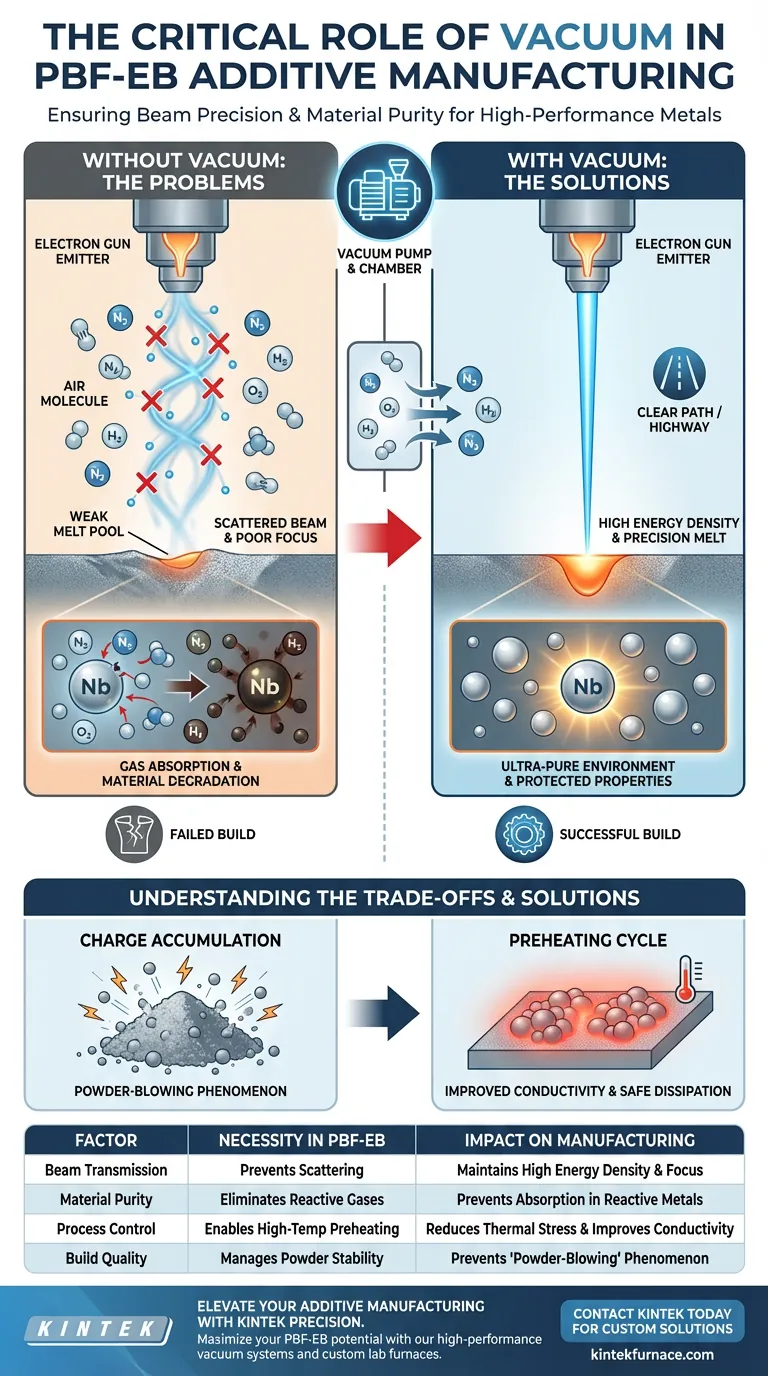
Why is a vacuum environment necessary for PBF-EB? Ensure Beam Precision & Material Purity Visual Guide

References

  1. Tobia Romano, Maurizio Vedani. Metal additive manufacturing for particle accelerator applications. DOI: 10.1103/physrevaccelbeams.27.054801

This article is also based on technical information from Kintek Furnace Knowledge Base .

Related Products

People Also Ask

Related Products

Ultra Vacuum Electrode Feedthrough Connector Flange Power Lead for High Precision Applications

Ultra Vacuum Electrode Feedthrough Connector Flange Power Lead for High Precision Applications

Ultra-Vacuum Electrode Feedthroughs for reliable UHV connections. High-sealing, customizable flange options, ideal for semiconductor & space applications.

Ultra High Vacuum Stainless Steel KF ISO CF Flange Pipe Straight Pipe Tee Cross Fitting

Ultra High Vacuum Stainless Steel KF ISO CF Flange Pipe Straight Pipe Tee Cross Fitting

KF/ISO/CF ultra-high vacuum stainless steel flange pipe systems for precision applications. Customizable, durable, and leak-tight. Get expert solutions now!

Split Chamber CVD Tube Furnace with Vacuum Station CVD Machine

Split Chamber CVD Tube Furnace with Vacuum Station CVD Machine

Split Chamber CVD Tube Furnace with Vacuum Station - High precision 1200°C lab furnace for advanced materials research. Customizable solutions available.

Small Vacuum Heat Treat and Tungsten Wire Sintering Furnace

Small Vacuum Heat Treat and Tungsten Wire Sintering Furnace

Compact vacuum tungsten wire sintering furnace for labs. Precise, mobile design with superior vacuum integrity. Ideal for advanced material research. Contact us!

Vacuum Heat Treat Sintering Furnace with Pressure for Vacuum Sintering

Vacuum Heat Treat Sintering Furnace with Pressure for Vacuum Sintering

KINTEK's Vacuum Pressure Sintering Furnace offers 2100℃ precision for ceramics, metals, and composites. Customizable, high-performance, and contamination-free. Get a quote now!

Vacuum Hot Press Furnace Machine Heated Vacuum Press Tube Furnace

Vacuum Hot Press Furnace Machine Heated Vacuum Press Tube Furnace

Discover KINTEK's advanced Vacuum Tube Hot Press Furnace for precise high-temperature sintering, hot pressing, and material bonding. Customizable solutions for labs.

Vacuum Hot Press Furnace Machine for Lamination and Heating

Vacuum Hot Press Furnace Machine for Lamination and Heating

KINTEK Vacuum Lamination Press: Precision bonding for wafer, thin-film & LCP applications. 500°C max temp, 20-ton pressure, CE certified. Custom solutions available.

304 316 Stainless Steel High Vacuum Ball Stop Valve for Vacuum Systems

304 316 Stainless Steel High Vacuum Ball Stop Valve for Vacuum Systems

KINTEK's 304/316 stainless steel vacuum ball valves and stop valves ensure high-performance sealing for industrial and scientific applications. Explore durable, corrosion-resistant solutions.

Slide PECVD Tube Furnace with Liquid Gasifier PECVD Machine

Slide PECVD Tube Furnace with Liquid Gasifier PECVD Machine

KINTEK Slide PECVD Tube Furnace: Precision thin film deposition with RF plasma, rapid thermal cycling, and customizable gas control. Ideal for semiconductors and solar cells.

MPCVD Machine System Reactor Bell-jar Resonator for Lab and Diamond Growth

MPCVD Machine System Reactor Bell-jar Resonator for Lab and Diamond Growth

KINTEK MPCVD Systems: Precision diamond growth machines for high-purity lab-grown diamonds. Reliable, efficient, and customizable for research and industry.

RF PECVD System Radio Frequency Plasma Enhanced Chemical Vapor Deposition

RF PECVD System Radio Frequency Plasma Enhanced Chemical Vapor Deposition

KINTEK RF PECVD System: Precision thin-film deposition for semiconductors, optics & MEMS. Automated, low-temperature process with superior film quality. Custom solutions available.

Inclined Rotary Plasma Enhanced Chemical Deposition PECVD Tube Furnace Machine

Inclined Rotary Plasma Enhanced Chemical Deposition PECVD Tube Furnace Machine

Advanced PECVD Tube Furnace for precise thin film deposition. Uniform heating, RF plasma source, customizable gas control. Ideal for semiconductor research.

600T Vacuum Induction Hot Press Vacuum Heat Treat and Sintering Furnace

600T Vacuum Induction Hot Press Vacuum Heat Treat and Sintering Furnace

600T Vacuum Induction Hot Press Furnace for precise sintering. Advanced 600T pressure, 2200°C heating, vacuum/atmosphere control. Ideal for research & production.

Vacuum Heat Treat Sintering and Brazing Furnace

Vacuum Heat Treat Sintering and Brazing Furnace

KINTEK Vacuum Brazing Furnaces deliver precision, clean joints with superior temperature control. Customizable for diverse metals, ideal for aerospace, medical, and thermal applications. Get a quote!

2200 ℃ Graphite Vacuum Heat Treat Furnace

2200 ℃ Graphite Vacuum Heat Treat Furnace

2200℃ Graphite Vacuum Furnace for high-temperature sintering. Precise PID control, 6*10⁻³Pa vacuum, durable graphite heating. Ideal for research & production.

Vacuum Heat Treat Sintering Furnace Molybdenum Wire Vacuum Sintering Furnace

Vacuum Heat Treat Sintering Furnace Molybdenum Wire Vacuum Sintering Furnace

KINTEK's Vacuum Molybdenum Wire Sintering Furnace excels in high-temperature, high-vacuum processes for sintering, annealing, and material research. Achieve precise 1700°C heating with uniform results. Custom solutions available.

Vacuum Heat Treat Furnace with Ceramic Fiber Liner

Vacuum Heat Treat Furnace with Ceramic Fiber Liner

KINTEK's Vacuum Furnace with Ceramic Fiber Lining offers precise high-temperature processing up to 1700°C, ensuring uniform heat distribution and energy efficiency. Ideal for labs and production.

Stainless Steel Quick Release Vacuum Chain Three Section Clamp

Stainless Steel Quick Release Vacuum Chain Three Section Clamp

Stainless steel quick release vacuum clamps ensure leak-free connections for high vacuum systems. Durable, corrosion-resistant, and easy to install.

High Pressure Laboratory Vacuum Tube Furnace Quartz Tubular Furnace

High Pressure Laboratory Vacuum Tube Furnace Quartz Tubular Furnace

KINTEK High Pressure Tube Furnace: Precision heating up to 1100°C with 15Mpa pressure control. Ideal for sintering, crystal growth, and lab research. Customizable solutions available.

2200 ℃ Tungsten Vacuum Heat Treat and Sintering Furnace

2200 ℃ Tungsten Vacuum Heat Treat and Sintering Furnace

2200°C Tungsten Vacuum Furnace for high-temperature materials processing. Precise control, superior vacuum, customizable solutions. Ideal for research & industrial applications.


Leave Your Message