
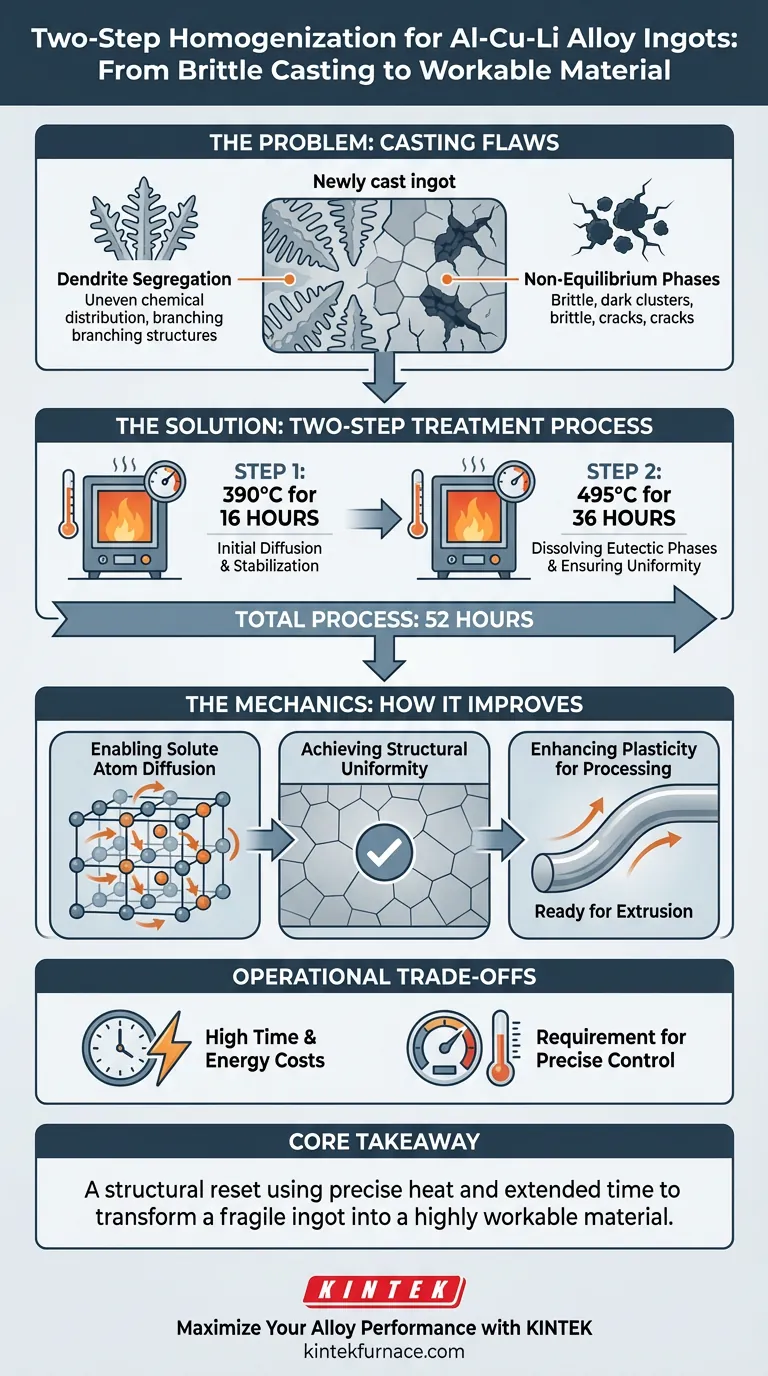
The primary purpose of a two-step homogenization furnace treatment for Al-Cu-Li alloy ingots is to correct structural irregularities created during the casting process. By subjecting the ingot to specific thermal stages, such as 390°C for 16 hours followed by 495°C for 36 hours, the treatment eliminates non-equilibrium eutectic phases and dendrite segregation. This ensures the material achieves the necessary uniformity and plasticity to survive subsequent mechanical processing, such as extrusion.
Core Takeaway Casting naturally leaves Al-Cu-Li alloys with a brittle, uneven internal structure. The two-step homogenization process acts as a structural reset, utilizing precise heat and extended time to diffuse solute atoms, thereby transforming a fragile ingot into a highly workable material ready for extrusion.
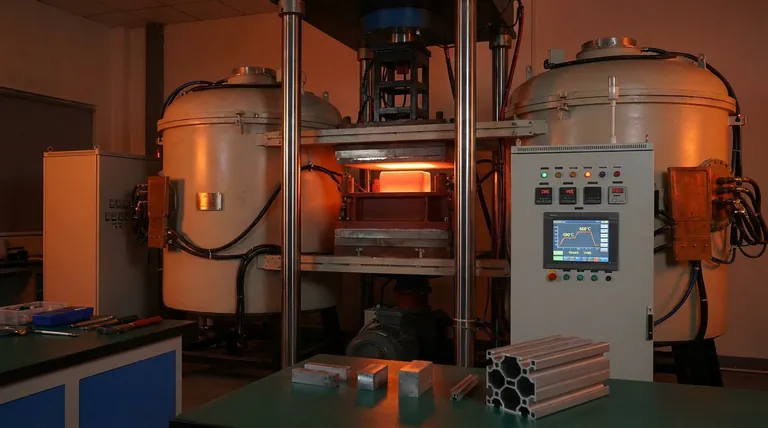
Addressing the Flaws of Casting
Eliminating Dendrite Segregation
When Al-Cu-Li alloys are cast, the cooling process is rarely perfectly uniform. This leads to dendrite segregation, where chemical elements distribute unevenly across the metal's grain structure.
The two-step treatment targets these segregated areas. It forces the material to re-balance, ensuring a consistent chemical composition throughout the ingot.
Dissolving Non-Equilibrium Phases
Casting often results in the formation of non-equilibrium eutectic phases. These are brittle structures that can compromise the integrity of the alloy.
The specific thermal regimen is designed to dissolve these unwanted phases back into the solid solution. This eliminates potential fracture points within the metal.
The Mechanics of Improvement
Enabling Solute Atom Diffusion
The effectiveness of this treatment relies on extended soaking times (e.g., 52 hours total in the cited example).
Holding the ingot at high temperatures provides the energy required for solute atoms to move. This diffusion process allows atoms to migrate from areas of high concentration to areas of low concentration.
Achieving Structural Uniformity
The ultimate goal of diffusion is a highly uniform internal microstructure.
Instead of a chaotic mix of brittle phases and segregated elements, the ingot becomes a homogeneous solid. This uniformity is critical for consistent performance in finished parts.
Enhancing Plasticity for Processing
A uniform structure directly translates to improved plasticity.
Without this treatment, the ingot would likely crack or fail under the high stress of extrusion. The homogenization process softens the alloy sufficiently to allow for successful deformation.
Understanding the Operational Trade-offs
High Time and Energy Costs
The two-step process described requires significant resources, specifically an extended soaking time totaling over 50 hours.
This represents a major bottleneck in production throughput and a substantial energy cost compared to single-step or shorter treatments.
Requirement for Precise Control
The reference highlights the need for precise temperature control (e.g., distinct steps at 390°C and 495°C).
Fluctuations in furnace temperature can fail to dissolve the eutectic phases or, conversely, overheat the alloy. This necessitates advanced furnace equipment and strict process monitoring.
Making the Right Choice for Your Goal
To determine if this rigorous treatment is required for your specific application, consider your downstream processing needs:
- If your primary focus is Extrusion Viability: You must implement the full two-step cycle to ensure the ingot has sufficient plasticity to prevent cracking during deformation.
- If your primary focus is Microstructural Consistency: You should prioritize the extended soaking times to guarantee the complete diffusion of solute atoms and the elimination of segregation.
The two-step homogenization is not merely a heating cycle; it is a critical conditioning phase that dictates the manufacturability of the alloy.
Summary Table:
| Stage | Temperature | Duration | Primary Objective |
|---|---|---|---|
| Step 1 | 390°C | 16 Hours | Initial diffusion and stabilization of structure |
| Step 2 | 495°C | 36 Hours | Dissolving eutectic phases & ensuring uniformity |
| Total Process | N/A | 52 Hours | Achieving maximum plasticity for extrusion |
Maximize Your Alloy Performance with KINTEK
Don't let structural irregularities compromise your material integrity. Backed by expert R&D and manufacturing, KINTEK offers high-precision Muffle, Tube, Rotary, Vacuum, and CVD systems designed to handle the rigorous 50+ hour soaking cycles required for Al-Cu-Li homogenization. Our lab high-temp furnaces are fully customizable to meet your unique thermal processing needs, ensuring perfect temperature control and structural uniformity every time.
Ready to elevate your extrusion success? Contact us today to find your custom furnace solution!
Visual Guide
References
- Meiqi Wang, Baiqing Xiong. Influence of Zn Addition on the Aging Precipitate Behavior and Mechanical Properties of Al-Cu-Li Alloy. DOI: 10.3390/ma17071562
This article is also based on technical information from Kintek Furnace Knowledge Base .
Related Products
- 1400℃ High Temperature Laboratory Tube Furnace with Alumina Tube
- Laboratory Quartz Tube Furnace RTP Heating Tubular Furnace
- 1700℃ High Temperature Laboratory Tube Furnace with Alumina Tube
- Multi Zone Laboratory Quartz Tube Furnace Tubular Furnace
- Vertical Laboratory Quartz Tube Furnace Tubular Furnace
People Also Ask
- How do high-temperature laboratory tube furnaces ensure environmental stability? Precision Thermal Reduction Tips
- How are high-temperature laboratory tube furnaces applied in long-term vacuum homogenization heat treatments for intermetallic samples?
- What is the function of a furnace in CuAlMn alloy treatment? Achieve Perfect Microstructural Homogenization
- How does a laboratory high-temperature tube furnace contribute to the conversion of electrospun fibers? Expert Insights
- What is the mechanism of a high-temperature furnace in Bi-2223 sintering? Achieve Precision Phase Transformation








