
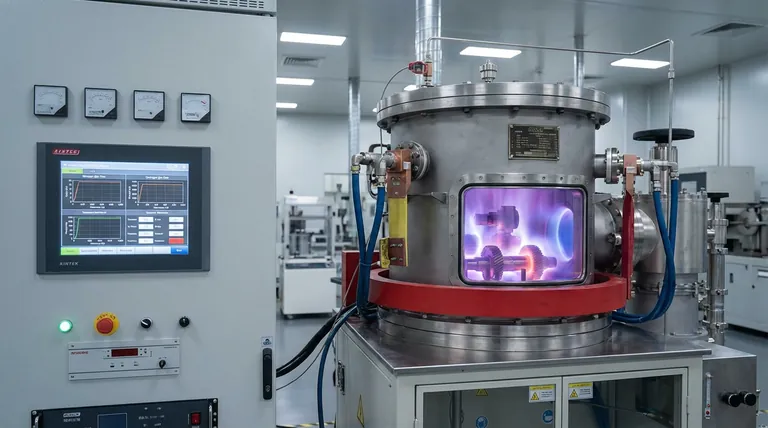
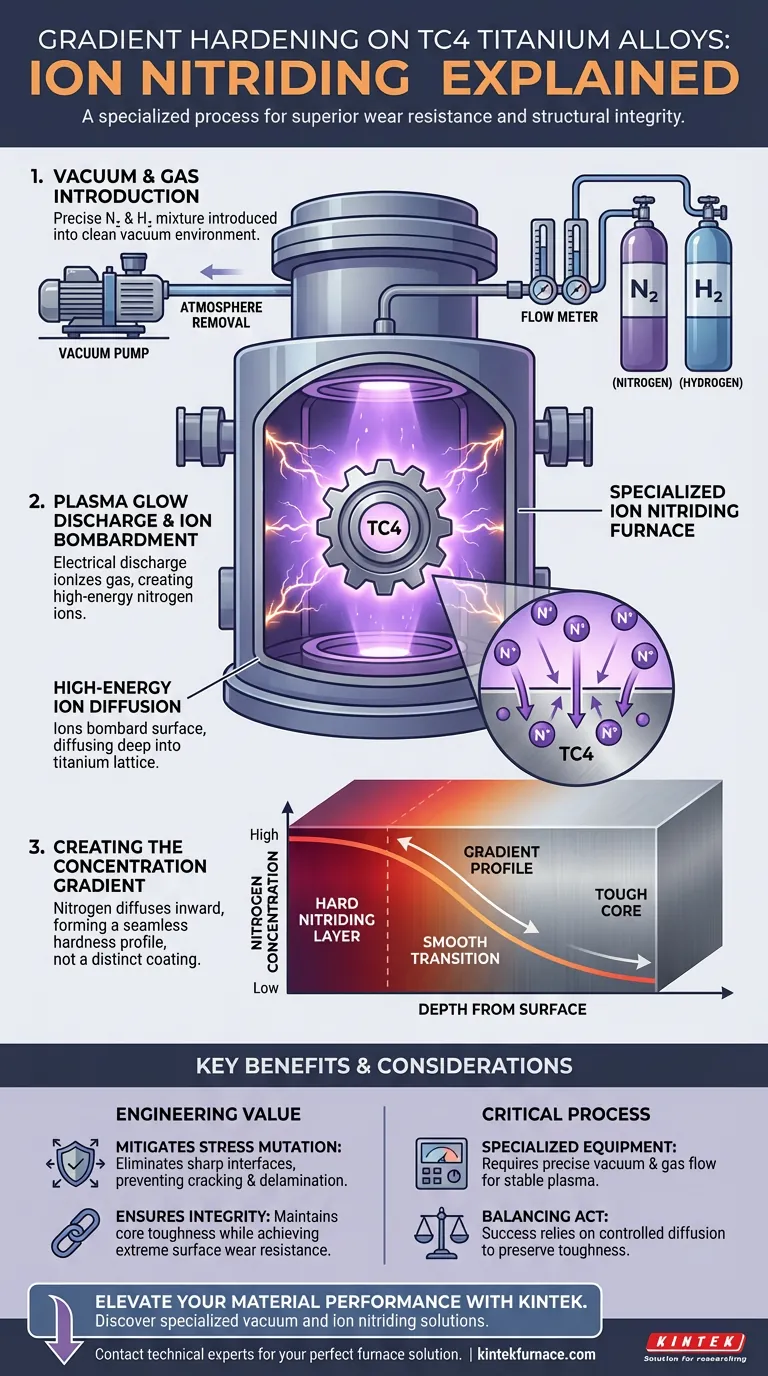
A specialized ion nitriding furnace achieves gradient hardening by introducing a controlled mixture of nitrogen and hydrogen gases into a vacuum environment. This setup utilizes plasma glow discharge to generate high-energy nitrogen ions that bombard the TC4 titanium alloy surface. Instead of merely coating the material, these ions diffuse into the substrate, creating a seamless nitrogen concentration gradient that hardens the surface from within.
The core value of this process lies in its ability to create a hardening profile that gradually transitions from a hard surface to the original substrate. This gradient structure effectively eliminates abrupt stress changes, preserving the alloy's structural toughness while significantly enhancing wear resistance.
The Mechanics of Plasma Diffusion
Establishing the Vacuum Environment
The process begins by securing the TC4 titanium alloy within a specialized furnace. The chamber is evacuated to create a vacuum, ensuring a clean environment free of atmospheric contaminants.
Introducing the Gas Mixture
Once the vacuum is established, a precise mixture of nitrogen and hydrogen gases is introduced. This specific gas composition is the raw material necessary for the hardening chemical reaction.
Generating Glow Discharge
The furnace initiates a plasma glow discharge within the gas mixture. This electrical phenomenon ionizes the gas, creating a high-energy plasma field surrounding the titanium components.
Ion Bombardment and Diffusion
Positively charged nitrogen ions are accelerated by the electrical field and bombard the TC4 surface with significant energy. These ions do not stop at the surface; they penetrate and diffuse deep into the titanium lattice.
The Engineering Value of Gradient Hardening
Creating a Concentration Gradient
As the nitrogen ions diffuse inward, they form a nitriding layer characterized by a specific distribution profile. The nitrogen concentration is highest at the surface and gradually decreases as it reaches deeper into the material.
Mitigating Stress Mutation
A critical advantage of this technique is the mitigation of stress mutation. In traditional coatings, a sharp interface between a hard shell and a soft core can lead to cracking or delamination.
Ensuring Structural Integrity
Because the hardening is a gradient rather than a distinct layer, there is no abrupt disconnect in mechanical properties. This allows the TC4 alloy to maintain its overall toughness and ductility, even though the surface is extremely hard.
Critical Process Considerations
Dependence on Specialized Equipment
Achieving this specific gradient requires a furnace capable of maintaining a stable vacuum and precise gas flow controls. Standard heat treatment ovens cannot generate the plasma glow discharge required for ion bombardment.
Balancing Hardness and Toughness
The success of the process relies on the diffusion mechanism. If the ions do not diffuse correctly, the gradient will not form, and the benefits regarding stress mutation and toughness preservation will be lost.
Making the Right Choice for Your Goal
To maximize the performance of your TC4 titanium alloy components, consider how this process aligns with your specific engineering requirements.
- If your primary focus is surface durability: Utilize this process to maximize surface hardness through high nitrogen concentration without risking coating delamination.
- If your primary focus is structural integrity: rely on the gradient diffusion to prevent stress risers and maintain the core toughness essential for load-bearing applications.
By integrating the hard surface directly into the substrate, you achieve a material that is both wear-resistant and structurally sound.
Summary Table:
| Process Phase | Action | Outcome |
|---|---|---|
| Vacuum Setup | Evacuation of chamber | Eliminates contaminants for pure reaction |
| Plasma Generation | Glow discharge of $N_2$ & $H_2$ | Creates high-energy nitrogen ions |
| Ion Bombardment | Kinetic energy diffusion | Nitrogen penetrates the titanium lattice |
| Gradient Formation | Concentration distribution | Transitions hardness smoothly to the core |
| Final Result | Structural integration | Eliminates stress mutation and delamination |
Elevate Your Material Performance with KINTEK
Is your application demanding extreme wear resistance without sacrificing structural toughness? KINTEK provides industry-leading specialized vacuum and ion nitriding solutions tailored for advanced alloys like TC4. Backed by expert R&D and precision manufacturing, we offer a comprehensive range of Muffle, Tube, Rotary, Vacuum, and CVD systems, all fully customizable to meet your unique metallurgical needs.
Don't settle for surface-level coatings—achieve deep, gradient hardening with equipment designed for precision. Contact our technical experts today to find your perfect furnace solution!
Visual Guide
References
- Hongyu Li, Shusheng Xu. Enhanced Friction and Wear Properties of TiN/MoS2 Composite Coating on the Surface of Plasma Nitrided Ti6Al4V Alloy. DOI: 10.3390/lubricants13010037
This article is also based on technical information from Kintek Furnace Knowledge Base .
Related Products
- 1200℃ Controlled Inert Nitrogen Atmosphere Furnace
- 1400℃ Controlled Inert Nitrogen Atmosphere Furnace
- 2200 ℃ Tungsten Vacuum Heat Treat and Sintering Furnace
- 1700℃ Controlled Inert Nitrogen Atmosphere Furnace
- Controlled Inert Nitrogen Hydrogen Atmosphere Furnace
People Also Ask
- What are the operational considerations for a controlled atmosphere furnace? Master Key Factors for Material Processing
- What are the advantages of a controlled atmosphere furnace over tube furnaces? Superior Process Control for Sensitive Materials
- Why is uniform atmosphere flow important in a controlled atmosphere furnace? Ensure Consistent Results and Avoid Costly Failures
- What factors should be considered when choosing a controlled atmosphere furnace? Ensure Optimal Performance for Your Materials
- What are the operational advantages of using a controlled atmosphere furnace? Boost Quality and Efficiency in Heat Treatment





