
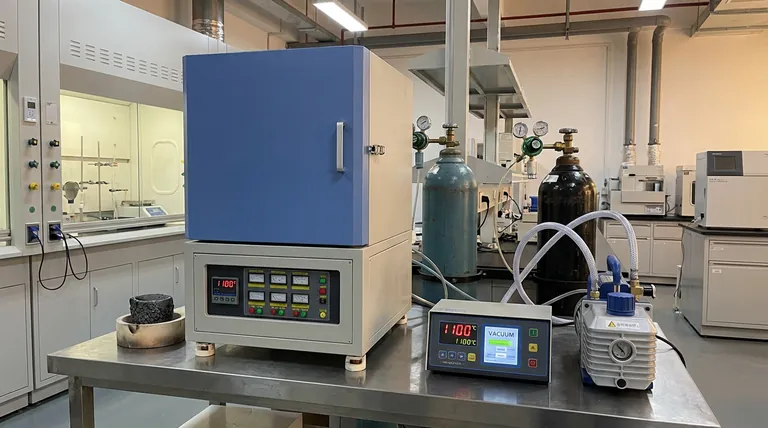
Atmosphere control determines the chemical integrity of low alloy steel during the homogenization annealing process. By utilizing a vacuum or inert environment within a tube or muffle furnace, you actively prevent surface oxidation and decarburization. This protection allows the material to undergo necessary microstructural changes without suffering the surface degradation typical of air-processed metals.
By maintaining a vacuum or inert atmosphere at temperatures around 1100°C, these furnaces ensure that carbon remains within the steel matrix rather than reacting with oxygen, resulting in a compositionally uniform material.
The Mechanics of Atmosphere Control
Preventing Surface Decarburization
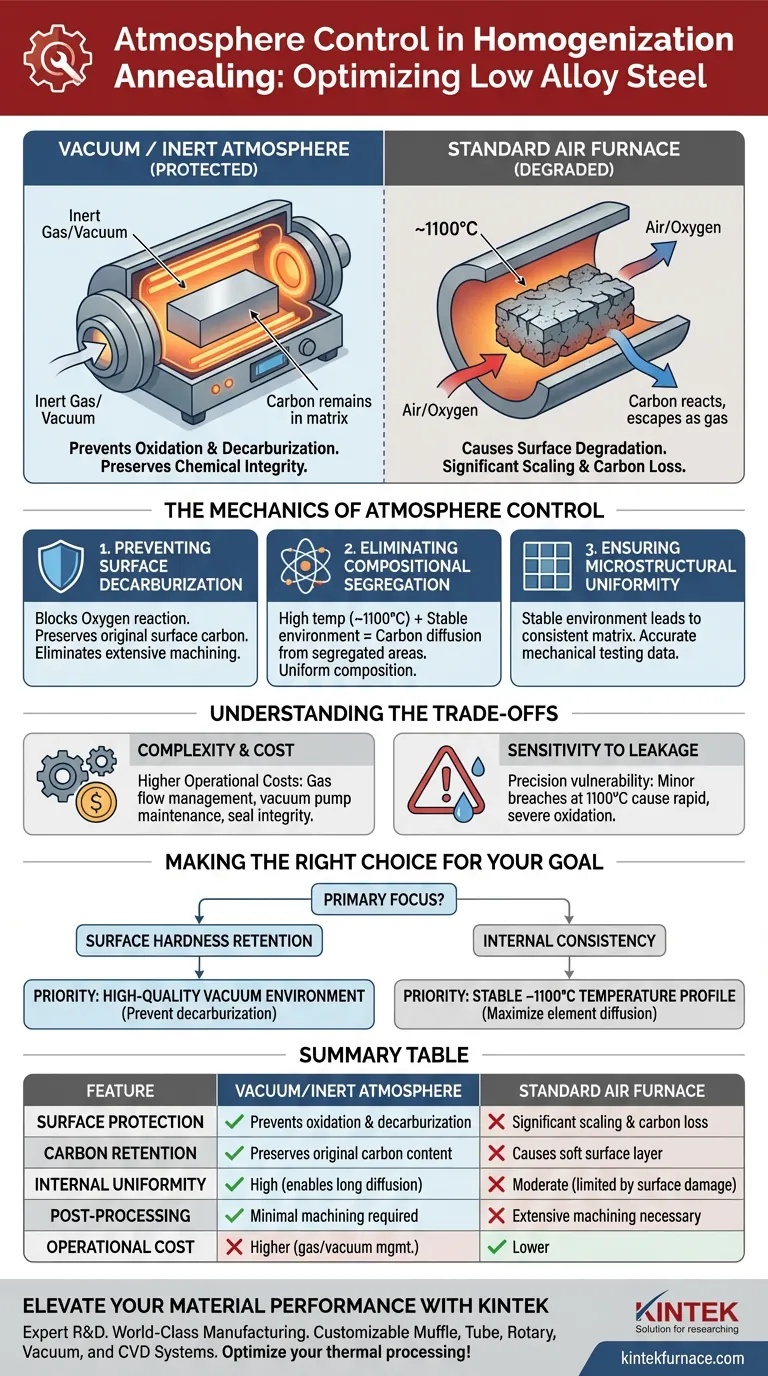
In standard air furnaces, high temperatures cause carbon atoms on the steel's surface to react with oxygen, escaping as gas. This leaves a "decarburized" layer with poor mechanical properties.
Vacuum and inert atmospheres effectively block this reaction. They preserve the steel's original carbon content right up to the surface, eliminating the need for extensive post-process machining to remove damaged layers.
Eliminating Compositional Segregation
Low alloy steels often suffer from segregation, where carbon and other elements clump together rather than spreading evenly.
Under a controlled atmosphere, you can safely hold the steel at high temperatures (approx. 1100°C) for extended periods. This thermal environment provides the necessary activation energy for carbon atoms to diffuse from segregated areas back into the main matrix.
Ensuring Microstructural Uniformity
The ultimate goal of homogenization is consistency. By removing the variable of oxidation, the furnace creates a stable environment where diffusion is the dominant physical process.
This results in a uniform microstructure throughout the cross-section of the material. A consistent matrix ensures that subsequent mechanical testing yields accurate data regarding the steel's true properties, rather than its defects.
Understanding the Trade-offs
Process Complexity and Cost
While air annealing is simple, operating under vacuum or inert gas adds significant variables. You must manage gas flow rates, vacuum pump maintenance, and seal integrity, which increases operational costs.
Sensitivity to Leakage
The precision of this process is also its vulnerability. At 1100°C, even a minor breach in the vacuum seal or a contaminant in the inert gas supply can lead to rapid, severe oxidation, potentially ruining the entire batch.
Making the Right Choice for Your Goal
- If your primary focus is surface hardness retention: Prioritize a high-quality vacuum environment to prevent the loss of surface carbon (decarburization).
- If your primary focus is internal consistency: Ensure the furnace can maintain a stable 1100°C temperature profile to maximize the diffusion of segregated elements.
Atmosphere control transforms annealing from a simple heating process into a precision chemical preservation strategy, ensuring your low alloy steel performs exactly as designed.
Summary Table:
| Feature | Vacuum/Inert Atmosphere | Standard Air Furnace |
|---|---|---|
| Surface Protection | Prevents oxidation & decarburization | Significant scaling & carbon loss |
| Carbon Retention | Preserves original carbon content | Causes soft surface layer |
| Internal Uniformity | High (enables long diffusion times) | Moderate (limited by surface damage) |
| Post-Processing | Minimal machining required | Extensive machining necessary |
| Operational Cost | Higher (gas/vacuum management) | Lower |
Elevate Your Material Performance with KINTEK
Don't let oxidation compromise your alloy research or manufacturing. Backed by expert R&D and world-class manufacturing, KINTEK offers a comprehensive range of Muffle, Tube, Rotary, Vacuum, and CVD systems. Our high-temperature lab furnaces are fully customizable to meet your specific homogenization and annealing requirements, ensuring your low alloy steels achieve perfect microstructural uniformity every time.
Ready to optimize your thermal processing? Contact KINTEK today to discuss your custom furnace needs!
Visual Guide
References
- Guillaume Ah‐Lung, Johan Jacquemin. Effects of Melting/Casting and Thermal Treatment Surrounding Gas Phase Composition on the Properties of a Low-Alloyed Steel. DOI: 10.3390/met14121317
This article is also based on technical information from Kintek Furnace Knowledge Base .
Related Products
- Vacuum Hot Press Furnace Machine Heated Vacuum Press Tube Furnace
- Vacuum Sealed Continuous Working Rotary Tube Furnace Rotating Tube Furnace
- High Pressure Laboratory Vacuum Tube Furnace
- Laboratory Vacuum Tilt Rotary Tube Furnace Rotating Tube Furnace
- Magnesium Extraction and Purification Condensing Tube Furnace
People Also Ask
- Why use Vacuum Hot Press (VHP) for ZnS Ceramics? Achieve Superior IR Transparency and Mechanical Strength
- What safety features are incorporated in vacuum hot press furnaces? Ensure Operator and Equipment Protection
- What are the benefits of the vacuum environment system in a vacuum hot press furnace? Unlock High-Density Sintering
- What considerations guide the selection of heating elements and pressurization methods for a vacuum hot press furnace?
- What is the significance of the vacuum environment for sintering stainless steel? Unlock High-Density Purity



















