
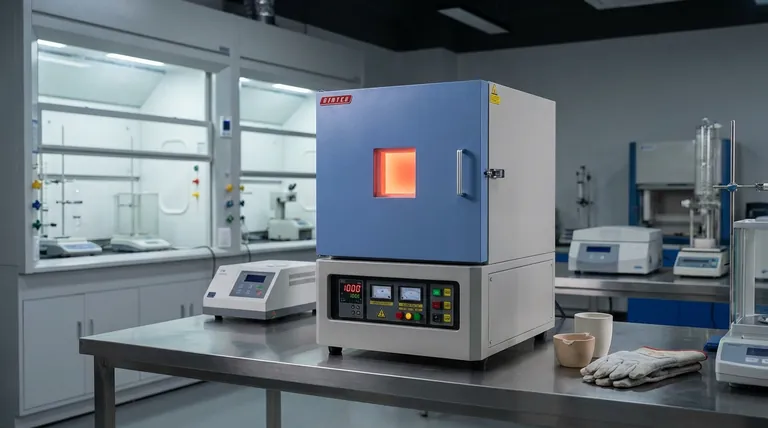
The primary purpose of using a high-temperature muffle or tube furnace in this context is to engineer the catalyst's final crystalline architecture. Specifically, for BSCF catalysts, maintaining a constant 1000 °C environment for five hours in air drives critical solid-phase reactions. This thermal treatment transforms separate metal oxides into a unified, stable cubic perovskite structure with high crystallinity.
The furnace acts as a reactor for atomic reorganization rather than simple drying. By sustaining 1000 °C, it forces metal oxides to diffuse and bond at the solid state, locking in the cubic perovskite phase essential for catalytic activity.
Driving Phase Transformation
To create a functional BSCF catalyst, you cannot simply mix ingredients; you must chemically bond them at the atomic level.
Facilitating Solid-Phase Reactions
At 1000 °C, the furnace provides the activation energy required for solid-phase reactions. Unlike liquid-phase mixing, this process allows metal oxides to interact and diffuse into one another while remaining in a solid state.
Forming the Cubic Perovskite Structure
The specific goal of this high-thermal treatment is phase purity. The extended exposure to heat ensures the complete conversion of precursors into a stable cubic perovskite structure. Without this specific crystalline arrangement, the material would lack the necessary catalytic properties.
Ensuring Material Quality
Beyond simple phase formation, the sintering process defines the physical quality and durability of the catalyst.
Achieving High Crystallinity
The furnace environment promotes high crystallinity in the catalytic active phase. A highly crystalline structure indicates a well-ordered atomic lattice, which is critical for consistent performance.
Stabilization of the Active Phase
The five-hour duration allows the material to reach thermodynamic equilibrium. This results in a robust "catalytic active phase" that is chemically stable and ready for operation, rather than a transient or metastable structure that might degrade quickly.
Understanding the Trade-offs
While high-temperature sintering is essential for BSCF formation, it introduces specific challenges that must be managed.
Risk of Grain Growth
Extended time at 1000 °C can lead to excessive grain growth or agglomeration. While you need heat to form the crystal structure, uncontrolled sintering can reduce the surface area, potentially lowering the number of exposed active sites.
Thermal Homogeneity
The effectiveness of this process relies entirely on a constant thermal environment. If the muffle or tube furnace has cold spots or fluctuates significantly, the solid-phase reactions will be incomplete, resulting in a catalyst with mixed phases and poor performance.
Making the Right Choice for Your Goal
To ensure the successful synthesis of BSCF catalysts, apply the following principles to your furnace operations:
- If your primary focus is Phase Purity: Ensure the furnace can maintain a strictly oxidizing atmosphere (air) for the full five-hour duration to facilitate complete solid-phase reactions.
- If your primary focus is Structural Stability: Verify that your furnace calibration limits temperature fluctuations at 1000 °C to prevent the formation of unstable secondary phases.
The furnace is the tool that transitions your material from a mixture of oxides into a unified, high-performance crystal lattice.
Summary Table:
| Process Objective | Mechanism at 1000 °C | Impact on BSCF Catalyst |
|---|---|---|
| Phase Transformation | Solid-phase atomic diffusion | Formation of unified cubic perovskite structure |
| Crystallinity | Thermal activation energy | Well-ordered atomic lattice for active phases |
| Structural Stability | Thermodynamic equilibrium | High chemical stability and phase purity |
| Risk Management | Controlled heating duration | Prevention of excessive grain growth/agglomeration |
Elevate Your Catalyst Synthesis with KINTEK Precision
Precise thermal homogeneity is the difference between a mixed-phase impurity and a high-performance BSCF catalyst. KINTEK provides industry-leading Muffle, Tube, Rotary, Vacuum, and CVD systems, engineered specifically to meet the rigorous demands of solid-phase reactions and high-temperature sintering.
Our customizable laboratory furnaces ensure the constant 1000 °C environment necessary for perfect cubic perovskite formation, backed by expert R&D and manufacturing. Whether you need to maintain strict oxidizing atmospheres or minimize temperature fluctuations, our equipment is built for your unique research needs.
Ready to optimize your material quality? Contact KINTEK today for a customized solution.
References
- Weijie Cao, Yoshiharu Uchimoto. Elucidation of the factors governing the oxygen evolution reaction in Ba<sub>0.5</sub>Sr<sub>0.5</sub>Co<sub><i>x</i></sub>Fe<sub>1−<i>x</i></sub>O<sub>3−<i>δ</i></sub> catalysts <i>via operando</i> hard and soft X-ray absorption spectroscopy. DOI: 10.1039/d5cy00056d
This article is also based on technical information from Kintek Furnace Knowledge Base .
Related Products
- 1800℃ High Temperature Muffle Oven Furnace for Laboratory
- High Temperature Muffle Oven Furnace for Laboratory Debinding and Pre Sintering
- 1700℃ High Temperature Muffle Oven Furnace for Laboratory
- 1400℃ Muffle Oven Furnace for Laboratory
- 1200℃ Muffle Oven Furnace for Laboratory
People Also Ask
- What is the primary function of a high-temperature laboratory muffle furnace in chemical synthesis? Achieve Precision.
- How does a high-temperature laboratory muffle furnace affect material properties? Transform Anodic Oxide Films Fast
- What is the critical role of a laboratory high-temperature muffle furnace in TiO2/LDH? Unlock Superior Crystallization
- Why is a laboratory high-temperature muffle furnace required for LaNixFe1-xO3 catalysts? Optimize Two-Stage Synthesis
- How is a laboratory high-temperature muffle furnace used to evaluate porous Co-Al materials? Precision Thermal Analysis



















