
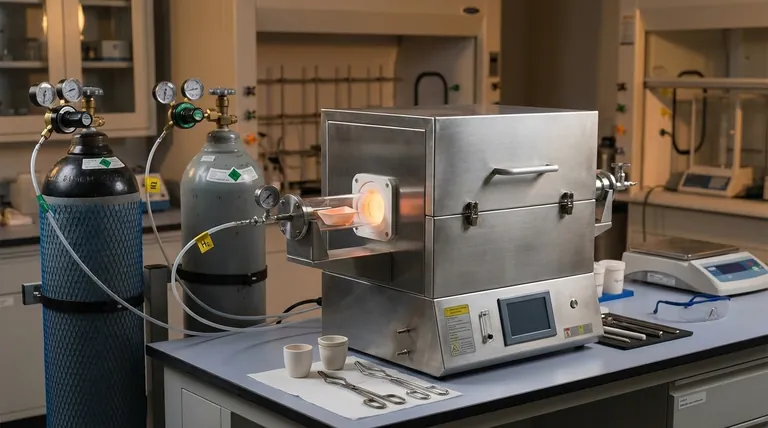
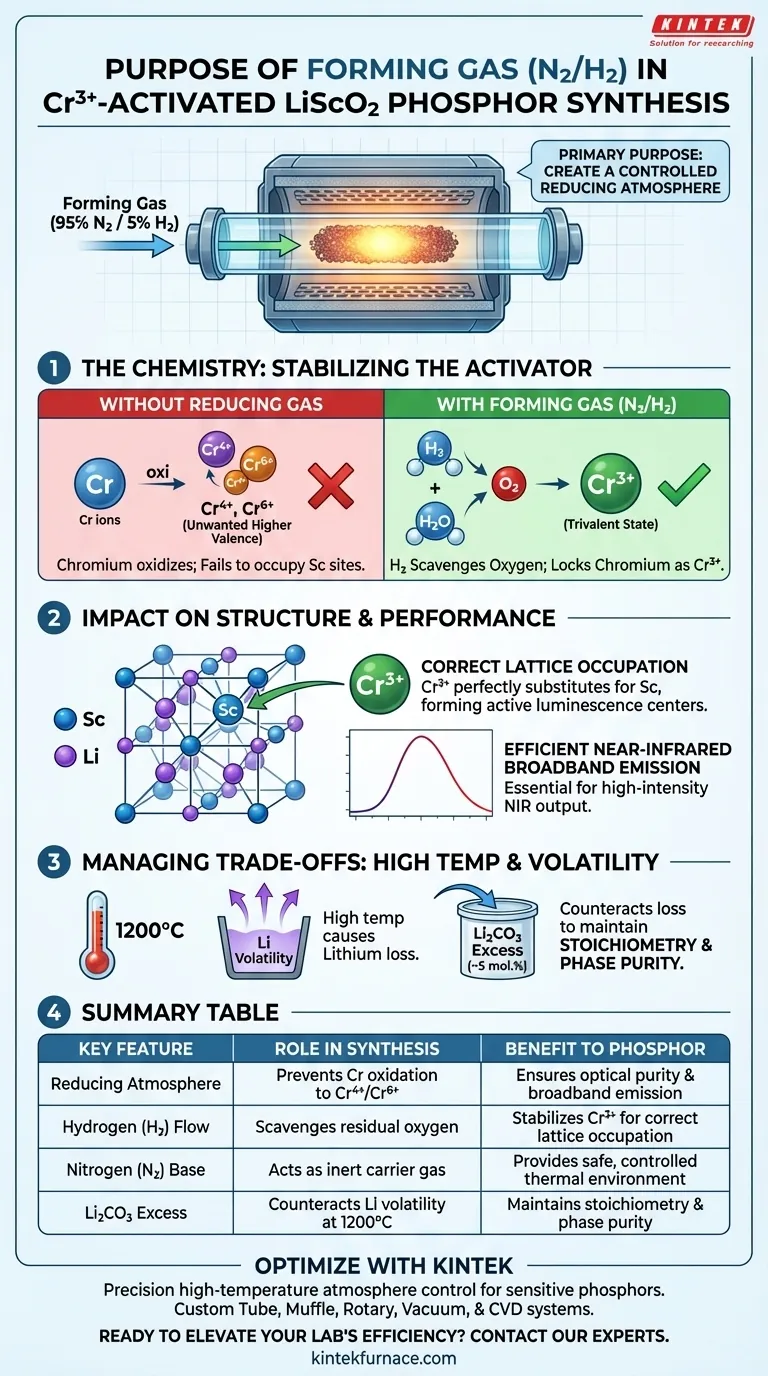
The primary purpose of using forming gas (specifically a Nitrogen/Hydrogen mix) is to create a controlled reducing atmosphere within the tube furnace. This environment is essential to chemically stabilize the Chromium activator during the high-temperature heat treatment, preventing it from reacting with oxygen to form unwanted higher valence states.
The forming gas acts as a chemical shield, ensuring the Chromium dopant remains in the trivalent state (Cr3+). This specific valence state is the only one capable of correctly occupying Scandium sites in the lattice, which is the fundamental requirement for achieving efficient near-infrared broadband emission.
The Chemistry of the Reducing Atmosphere
Preventing Unwanted Oxidation
During high-temperature synthesis, transition metals like Chromium are highly susceptible to oxidation.
Without a reducing agent, Chromium would naturally oxidize into higher valence states, specifically tetravalent (Cr4+) or hexavalent (Cr6+) ions.
Stabilizing the Trivalent State
The hydrogen component (typically 5%) in the forming gas actively scavenges residual oxygen.
This reaction forces the environment to remain reducing, locking the Chromium atoms in the critical trivalent (Cr3+) state required for this specific phosphor.
Impact on Structure and Performance
Correct Lattice Site Occupation
For the LiScO2 phosphor to function, the activator must integrate perfectly into the crystal structure.
Because Cr3+ has a specific ionic radius and charge, it is chemically suited to substitute for Scandium (Sc) ions within the host lattice.
If Chromium were allowed to oxidize to Cr4+ or Cr6+, this substitution would fail, leading to lattice defects rather than active luminescence centers.
Ensuring Optical Efficiency
The luminescence properties of the material are directly tied to the specific electronic environment of the Cr3+ ion.
By maintaining the Cr3+ state via the forming gas, you ensure the material creates stable, high-intensity near-infrared broadband emission.
Understanding the Trade-offs
High Temperature vs. Material Volatility
While high temperatures (around 1200°C) are necessary to facilitate the Cr3+ substitution, they introduce side effects that the gas alone cannot fix.
Specifically, Lithium is highly volatile at these temperatures and tends to evaporate from the material.
Managing Stoichiometry
The reducing atmosphere protects the Chromium, but it does not prevent Lithium loss.
To counter this, the synthesis requires adding approximately 5 mol.% excess Lithium Carbonate to the starting mixture.
This pre-compensation ensures the final product maintains the correct stoichiometric ratio, avoiding secondary phases that could degrade the purity guarded by the forming gas.
Making the Right Choice for Your Goal
To achieve high-quality LiScO2:Cr3+ phosphors, you must balance chemical protection with stoichiometric compensation.
- If your primary focus is Optical Purity: Ensure a consistent flow of forming gas (5% H2) to strictly prevent the formation of Cr4+ or Cr6+ species that kill luminescence.
- If your primary focus is Phase Purity: Combine the reducing atmosphere with a 5 mol.% excess of Lithium Carbonate to compensate for volatilization at 1200°C.
Mastering the atmosphere controls the activator's valence, while mastering the stoichiometry controls the host lattice's integrity.
Summary Table:
| Key Feature | Role in Synthesis | Benefit to Phosphor |
|---|---|---|
| Reducing Atmosphere | Prevents Chromium oxidation to Cr4+ or Cr6+ | Ensures optical purity and broadband emission |
| Hydrogen (H2) Flow | Scavenges residual oxygen in the furnace | Stabilizes Cr3+ ions for correct lattice occupation |
| Nitrogen (N2) Base | Acts as an inert carrier gas | Provides a safe, controlled thermal environment |
| Li2CO3 Excess | Counteracts lithium volatility at 1200°C | Maintains stoichiometry and phase purity |
Optimize Your Material Synthesis with KINTEK
Precision is paramount when managing high-temperature atmospheres for sensitive phosphors. Backed by expert R&D and manufacturing, KINTEK offers high-performance Tube, Muffle, Rotary, Vacuum, and CVD systems, all fully customizable to meet your unique research needs.
Whether you require precise forming gas control to stabilize activators or advanced thermal uniformity to manage material volatility, our laboratory furnaces provide the reliability your innovations deserve.
Ready to elevate your lab's efficiency? Contact our experts today to find your custom furnace solution!
Visual Guide
References
- Leoni Frehmeyer, Thomas Jüstel. On the optimisation of the broadband NIR emitter LiScO2:Cr3+. DOI: 10.6001/chemija.2025.36.2.5
This article is also based on technical information from Kintek Furnace Knowledge Base .
Related Products
- Vacuum Sealed Continuous Working Rotary Tube Furnace Rotating Tube Furnace
- 1400℃ High Temperature Laboratory Tube Furnace with Alumina Tube
- 1700℃ High Temperature Laboratory Tube Furnace with Alumina Tube
- High Pressure Laboratory Vacuum Tube Furnace
- Magnesium Extraction and Purification Condensing Tube Furnace
People Also Ask
- What is the purpose of rotary tube furnaces? Achieve Uniform Heat Treatment for Powders and Granules
- What are the key advantages of using a rotary tube furnace? Achieve Dynamic, Uniform Heating for Powders
- How does the amount of material processed vary between batch and continuous rotary tube furnaces? Scale Your Production Efficiently
- What are the advantages of rotary tube furnaces in fuel compatibility? Boost Efficiency and Cut Costs
- What is the temperature range of some rotary tube furnaces? Achieve Uniform Heating Up to 1200°C



















