
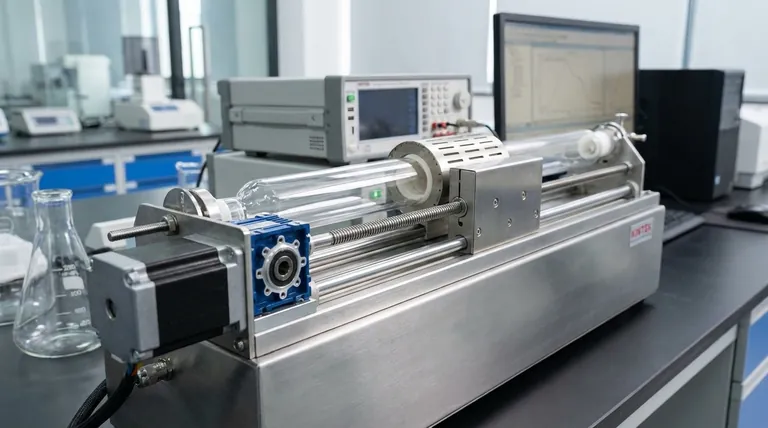
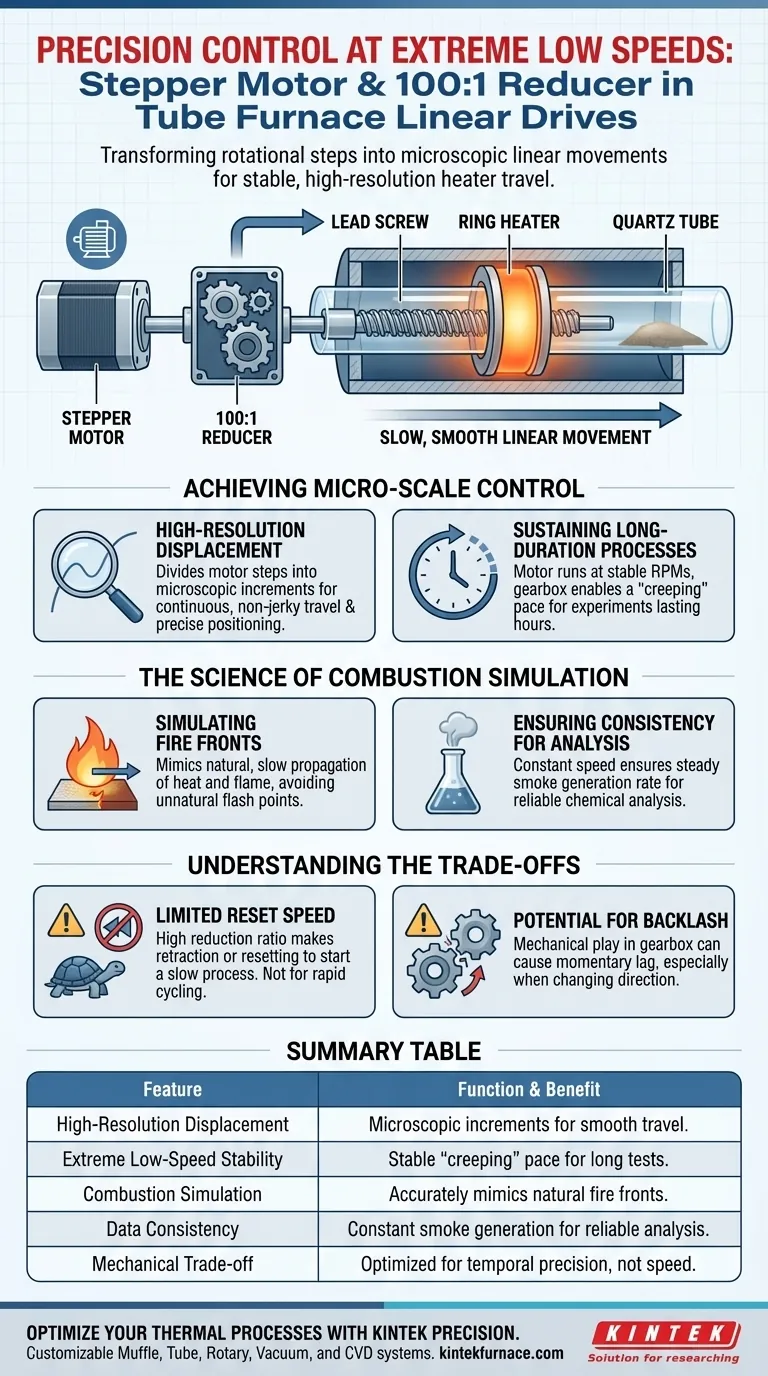
Precision control at extreme low speeds is the primary purpose of this configuration. By pairing a stepper motor with a high-ratio (100:1) reducer, the linear drive mechanism transforms standard rotational steps into microscopic linear movements, allowing the ring heater to travel along the quartz tube with exceptional stability and resolution.
The combination of a stepper motor and a 100:1 reducer is essential for temporal precision rather than raw power. It enables the physical simulation of slow-moving natural phenomena, such as advancing fire fronts, ensuring consistent combustion and smoke generation over extended periods.
Achieving Micro-Scale Control
High-Resolution Displacement
The core function of the 100:1 reducer is to divide the physical step of the motor into significantly smaller increments.
This ensures that the movement of the heater is not "stepped" or jerky, but effectively continuous. It allows for the precise positioning required to maintain a specific temperature gradient along the tube.
Sustaining Long-Duration Processes
Combustion experiments in laboratory settings often require observation periods ranging from minutes to several hours.
Direct-drive motors struggle to maintain smooth rotation at the extremely low RPMs required for these durations. The reducer allows the motor to spin at a stable speed while the output shaft moves the heater at the necessary "creeping" pace.
The Science of Combustion Simulation
Simulating Fire Fronts
To gather accurate data, the furnace must replicate how fire naturally advances through a material.
This drive mechanism simulates a "creeping" fire front. By moving the heater slowly, the system mimics the natural propagation of heat and flame, rather than subjecting the sample to an instant, unnatural flash point.
Ensuring Consistency for Analysis
Reliable laboratory analysis depends on the consistent generation of smoke and combustion byproducts.
Any fluctuation in the heater's speed would alter the rate of combustion, leading to inconsistent data. The high gear reduction mitigates mechanical variances, ensuring the smoke generation rate remains constant for valid chemical analysis.
Understanding the Trade-offs
Limited Reset Speed
The 100:1 reduction ratio that enables precision acts as a bottleneck for rapid movement.
Retracting the heater or resetting the mechanism to the starting position is a slow process. This configuration is ill-suited for experiments requiring rapid cycling or fast positional adjustments.
Potential for Backlash
While the reducer increases resolution, gearboxes introduce the possibility of mechanical play, known as backlash.
In ultra-precise applications, this play can result in a momentary lag between the motor starting and the heater moving. While generally negligible for continuous unidirectional movement, it must be accounted for if the direction changes.
Making the Right Choice for Your Goal
This mechanism is a specialized tool designed for specific experimental parameters. Here is how to view its utility:
- If your primary focus is accurate simulation: Rely on this high-reduction setup to mimic the natural, slow timescale of environmental combustion.
- If your primary focus is data consistency: Trust the reducer to smooth out motor pulses, providing the steady-state smoke generation required for sensitive analyzers.
Ultimately, this geared assembly serves as the critical bridge between mechanical rotation and the organic timeline of natural combustion.
Summary Table:
| Feature | Function & Benefit |
|---|---|
| High-Resolution Displacement | Converts motor steps into microscopic linear increments for smooth, continuous travel. |
| Extreme Low-Speed Stability | Allows the motor to run at stable RPMs while achieving a "creeping" pace for long-duration tests. |
| Combustion Simulation | Accurately mimics natural fire front propagation for realistic thermal gradients. |
| Data Consistency | Ensures a constant rate of smoke generation and byproducts for reliable chemical analysis. |
| Mechanical Trade-off | Optimized for temporal precision over raw speed; best suited for unidirectional movement. |
Optimize Your Thermal Processes with KINTEK Precision
Precise control is the difference between a successful simulation and inconsistent data. At KINTEK, we specialize in high-performance thermal solutions designed for the most demanding research environments. Backed by expert R&D and world-class manufacturing, we offer a comprehensive range of Muffle, Tube, Rotary, Vacuum, and CVD systems—all fully customizable to meet your specific linear drive and temperature gradient requirements.
Whether you need ultra-low speed stability for combustion research or high-temperature uniformity for material synthesis, our engineers are ready to tailor a system for your unique needs. Contact us today to discuss your project and see how KINTEK’s advanced laboratory furnaces can elevate your experimental accuracy.
Visual Guide
References
- Casey Coffland, Elliott T. Gall. An open-source linear actuated-quartz tube furnace with programmable ceramic heater movement for laboratory-scale studies of combustion and emission. DOI: 10.2139/ssrn.5687995
This article is also based on technical information from Kintek Furnace Knowledge Base .
Related Products
- Split Chamber CVD Tube Furnace with Vacuum Station CVD Machine
- Vertical Laboratory Quartz Tube Furnace Tubular Furnace
- Slide PECVD Tube Furnace with Liquid Gasifier PECVD Machine
- Vacuum Sealed Continuous Working Rotary Tube Furnace Rotating Tube Furnace
- Custom Made Versatile CVD Tube Furnace Chemical Vapor Deposition CVD Equipment Machine
People Also Ask
- What role does a Tube Furnace play in the CVD growth of carbon nanotubes? Achieve High-Purity CNT Synthesis
- What are the advantages of using a CVD tube furnace for preparing gate dielectrics? Achieve High-Quality Thin Films for Transistors
- What are the operational and maintenance requirements for a CVD tube furnace? Ensure Precision for Thin Film Deposition
- How does a CVD tube furnace achieve high purity in gate media preparation? Master Precision Control for Flawless Films
- What are the key application fields of CVD tube furnaces? Unlock Precision in Thin-Film Synthesis



















