
The primary purpose of maintaining high-purity argon gas at a specific pressure during vacuum induction melting (VIM) is to actively suppress the carbon-oxygen reaction within the molten steel. By maintaining an atmosphere of approximately 30,000 Pa, you create a counter-pressure that prevents excessive carbon loss, ensuring the alloy retains its precise chemical composition.
The core function of the argon atmosphere is to act as a chemical stabilizer. While the vacuum removes unwanted gases, the argon pressure provides a necessary "lid" that stops carbon from reacting with oxygen and boiling off, locking in the material's critical properties.
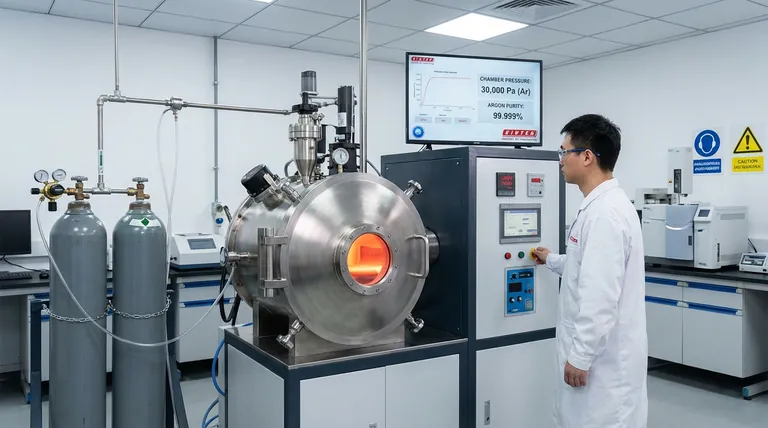
The Mechanics of Atmosphere Control
Suppressing the Carbon-Oxygen Reaction
In a pure vacuum environment, oxygen and carbon within the steel have a high tendency to react, forming carbon monoxide gas that escapes the melt.
While this reaction is sometimes desired for deoxidation, unchecked vacuum exposure leads to excessive carbon loss.
Introducing argon suppresses this reaction, preserving the carbon content required for the steel’s intended mechanical grade.
The Role of Partial Pressure
The specific pressure mentioned—approximately 30,000 Pa—is critical for balancing the partial pressure above the melt.
This pressure level is sufficient to counteract the internal pressure of the carbon-oxygen reaction without re-introducing contaminants.
It essentially forces the chemistry to stabilize, preventing the elements from separating or evaporating during the final stages of melting.
Preventing Impurity Intrusion
Beyond stabilizing carbon, the argon atmosphere acts as a shield during the final processing steps.
It prevents the intrusion of impurity elements that might otherwise enter the melt if the vacuum integrity fluctuated or if interactions with the crucible occurred.
This ensures the homogeneity and cleanliness of the final ingot.
Understanding the Trade-offs
Vacuum vs. Pressure
The VIM process relies on a delicate balance between vacuum (for removal) and pressure (for retention).
Relying solely on deep vacuum eliminates atmospheric contaminants like nitrogen and oxygen, but risks depleting volatile alloying elements and carbon.
Conversely, introducing argon stops this depletion but halts the degassing process.
Precision Timing
The introduction of argon must be timed precisely.
If introduced too early, you may trap oxygen or nitrogen that the vacuum was meant to remove.
If introduced too late, the carbon content may have already dropped below specification, requiring costly adjustments.
Making the Right Choice for Your Goal
To maximize the quality of your steel production, apply the argon protocol based on your specific metallurgical targets:
- If your primary focus is Compositional Accuracy: Introduce high-purity argon at 30,000 Pa specifically to halt the carbon-oxygen reaction once the desired carbon level is reached.
- If your primary focus is Purity and Inclusion Removal: Maintain a high vacuum for the majority of the melt to eliminate atmospheric gases, using argon only in the final stages to stabilize the melt before pouring.
Success in vacuum induction melting comes not just from removing air, but from knowing exactly when to replace it with a controlled, inert environment.
Summary Table:
| Feature | Function in VIM Process | Impact on Steel Quality |
|---|---|---|
| Argon Pressure (30,000 Pa) | Counteracts carbon-oxygen reaction pressure | Prevents excessive carbon loss |
| Inert Atmosphere | Acts as a chemical stabilizer/shield | Prevents impurity intrusion and oxidation |
| Partial Pressure Control | Balances internal melt reactions | Locks in precise chemical specifications |
| Strategic Timing | Balances vacuum degassing vs. retention | Ensures high homogeneity and cleanliness |
Achieve Unmatched Metallurgical Precision with KINTEK
Don't let volatile carbon loss compromise your steel's integrity. At KINTEK, we understand that success in vacuum induction melting requires more than just a vacuum—it requires precise control and expert engineering.
Backed by industry-leading R&D and manufacturing, we provide high-performance Muffle, Tube, Rotary, Vacuum, and CVD systems, all fully customizable to meet your unique lab or production requirements. Whether you are refining alloys or developing new materials, our high-temperature furnace solutions offer the stability and cleanliness your research demands.
Ready to optimize your thermal processes? Contact KINTEK today for a customized consultation!
References
- Jun Liu, Xikou He. Effect of Ce-Y Composite Addition on the Inclusion Evolution in T91 Heat-Resistant Steel. DOI: 10.3390/ma18071459
This article is also based on technical information from Kintek Furnace Knowledge Base .
Related Products
- Vacuum Induction Melting Furnace
- 600T Vacuum Induction Hot Press Vacuum Heat Treat and Sintering Furnace
- Small Vacuum Heat Treat and Tungsten Wire Sintering Furnace
- Vacuum Heat Treat Sintering and Brazing Furnace
- Vacuum Heat Treat Sintering Furnace Molybdenum Wire Vacuum Sintering Furnace
People Also Ask
- What are the core functions of the High Vacuum Induction Melting (VIM) furnace? Optimize DD5 Superalloy Purification
- Why is a Vacuum Induction Melting furnace (VIM) used for Cu-Zn-Al-Sn alloys? Achieve Precision Composition Control
- What is the role of VIM and directional solidification in aero-engine blade substrates? Engineering Extreme Durability
- What role does a Vacuum Induction Melting furnace play in the production of high-aluminum nickel-based superalloys?
- What are the advantages of using a VIM furnace to control residual oxygen pressure? Achieve Superior Metal Uniformity



















