
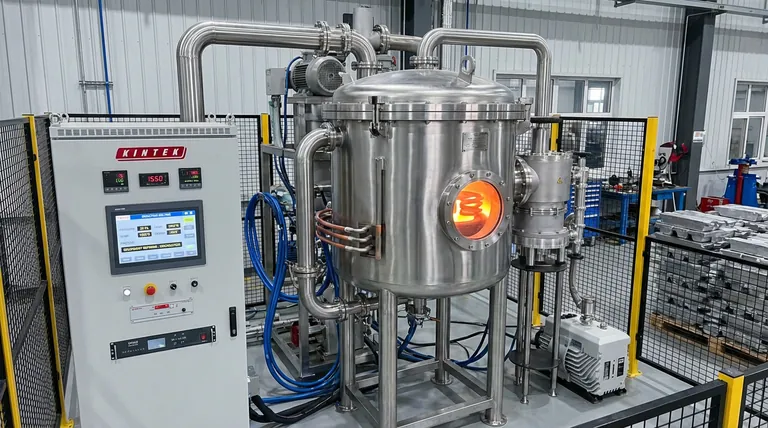
The primary role of a vacuum induction furnace (VIF) in refining M2 high-speed steel is to facilitate deep deoxidation through precise pressure manipulation. By creating a controlled environment with pressures as low as 35 Pa, the furnace fundamentally alters the chemical equilibrium of the molten bath. This shift allows carbon to react with dissolved oxygen, expelling the oxygen as gas and significantly enhancing the steel's cleanliness.
Core Insight: In the production of M2 high-speed steel, the vacuum induction furnace acts as a chemical trigger. It disrupts the carbon-oxygen equilibrium, forcing dissolved oxygen to react with carbon and escape as carbon monoxide gas, rather than remaining in the steel as solid oxide inclusions.
The Mechanism of Deep Deoxidation
The defining challenge in refining M2 high-speed steel is removing dissolved oxygen without introducing new solid impurities. The VIF addresses this by utilizing vacuum physics to drive chemical reactions.
Disrupting the Chemical Equilibrium
Under standard atmospheric pressure, carbon and oxygen can coexist in molten steel up to a certain limit. The VIF disrupts this stability by drastically reducing the environmental pressure. This change in physical conditions forces the chemical balance to shift, making the coexistence of these elements unstable.
The Critical Role of Low Pressure
To trigger the necessary reaction, the VIF must reduce the pressure to extremely low levels, specifically around 35 Pa. At this threshold, the thermodynamic conditions favor the combination of carbon and oxygen. This pressure control is the specific variable that activates the refining process.
Expelling Impurities as Gas
Once the equilibrium is broken, the carbon and oxygen react to form carbon monoxide (CO). Because the environment is under a vacuum, this CO forms as a gas and bubbles out of the liquid metal. This removes the oxygen permanently, leaving behind a purer alloy matrix.
Why M2 Steel Requires This Environment
M2 high-speed steel is a performance material that relies on structural integrity. The VIF ensures this integrity by creating conditions that standard furnaces cannot replicate.
Preventing Solid Inclusions
Standard deoxidation methods often use additives like aluminum or silicon, which react with oxygen to form solid oxides (ash) that can get trapped in the steel. The VIF process is superior because the byproduct is a gas (CO), not a solid. This results in deep deoxidation and a cleaner final microstructure.
Precision Temperature Control
Beyond pressure, the VIF allows for exact regulation of the melt temperature. Precise thermal control is essential to maintain the kinetics of the carbon-oxygen reaction. It ensures the melt remains fluid enough for gas to escape while preventing the overheating of the alloy components.
Understanding the Trade-offs
While the vacuum induction furnace provides superior cleanliness, the process relies on strict adherence to operational parameters.
Sensitivity to Vacuum Integrity
The success of this refining method is binary; it relies entirely on maintaining the vacuum at or near 35 Pa. If the pressure rises even slightly due to a leak or pump inefficiency, the carbon-oxygen equilibrium will not shift sufficiently. This would leave dissolved oxygen in the steel, compromising the material's properties.
Dependence on Carbon Content
The process utilizes the carbon already present in the steel to act as the "cleaner." This requires careful calculation of the initial carbon content to ensure there is enough to react with the oxygen, but not so much that the final alloy composition falls out of specification.
Making the Right Choice for Your Goal
When implementing secondary refining for M2 high-speed steel, your operational focus should align with the specific benefits of the VIF.
- If your primary focus is Reducing Inclusions: Prioritize the vacuum system's ability to hold a stable 35 Pa pressure to ensure oxygen is expelled as gas, not solids.
- If your primary focus is Compositional Accuracy: Leverage the furnace's precise temperature control to manage reaction kinetics without overheating the complex alloy mix.
Ultimately, the vacuum induction furnace is not just a melting vessel; it is a tool for chemical manipulation that converts detrimental oxygen into harmless gas.
Summary Table:
| Feature | Impact on M2 High-Speed Steel Refining |
|---|---|
| Pressure Control (35 Pa) | Shifts carbon-oxygen equilibrium to trigger gas-phase deoxidation. |
| Deoxidation Method | Carbon reacts with oxygen to form CO gas, preventing solid oxide inclusions. |
| Atmospheric Integrity | Deep vacuum environment eliminates nitrogen and hydrogen contamination. |
| Temperature Precision | Maintains optimal kinetics for reaction without degrading alloy components. |
| Final Quality | Produces a cleaner microstructure with superior structural integrity. |
Elevate Your Alloy Quality with KINTEK's Advanced Furnace Technology
Precision in M2 high-speed steel refining requires uncompromising control over vacuum and temperature. KINTEK provides industry-leading Vacuum Induction Furnaces (VIF), CVD systems, and customizable high-temperature lab furnaces designed to meet the rigorous demands of modern metallurgy.
Backed by expert R&D and world-class manufacturing, our systems ensure your materials achieve the deep deoxidation and chemical purity necessary for high-performance applications. Whether you need a standard setup or a tailored solution for unique research needs, KINTEK is your partner in thermal excellence.
Ready to optimize your secondary refining process? Contact our expert team today to discuss how our vacuum solutions can enhance your production outcomes.
References
- Yuheng Dai, Xicheng Wei. The Inclusion Characteristics and Mechanical Properties of M2 High-Speed Steel Treated with a Vacuum Carbon Deoxidation Process. DOI: 10.3390/met14101146
This article is also based on technical information from Kintek Furnace Knowledge Base .
Related Products
- 600T Vacuum Induction Hot Press Vacuum Heat Treat and Sintering Furnace
- Vacuum Induction Melting Furnace
- High Pressure Laboratory Vacuum Tube Furnace
- Small Vacuum Heat Treat and Tungsten Wire Sintering Furnace
- Vacuum Hot Press Furnace Machine Heated Vacuum Press Tube Furnace
People Also Ask
- Why use Vacuum Hot Press (VHP) for ZnS Ceramics? Achieve Superior IR Transparency and Mechanical Strength
- How does a vacuum hot press sintering furnace mitigate copper sintering swelling? Solve Fe-Cu Expansion Issues
- What are the key advantages of vacuum hot press sintering furnaces? Achieve Superior Density and Purity in Materials
- How does the vacuum environment in a vacuum hot press sintering furnace protect chromium-containing ceramics? Find out.
- What is the core function of a vacuum hot press sintering furnace in the preparation of high-density RuTi alloys? Achieve Maximum Density and Purity



















