
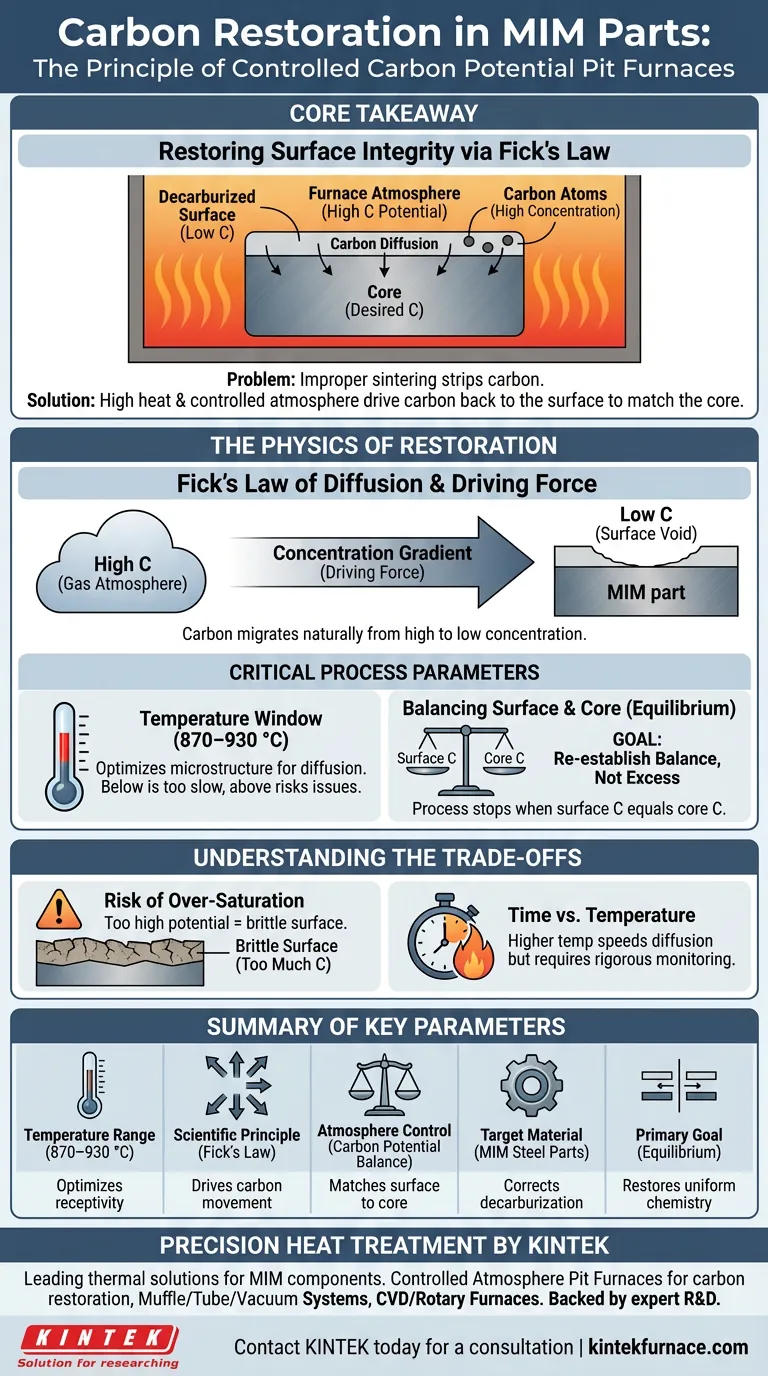
The principle behind carbon restoration in a controlled carbon potential pit furnace is the corrective application of Fick's Law of Diffusion. By exposing Metal Injection Molding (MIM) parts to a specific temperature range (870–930 °C) and a carbon-rich atmosphere, the furnace drives carbon atoms back into the steel's depleted surface layer until it reaches equilibrium with the core.
Core Takeaway: Improper sintering atmospheres can strip carbon from steel surfaces, weakening the part. A controlled carbon potential furnace uses high heat and atmospheric pressure to force carbon back into the steel, restoring the material's surface chemistry to match its internal core.
The Physics of Restoration
Fick's Law of Diffusion
The scientific foundation of this process is Fick's Law. This law dictates that particles—in this case, carbon atoms—will naturally migrate from an area of high concentration to an area of low concentration.
The Concentration Gradient
Because the MIM part has a decarburized (low carbon) surface, the furnace creates a "carbon potential" in the atmosphere that is higher than the surface but equal to the desired core specification.
Driving Force
This difference in concentration creates a driving force. Carbon atoms from the gas atmosphere penetrate the steel's surface to fill the "void" left by previous processing errors.
Critical Process Parameters
The Temperature Window
Carbon restoration requires a specific thermal environment to function correctly. The process is typically conducted between 870 and 930 °C.
Why This Range Matters
At these temperatures, the microstructure of the steel is receptive to diffusion. Below this range, diffusion is too slow; significantly above it, you risk other metallurgical issues.
Balancing Surface and Core
The ultimate goal is not to add excess carbon (which would be carburizing), but to re-establish a balance. The process stops when the carbon content at the surface equals the carbon content at the core.
Understanding the Trade-offs
Risk of Over-Saturation
Precise control of the atmosphere is non-negotiable. If the carbon potential in the furnace is set too high, you will overshoot the target, resulting in a brittle surface with too much carbon.
Time vs. Temperature
While higher temperatures within the 870–930 °C range speed up diffusion, they also require more rigorous monitoring to prevent grain growth or distortion in the MIM parts.
Making the Right Choice for Your Goal
To effectively utilize a pit furnace for carbon restoration, you must align the process with your quality requirements.
- If your primary focus is correcting sintering errors: Ensure the furnace's carbon potential strictly matches the specific alloy's required carbon content to avoid creating a new problem.
- If your primary focus is process efficiency: Operate closer to the 930 °C upper limit to maximize the rate of diffusion, but increase the frequency of atmosphere sampling.
Mastering this equilibrium ensures your MIM parts maintain uniform strength and hardness from the inside out.
Summary Table:
| Parameter | Specification | Purpose in Carbon Restoration |
|---|---|---|
| Temperature Range | 870 – 930 °C | Optimizes microstructure receptivity for carbon diffusion |
| Scientific Principle | Fick's Law of Diffusion | Drives carbon from high concentration (gas) to low (steel surface) |
| Atmosphere Control | Carbon Potential Balance | Matches the surface carbon content to the internal core |
| Target Material | MIM Steel Parts | Corrects decarburization caused by improper sintering atmospheres |
| Primary Goal | Equilibrium | Restores uniform surface chemistry without over-saturating |
Precision Heat Treatment for Critical MIM Components
Don't let decarburization compromise the strength and hardness of your Metal Injection Molding parts. KINTEK provides industry-leading thermal solutions designed to restore material integrity and ensure uniform quality.
Backed by expert R&D and world-class manufacturing, we offer a comprehensive range of high-temperature laboratory equipment, including:
- Controlled Atmosphere Pit Furnaces for precise carbon restoration.
- Muffle, Tube, and Vacuum Systems for versatile thermal processing.
- CVD and Rotary Furnaces tailored to advanced material synthesis.
Whether you need to correct sintering errors or optimize process efficiency, KINTEK’s customizable systems are engineered to meet your unique metallurgical needs.
Ready to elevate your material performance? Contact KINTEK today for a consultation!
Visual Guide
References
- Jorge Luis Braz Medeiros, Luciano Volcanoglo Biehl. Effect of Sintering Atmosphere Control on the Surface Engineering of Catamold Steels Produced by MIM: A Review. DOI: 10.3390/surfaces9010007
This article is also based on technical information from Kintek Furnace Knowledge Base .
Related Products
- 1200℃ Controlled Inert Nitrogen Atmosphere Furnace
- Electric Rotary Kiln Small Rotary Furnace for Activated Carbon Regeneration
- 1700℃ Controlled Inert Nitrogen Atmosphere Furnace
- Mesh Belt Controlled Atmosphere Furnace Inert Nitrogen Atmosphere Furnace
- Vacuum Induction Melting Furnace
People Also Ask
- What controlled-atmosphere furnace conditions are required for sintering powder metallurgy copper alloy compacts? Ideal Setup
- What Roles Do a Controlled Atmosphere Furnace and Oil Quenching Tank Play in AISI 5140 Steel Heat Treatment?
- How Sintering Temp Affects Density & Resistivity of Cu-Oxide Composites
- What factors should be considered when choosing a controlled atmosphere furnace? Ensure Optimal Performance for Your Materials
- How does a controlled atmosphere furnace prevent oxidation and decarburization? Master Precision Heat Treatment






