
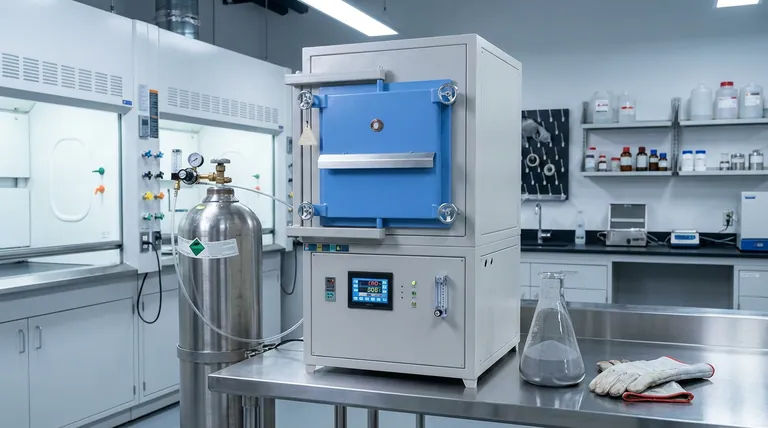
The necessity of an Argon (Ar) atmosphere lies in chemical preservation. Conducting heat treatment of maraging steel powder in a controlled Ar atmosphere is essential to prevent the oxidation of highly reactive alloying elements, specifically titanium (Ti) and aluminum (Al). By displacing oxygen with inert argon, you minimize the thickness of oxide layers on the powder surface, which is critical for successful downstream processing.
Maraging steel relies on specific alloying elements that are highly sensitive to oxygen. An argon atmosphere serves as a critical barrier, preventing the formation of thick oxide shells that would otherwise inhibit particle bonding and compromise the material's final structural density.
The Chemistry of Surface Integrity
The Vulnerability of Titanium and Aluminum
Maraging steel is distinct because it derives its strength from intermetallic precipitates involving elements like titanium (Ti) and aluminum (Al).
However, these specific elements possess a high affinity for oxygen. Without protection, they react rapidly when exposed to heat and air, fundamentally altering surface chemistry.
The Role of High-Purity Argon
An Argon atmosphere functions as a displacement mechanism.
By filling the furnace with high-purity argon, you physically remove and exclude oxygen molecules from the environment. This inert shield prevents the reactive elements in the steel from contacting oxygen during the high-temperature treatment.
Impact on Sintering and Densification
Minimizing Oxide Layer Thickness
The primary goal of using Argon is to keep the surface oxide layer as thin as possible.
If heat treatment occurs in an uncontrolled atmosphere, a thick, stable oxide shell forms around each powder particle. This shell acts as a physical contaminant and a barrier.
Enabling Optimal Interface Bonding
For maraging steel powder to be useful, particles must eventually fuse together.
A clean, minimal-oxide surface creates the necessary conditions for interface bonding. This allows the particles to merge effectively during subsequent sintering, leading to high densification and structural integrity.
Understanding the Risks and Trade-offs
The Consequence of Inadequate Atmosphere
If the atmosphere is not strictly controlled, the resulting oxidation is often irreversible.
Oxidized powder particles cannot bond properly, leading to porous, weak final parts. No amount of pressure or heat in later stages can fully correct the defects caused by a compromised surface layer.
Purity Considerations
Simply using Argon is not enough; the purity level dictates success.
Trace amounts of oxygen or moisture within low-quality Argon can still trigger oxidation in titanium and aluminum. The system requires high-purity gas to ensure the "displacement" of oxygen is near-absolute.
Optimizing Your Heat Treatment Process
To ensure you are achieving the mechanical properties maraging steel is known for, consider your specific processing goals:
- If your primary focus is Structural Strength: Prioritize high-purity Argon to preserve the Titanium and Aluminum required for precipitation hardening.
- If your primary focus is High Density: Ensure the atmosphere is strictly controlled to minimize oxide thickness, removing barriers to particle bonding during sintering.
Strict atmospheric control is not merely a precaution; it is the prerequisite for a viable metallurgical bond.
Summary Table:
| Factor | Impact of Controlled Argon Atmosphere | Consequence of Poor Atmosphere Control |
|---|---|---|
| Chemical Stability | Preserves reactive Ti and Al elements | Rapid oxidation and loss of alloying benefits |
| Oxide Layer | Maintains a minimal, thin surface layer | Forms thick, stable oxide shells around particles |
| Particle Bonding | Enables optimal interface bonding | Inhibits fusion; creates physical barriers |
| Final Density | Achieves high structural integrity | Leads to porous, weak, and brittle components |
| Reversibility | Prevents surface degradation | Causes irreversible metallurgical defects |
Maximize Material Integrity with KINTEK Solutions
Don't let oxidation compromise your advanced materials. KINTEK provides industry-leading controlled atmosphere systems, including specialized Vacuum, CVD, and High-Temp Muffle furnaces designed for the precise demands of maraging steel processing. Backed by expert R&D and manufacturing, our customizable solutions ensure high-purity argon environments that protect your reactive alloys and guarantee superior densification.
Ready to elevate your metallurgical results? Contact our experts today to find the perfect thermal processing solution for your unique laboratory or production needs.
References
- Innovative Powder Pre-Treatment Strategies for Enhancing Maraging Steel Performance. DOI: 10.3390/ma18020437
This article is also based on technical information from Kintek Furnace Knowledge Base .
Related Products
- 1200℃ Controlled Inert Nitrogen Atmosphere Furnace
- 1700℃ Controlled Inert Nitrogen Atmosphere Furnace
- 1400℃ Controlled Inert Nitrogen Atmosphere Furnace
- Mesh Belt Controlled Atmosphere Furnace Inert Nitrogen Atmosphere Furnace
- Controlled Inert Nitrogen Hydrogen Atmosphere Furnace
People Also Ask
- What controlled-atmosphere furnace conditions are required for sintering powder metallurgy copper alloy compacts? Ideal Setup
- Why is uniform atmosphere flow important in a controlled atmosphere furnace? Ensure Consistent Results and Avoid Costly Failures
- What are the four main types of controlled atmospheres used in these furnaces? Optimize Your Heat Treatment Processes
- What causes discrepancies between theoretical and experimental grain boundary mobility during ceramic sintering? Explained
- What factors should be considered when choosing a controlled atmosphere furnace? Ensure Optimal Performance for Your Materials









