
The primary objective of using Hot Isostatic Pressing (HIP) on L-PBF Ti-6Al-4V components is to eliminate internal porosity and inherent manufacturing defects to achieve near-full material density. By applying simultaneous high temperature and high pressure, HIP compacts lack-of-fusion voids, which significantly enhances the material's mechanical properties. This process is essential for maximizing high-cycle fatigue life by removing the structural weaknesses that typically serve as crack initiation sites.
While Laser Powder Bed Fusion (L-PBF) allows for complex geometries, it often leaves microscopic voids; HIP serves as a critical post-processing step that collapses these defects, effectively shifting the material's failure point from internal pores to the microstructure itself.
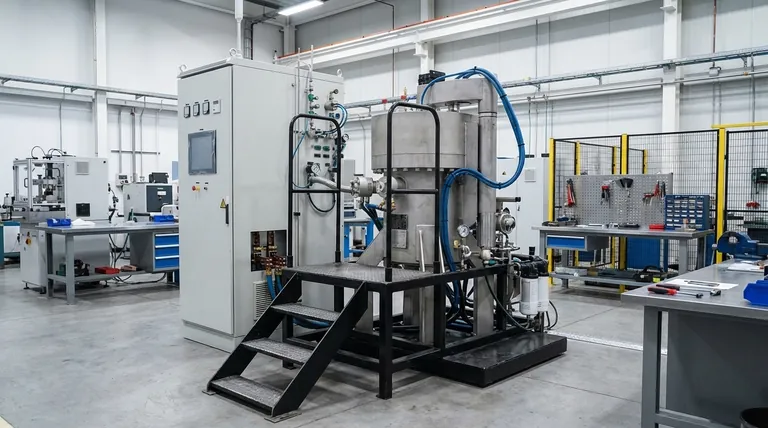
How HIP Transforms L-PBF Components
Simultaneous Heat and Pressure
The HIP process subjects components to a unique environment of elevated temperatures combined with extreme isostatic gas pressure.
While standard heat treatment relies on temperature alone, HIP introduces pressures typically ranging between 100-200 MPa, though some processes may utilize pressures as high as 300 MPa.
Eliminating Internal Voids
The central challenge with L-PBF manufacturing is the presence of "lack-of-fusion" defects and micro-pores.
These microscopic voids compromise the structural integrity of the part. The synergistic effect of heat and pressure during HIP forces these voids to close, bonding the material to achieve near-full density.
Enhancing Mechanical Performance
Shifting the Failure Mechanism
The most critical technical benefit of HIP is the alteration of how the material fails under stress.
In untreated L-PBF parts, fatigue cracks usually initiate at defect sites (pores). HIP eliminates these defects, shifting the fatigue crack initiation mechanism from being defect-driven to microstructure-driven.
Improving Fatigue Life
Because the crack initiation mechanism is no longer dictated by random voids, the high-cycle fatigue life of the alloy is substantially increased.
This reliability is paramount for aerospace or medical applications where Ti-6Al-4V is commonly used and where component failure is not an option.
Microstructural Refinement
Beyond density, HIP impacts the grain structure of the titanium alloy.
The process results in a microstructure consisting of fine, fragmented lamellar structures. This transformation improves not only fatigue strength but also fracture elongation compared to parts processed in standard furnaces.
Understanding the Trade-offs
Equipment vs. Standard Furnaces
It is important to recognize that HIP is a more intensive process than standard vacuum furnace treatments.
While standard furnaces can relieve stress, they cannot provide the densification achieved through isostatic pressure. If your component requires only basic stress relief without the need for maximum fatigue resistance, standard furnace processing may be sufficient. However, for critical load-bearing applications, the superior density and elongation provided by HIP are necessary to mitigate the risks associated with internal porosity.
Making the Right Choice for Your Goal
To determine if HIP is the correct post-processing step for your Ti-6Al-4V project, consider your performance requirements:
- If your primary focus is maximum durability: HIP is essential to eliminate porosity and maximize high-cycle fatigue life for critical, load-bearing parts.
- If your primary focus is ductility and elongation: Use HIP to achieve the fine, fragmented lamellar microstructure that improves fracture elongation beyond what standard furnaces offer.
By integrating HIP, you ensure that the integrity of your final component matches the precision of your design.
Summary Table:
| Feature | Standard Vacuum Furnace | Hot Isostatic Pressing (HIP) |
|---|---|---|
| Primary Function | Stress Relief | Densification & Defect Removal |
| Pressure Applied | Atmospheric / Low | High Isostatic (100-300 MPa) |
| Internal Porosity | Remains Unchanged | Eliminated (Near-full density) |
| Fatigue Life | Defect-driven (Lower) | Microstructure-driven (Higher) |
| Microstructure | Coarser lamellar | Fine, fragmented lamellar |
| Best Use Case | Basic structural parts | Critical load-bearing aerospace/medical |
Elevate Your Additive Manufacturing with KINTEK
Don't let internal defects compromise your high-performance Ti-6Al-4V components. Backed by expert R&D and manufacturing, KINTEK offers cutting-edge Hot Isostatic Pressing (HIP) solutions along with Muffle, Tube, Rotary, Vacuum, and CVD systems—all fully customizable to meet your unique materials science needs.
Ready to achieve maximum fatigue resistance and material density? Contact our experts today to discover how our high-temperature furnace technology can transform your production quality.
References
- Zongchen Li, Christian Affolter. High-Cycle Fatigue Performance of Laser Powder Bed Fusion Ti-6Al-4V Alloy with Inherent Internal Defects: A Critical Literature Review. DOI: 10.3390/met14090972
This article is also based on technical information from Kintek Furnace Knowledge Base .
Related Products
- High Pressure Laboratory Vacuum Tube Furnace
- Vacuum Hot Press Furnace Machine Heated Vacuum Press
- Vacuum Hot Press Furnace Machine Heated Vacuum Press Tube Furnace
- Vacuum Hot Press Furnace Machine for Lamination and Heating
People Also Ask
- What role does a high vacuum tube furnace play in Co-Al sintering? Master High-Purity Porous Material Synthesis
- What are the different types of tube furnaces available? Find the Perfect Fit for Your Lab's Needs
- What are the main advantages of vacuum tube furnaces in the market? Achieve Purity and Precision in Material Processing
- What is the role of a vacuum tube furnace during the final thermal treatment stage of Fe3O4@CSAC catalysts?
- What parameters must be controlled when calcining freeze-dried oxide precursors in a laboratory tube furnace? A Guide



