
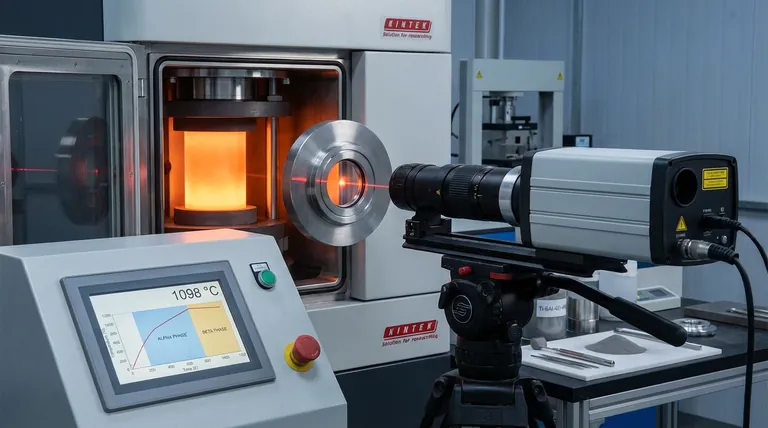
The primary function of an infrared pyrometer in the Spark Plasma Sintering (SPS) process is to provide precise, real-time, non-contact temperature monitoring. This device acts as the central feedback mechanism for the control system, allowing for the exact thermal regulation required to sinter Ti-6Al-4Zr-4Nb alloys successfully.
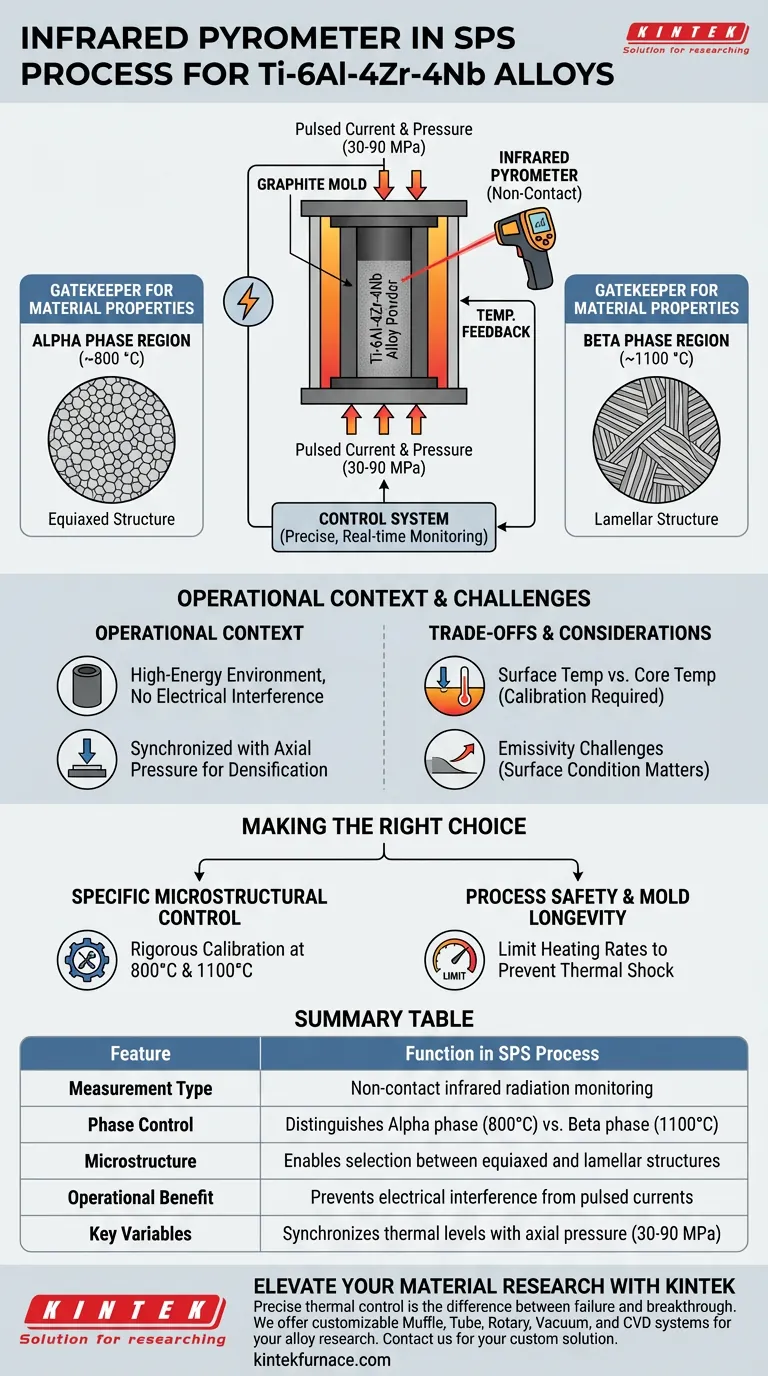
The pyrometer serves as the critical gatekeeper for material properties in Ti-6Al-4Zr-4Nb alloys. By distinguishing between the alpha phase region at 800 °C and the beta phase region at 1100 °C, it enables precise manipulation of the alloy’s final microstructure.
The Critical Role of Phase Control
Distinguishing Phase Regions
For Ti-6Al-4Zr-4Nb alloys, temperature is not just a variable; it is the defining factor of the material's state. The infrared pyrometer provides the data necessary to navigate distinct phase regions.
It specifically monitors the transition between the alpha phase region (around 800 °C) and the beta phase region (around 1100 °C). Without this accurate feedback, the operator is blind to the metallurgical changes occurring within the chamber.
Regulating Microstructure
The reading provided by the pyrometer directly influences the final physical structure of the alloy.
By holding the temperature at specific setpoints based on pyrometer feedback, engineers can dictate whether the final product exhibits equiaxed or lamellar structures. Reliable feedback is essential to ensure the process yields the specific mechanical properties required for the application.
Operational Context within SPS
Monitoring in a High-Energy Environment
The SPS process utilizes high-strength cylindrical graphite molds that serve as both the powder container and the heating element.
Because these molds conduct high pulsed currents to generate internal heating, standard contact sensors can be impractical or interfere with the electrical path. The infrared pyrometer overcomes this by measuring thermal radiation from a distance, ensuring no electrical interference.
Managing Densification
During sintering, the alloy powder undergoes axial pressures ranging from 30 MPa to 90 MPa to facilitate densification.
The pyrometer ensures that the heat applied matches the pressure curve. This synchronization promotes efficient atomic diffusion and ensures the graphite mold reaches the correct temperature to facilitate consolidation without overheating.
Understanding the Trade-offs
Surface vs. Core Temperature
It is important to acknowledge that an infrared pyrometer typically measures the surface temperature of the graphite mold or a specific blackbody hole, rather than the powder core directly.
While graphite has excellent thermal conductivity, there may be a slight thermal lag between the measured point and the alloy center. Calibration is required to ensure the "read" temperature correlates accurately with the actual sample temperature.
Emissivity Challenges
The accuracy of an infrared pyrometer depends on the emissivity setting of the target material.
If the surface condition of the graphite mold changes (e.g., degradation or oxidation), the emissivity may shift. This can lead to erroneous temperature readings if not monitored and corrected, potentially pushing the alloy into an unintended phase region.
Making the Right Choice for Your Goal
To maximize the effectiveness of the SPS process for Ti-6Al-4Zr-4Nb alloys, consider your specific objectives:
- If your primary focus is specific microstructural control: rigorous calibration of the pyrometer at the 800 °C and 1100 °C setpoints is mandatory to ensure precise alpha/beta phase selection.
- If your primary focus is process safety and mold longevity: use the pyrometer to strictly limit heating rates, preventing thermal shock to the graphite mold under high axial pressures.
Precise optical monitoring transforms temperature from a simple metric into a tool for microstructural engineering.
Summary Table:
| Feature | Function in SPS Process |
|---|---|
| Measurement Type | Non-contact infrared radiation monitoring |
| Phase Control | Distinguishes Alpha phase (800°C) vs. Beta phase (1100°C) |
| Microstructure | Enables selection between equiaxed and lamellar structures |
| Operational Benefit | Prevents electrical interference from pulsed currents |
| Key Variables | Synchronizes thermal levels with axial pressure (30-90 MPa) |
Elevate Your Material Research with KINTEK
Precise thermal control is the difference between a failed sample and a breakthrough. At KINTEK, we understand the intricacies of Spark Plasma Sintering and high-temperature metallurgy. Backed by expert R&D and manufacturing, we offer a comprehensive range of Muffle, Tube, Rotary, Vacuum, and CVD systems, all fully customizable to meet the rigorous demands of your Ti-6Al-4Zr-4Nb alloy research.
Whether you need precise optical monitoring or robust high-temp lab furnaces, our engineering team is ready to support your unique needs. Contact us today to find your custom solution.
Visual Guide
References
- Shilong Liang, Yoko Yamabe‐Mitarai. Microstructure Evolution and Mechanical Properties of Ti–6Al–4Zr–4Nb Alloys Fabricated by Spark Plasma Sintering (SPS). DOI: 10.1007/s11661-024-07422-8
This article is also based on technical information from Kintek Furnace Knowledge Base .
Related Products
People Also Ask
- Why is it necessary to maintain a high vacuum environment during the SPS of SiC? Key to High-Density Ceramics
- How does the heating mechanism of Spark Plasma Sintering (SPS) function? Enhance TiC/SiC Composite Fabrication
- What are the technical advantages of using an SPS sintering furnace? Elevate Al2O3-TiC Material Performance
- What are the steps in the discharge plasma sintering process? Master Fast, High-Density Material Consolidation
- What are the advantages of spark plasma sintering (SPS) over traditional forging? Precision Microstructural Control
