
The primary function of a muffle furnace in this context is to execute the carbonization process. It provides a strictly controlled, high-temperature environment that facilitates the pyrolysis of cleaned and dried sugarcane bagasse. This thermal treatment effectively eliminates organic components to yield a non-reactive ash, which is the foundational step for extracting high-purity silica.
Core Takeaway: The muffle furnace serves as a precise purification vessel. By subjecting the biomass to controlled thermal decomposition, it strips away volatile organic matter and converts the raw bagasse into a stable, carbon-rich ash ready for chemical processing.
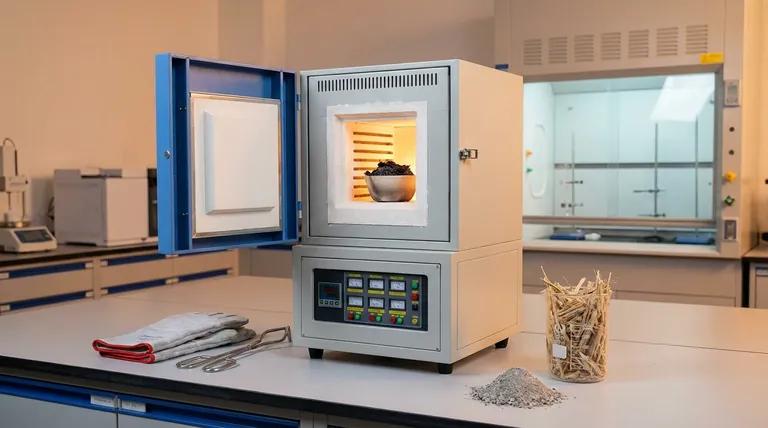
The Mechanics of Carbonization
Creating a Controlled Thermal Environment
The defining characteristic of a muffle furnace is its ability to isolate the sugarcane bagasse from the direct by-products of combustion. This ensures that the material is heated uniformly without contamination from fuel gases or direct flames. This isolation is critical for maintaining the chemical integrity of the ash during pretreatment.
Facilitating Pyrolysis
Inside the furnace, the dried sugarcane undergoes pyrolysis, a process of thermal decomposition in an inert or limited-oxygen atmosphere. The furnace maintains high temperatures to break down the complex organic structures within the biomass. This effectively drives off volatile matter and converts the physical structure of the bagasse into char.
Preparation for Silica Extraction
The ultimate goal of this stage is purification. By removing organic contaminants through heat, the muffle furnace transforms the raw agricultural waste into "non-reactive ash." This treated ash contains the concentrated silica content required for subsequent extraction processes, ensuring the final product achieves high purity.
Understanding the Trade-offs
Temperature Precision vs. Processing Time
While muffle furnaces offer exceptional temperature uniformity, they are generally batch-process devices that can be slower than continuous kilns. You gain precision in the carbonization profile, ensuring no organic residue remains, but you sacrifice the speed of continuous throughput.
The Risk of Over-Sintering
The "controlled" aspect of the furnace is vital; if the temperature is not managed correctly, the material may transition from carbonization to partial sintering. As noted in broader material synthesis applications, excessive heat can cause particles to bond prematurely. In the context of SCBA, this could reduce the reactivity of the ash or make the subsequent silica extraction more difficult.
Making the Right Choice for Your Goal
To maximize the efficacy of your pretreatment stage, consider your specific end-goals for the silica product:
- If your primary focus is high-purity silica: Prioritize a slower ramp rate and precise temperature holding to ensure complete removal of all organic volatiles without overheating the ash.
- If your primary focus is process efficiency: Optimize the furnace load to balance batch size with the time required for uniform heat penetration, preventing cold spots that lead to incomplete carbonization.
The muffle furnace is the gatekeeper of quality, converting variable agricultural waste into a consistent chemical feedstock.
Summary Table:
| Feature | Role in SCBA Pretreatment | Impact on Final Product |
|---|---|---|
| Isolation Heating | Prevents contamination from combustion by-products | Ensures high chemical integrity of the ash |
| Pyrolysis Control | Drives off volatile organic matter via high heat | Yields a stable, non-reactive carbon-rich ash |
| Thermal Uniformity | Eliminates cold spots during batch processing | Guarantees complete carbonization of biomass |
| Temperature Precision | Prevents over-sintering and particle bonding | Maintains high reactivity for silica extraction |
Elevate Your Material Research with KINTEK Precision
High-purity silica extraction begins with uncompromising thermal control. Backed by expert R&D and world-class manufacturing, KINTEK provides high-performance Muffle, Tube, Rotary, Vacuum, and CVD systems designed to meet the rigorous demands of biomass carbonization and material synthesis.
Whether you need a standard laboratory furnace or a fully customizable high-temperature system tailored to your unique pretreatment protocols, KINTEK delivers the uniformity and precision your research deserves.
Ready to optimize your silica extraction process? Contact KINTEK today to find your perfect furnace solution.
References
- Green Synthesis of Silica Nanoparticles from Sugarcane Bagasse Ash for Sustainable Heavy Metal Remediation from Industrial Effluents. DOI: 10.62154/ajastr.2025.019.01017
This article is also based on technical information from Kintek Furnace Knowledge Base .
Related Products
- High Temperature Muffle Oven Furnace for Laboratory Debinding and Pre Sintering
- 1200℃ Muffle Oven Furnace for Laboratory
- Laboratory Muffle Oven Furnace with Bottom Lifting
- 1400℃ Muffle Oven Furnace for Laboratory
- 1700℃ High Temperature Muffle Oven Furnace for Laboratory
People Also Ask
- What thermal phenomena occur during polymer binder burnout in ceramic green bodies? Lab Furnace Guide
- What role does a high-temperature muffle furnace play in STFO synthesis? Achieve Pure Perovskite Results
- Why is controlled heat treatment in a muffle furnace necessary for calcined clay? Achieve Optimal Pozzolanic Activity
- How does a high-temperature muffle furnace facilitate the formation of LaNbxAl1−xO3+δ perovskite structures? Key Roles
- What role does a high-temperature muffle furnace play in the formation of biochar catalysts? Master Catalyst Synthesis






