
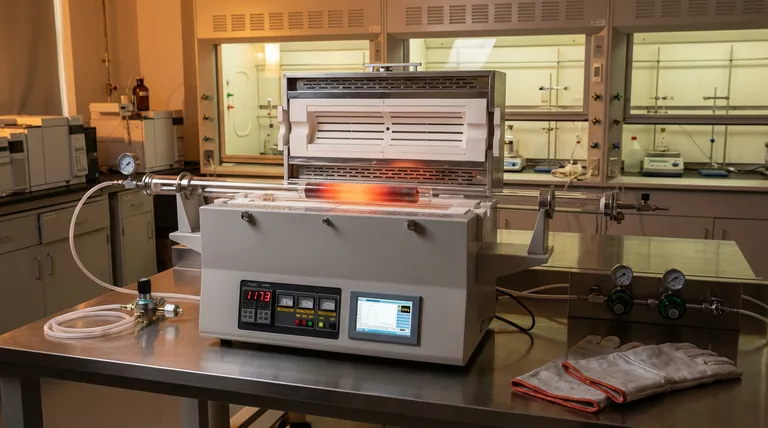
The primary function of a laboratory high-temperature furnace in this context is to establish a precise thermal environment for microstructural homogenization. Specifically for CuAlMn alloys, the furnace heats the hot-rolled material to 1173 K and maintains this temperature for exactly one hour. This sustained thermal energy forces the complete dissolution of alloying elements into the copper matrix to create a uniform structure.
By eliminating phase anisotropy and forming a single austenite phase, this treatment serves as the non-negotiable foundation for generating the alloy's shape memory functions during subsequent quenching.
The Mechanism of Solid Solution Treatment
Achieving the Single Austenite Phase
The core objective of the furnace is to drive a phase transformation. By holding the alloy at 1173 K, the furnace provides the thermodynamic conditions necessary to fully dissolve all solute elements into the copper matrix. This results in the formation of a single austenite structure, which is the critical starting point for functional performance.
Eliminating Phase Anisotropy
Hot-rolled alloys often exhibit non-uniform structures or "phase anisotropy" due to prior processing. The furnace's stable high-temperature environment promotes atomic diffusion, effectively erasing these irregularities. This ensures the material is chemically and structurally uniform before it undergoes cooling.
Preparing for Shape Memory Effects
The output of this furnace treatment is not the final product, but the "organizational basis" for what comes next. The single austenite structure created in the furnace is required to obtain metastable phases during the quenching process. Without this precise solution treatment, the alloy cannot exhibit its intended shape memory characteristics.
Critical Process Parameters
Precise Temperature Maintenance
The furnace must maintain a rigid temperature of 1173 K. Fluctuations in the thermal field can lead to incomplete dissolution of elements or the retention of unwanted phases. A stable thermal environment is essential to ensure that the entire volume of the sample reaches thermodynamic equilibrium.
Controlled Insulation Time
Time is just as critical as temperature; the process requires a holding period of one hour. This duration allows sufficient time for the diffusion of atoms across the matrix. It ensures that the homogenization extends from the surface to the core of the alloy, eliminating segregation.
Understanding the Trade-offs
The Risk of Insufficient Heating
If the furnace fails to reach or maintain 1173 K, or if the holding time is less than one hour, second-phase particles may remain undissolved. These retained phases disrupt the austenite matrix and will severely degrade the alloy's potential shape memory effect.
The Consequence of Inconsistency
A furnace with a non-uniform thermal field can induce localized variances in the alloy's microstructure. This lack of homogeneity leads to unpredictable mechanical properties. To ensure reliable performance, the furnace must guarantee a uniform temperature distribution across the entire sample zone.
Making the Right Choice for Your Goal
To maximize the effectiveness of your solid solution treatment, align your furnace parameters with your specific metallurgical objectives:
- If your primary focus is Shape Memory: Ensure your furnace can hold exactly 1173 K without fluctuation to guarantee a pure austenite starting structure.
- If your primary focus is Microstructural Homogeneity: Prioritize the one-hour insulation time to allow full atomic diffusion and the elimination of phase anisotropy.
Success in processing CuAlMn alloys relies entirely on the precision of this initial heating step to set the stage for quenching.
Summary Table:
| Parameter | Requirement | Role in CuAlMn Treatment |
|---|---|---|
| Target Temperature | 1173 K | Dissolves alloying elements into a single austenite phase |
| Insulation Time | 1 Hour | Ensures full atomic diffusion and eliminates anisotropy |
| Atmosphere Stability | High | Prevents oxidation during the critical homogenization phase |
| Thermal Uniformity | Precise | Guarantees consistent shape memory properties across the sample |
Elevate Your Metallurgical Precision with KINTEK
Unlock the full potential of your shape memory alloys with KINTEK’s industry-leading thermal solutions. Backed by expert R&D and world-class manufacturing, KINTEK offers a comprehensive range of Muffle, Tube, Rotary, Vacuum, and CVD systems—all specifically designed to maintain the rigid temperature stability required for critical processes like solid solution treatment.
Whether you need precise 1173 K control for CuAlMn alloys or a fully customizable system for unique material research, our high-temp lab furnaces provide the uniform thermal environment your laboratory demands.
Ready to optimize your heat treatment results? Contact us today to find your custom solution!
References
- Adelaide Nespoli, Carlo Fanciulli. A Study of a Cryogenic CuAlMn Shape Memory Alloy. DOI: 10.3390/met14030323
This article is also based on technical information from Kintek Furnace Knowledge Base .
Related Products
- 1400℃ High Temperature Laboratory Tube Furnace with Alumina Tube
- 1700℃ High Temperature Laboratory Tube Furnace with Alumina Tube
- 1200℃ Split Tube Furnace Laboratory Quartz Tube Furnace with Quartz Tube
- Vertical Laboratory Quartz Tube Furnace Tubular Furnace
- 1800℃ High Temperature Muffle Oven Furnace for Laboratory
People Also Ask
- How does zone-melting in tube furnaces synthesize bismuth micro-wires? Master Single-Crystal Thermoelectric Growth
- How are high-temp tube furnaces used to measure diffusion coefficients per Fick's law? Master Precision Annealing
- How are high-temperature laboratory tube furnaces applied in long-term vacuum homogenization heat treatments for intermetallic samples?
- How do high-temperature laboratory tube furnaces ensure environmental stability? Precision Thermal Reduction Tips
- How are high-temperature tube furnaces applied in testing ceramic-supported alloy membranes? Insights



















