
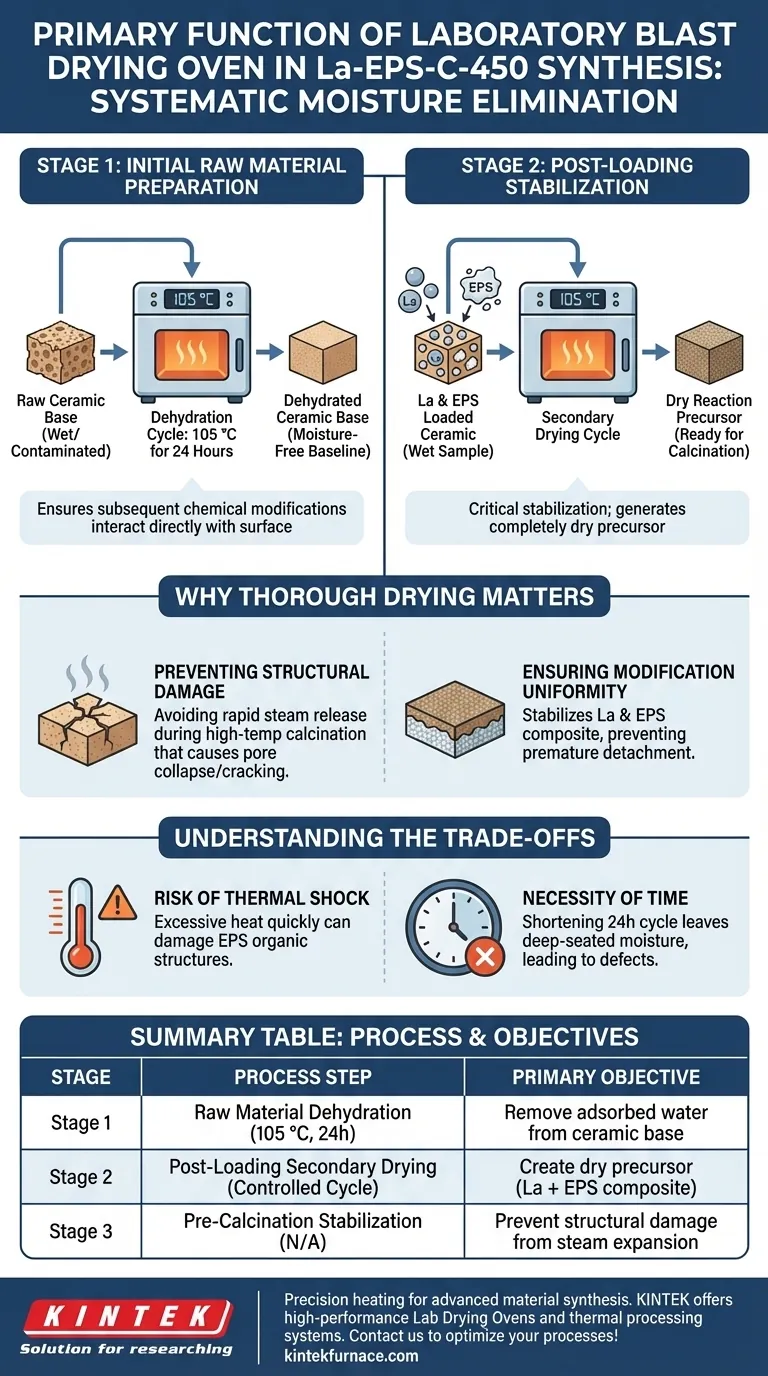
The primary function of a laboratory blast drying oven in the synthesis of La-EPS-C-450 is to systematically eliminate moisture at two distinct points in the preparation workflow. It is initially employed to dehydrate cleaned raw ceramic materials at 105 °C for 24 hours and is subsequently used for the secondary drying of samples after they have been loaded with lanthanum (La) and extracellular polymeric substances (EPS).
The drying process is not merely about water removal; it is a critical stabilization step that generates a completely dry reaction precursor. This ensures the material is physically stable and ready for the rigors of the subsequent high-temperature calcination process.
Stage 1: Initial Raw Material Preparation
Dehydrating the Ceramic Base
Before any modification occurs, the raw ceramic substrate must be completely free of contaminants and moisture.
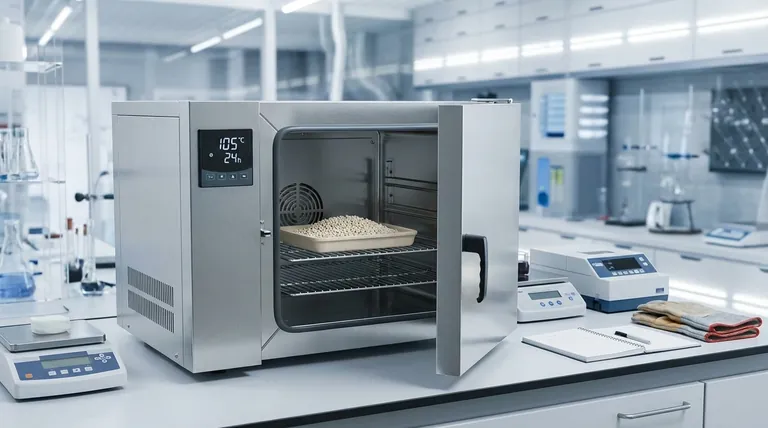
The blast drying oven operates at 105 °C for a continuous 24-hour cycle to treat the cleaned raw materials.
Establishing a Baseline
This step removes physically adsorbed water from the ceramic structure.
By starting with a thoroughly dehydrated base, researchers ensure that subsequent chemical modifications interact directly with the ceramic surface rather than with residual moisture.
Stage 2: Post-Loading Stabilization
Secondary Drying of the Composite
Once the ceramic has been loaded with lanthanum (La) and EPS, the material becomes a "wet sample" again.
The blast drying oven is utilized a second time to perform secondary drying on these modified samples.
Preparing for Calcination
The goal of this stage is to create a "dry reaction precursor."
The material must be completely devoid of free moisture before it enters the high-temperature calcination phase.
Why Thorough Drying Matters
Preventing Structural Damage
While the primary reference focuses on the "what," understanding the "why" is essential for process control.
If moisture remains within the internal structure during high-temperature processing, rapid steam release can occur.
This sudden expansion can cause irregular pore collapse or structural cracking, compromising the mechanical integrity of the final adsorbent.
Ensuring Modification Uniformity
Proper drying ensures that the La and EPS components are settled onto the ceramic surface without interference from evaporating solvents during the heating ramp.
This stabilizes the composite structure, preventing the "binder" or active components from detaching or degrading prematurely.
Understanding the Trade-offs
The Risk of Thermal Shock
While blast drying is efficient, specific temperature control is vital.
Applying excessive heat too quickly to a wet composite can damage temperature-sensitive components, such as the organic structures within EPS.
The Necessity of Time
There is often a temptation to shorten the 24-hour drying cycle to speed up production.
However, shortening this window risks leaving deep-seated moisture in the ceramic pores, which will inevitably lead to defects during the final calcination.
Making the Right Choice for Your Goal
To ensure the highest quality La-EPS-C-450 adsorbent, apply the drying process based on your specific preparation phase:
- If your primary focus is substrate integrity: Strictly adhere to the 105 °C temperature for 24 hours for raw materials to guarantee the complete removal of physically adsorbed water.
- If your primary focus is coating stability: Ensure the secondary drying phase is exhaustive to produce a fully dry precursor, preventing steam-induced damage during calcination.
Successful adsorbent preparation relies on the blast drying oven effectively acting as the gatekeeper between wet chemistry and high-temperature thermal treatment.
Summary Table:
| Stage | Process Step | Temperature & Duration | Primary Objective |
|---|---|---|---|
| Stage 1 | Raw Material Dehydration | 105 °C for 24 Hours | Remove adsorbed water from ceramic base |
| Stage 2 | Post-Loading Secondary Drying | Controlled Cycle | Create dry precursor (La + EPS composite) |
| Stage 3 | Pre-Calcination Stabilization | N/A | Prevent structural damage from steam expansion |
Precision heating is the backbone of advanced material synthesis. Backed by expert R&D and manufacturing, KINTEK offers high-performance Muffle, Tube, Rotary, Vacuum, and CVD systems, alongside lab drying ovens, all customizable for your unique research needs. Whether you are preparing ceramic adsorbents or complex composites, our equipment ensures the thermal stability and uniformity your project demands. Contact KINTEK today to optimize your lab's thermal processes!
Visual Guide
References
- Yaoyao Lu, Ren‐Cun Jin. Lanthanum and Sludge Extracellular Polymeric Substances Coprecipitation-Modified Ceramic for Treating Low Phosphorus-Bearing Wastewater. DOI: 10.3390/w17081237
This article is also based on technical information from Kintek Furnace Knowledge Base .
Related Products
- Laboratory Muffle Oven Furnace with Bottom Lifting
- High Temperature Muffle Oven Furnace for Laboratory Debinding and Pre Sintering
- 1200℃ Muffle Oven Furnace for Laboratory
- 1800℃ High Temperature Muffle Oven Furnace for Laboratory
- 1400℃ Muffle Oven Furnace for Laboratory
People Also Ask
- What function does a muffle furnace perform in Ba0.75Ca0.25TiO3 calcination? Ensure Phase Purity & Synthesis
- What is the importance of the calcination process? Master High-Purity Calcium Phosphate Nanopowder Production
- Why is a high-temperature muffle furnace required for FeOx-MOx/TiO2? Engineering High-Performance Nanocomposites
- Why is a high-temperature laboratory muffle furnace essential for the alkali fusion process in zeolite synthesis?
- What are the primary functions of a high-temperature laboratory muffle furnace in the preparation of biosorbent materials?








