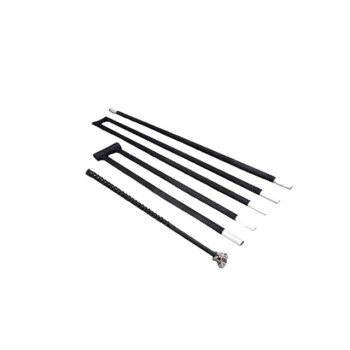
In most industrial air applications, the maximum operating temperature of silicon carbide (SiC) is 1600°C (2912°F). This limit is not arbitrary; it is defined by a chemical reaction that occurs at high temperatures. While SiC begins to form a protective surface layer at 1200°C, operating beyond 1600°C will cause this layer to fail and the material to degrade.
The key to understanding SiC's temperature rating is recognizing that its practical limit of 1600°C is determined by its interaction with air. Its exceptional performance relies on a self-generated protective oxide layer, which also defines its operational ceiling.
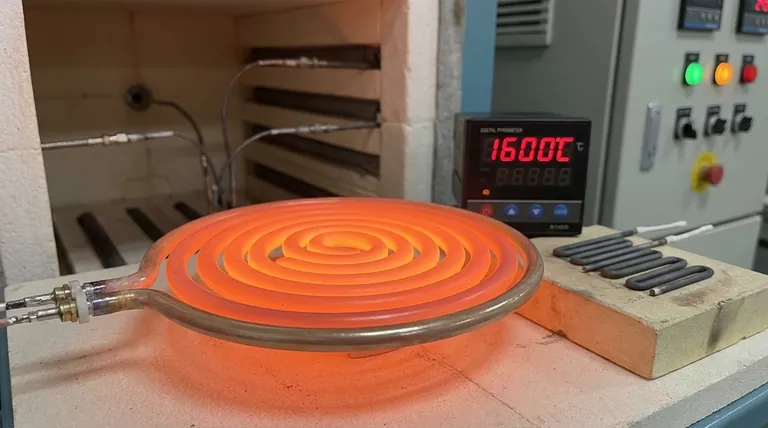
The Science Behind SiC's Temperature Limit
To properly evaluate SiC for your application, you must understand the mechanism that allows it to function at such high temperatures and what defines its failure point.
The Role of Passive Oxidation
At temperatures around 1200°C (2192°F), the surface of the silicon carbide reacts with oxygen in the air. This process, called passive oxidation, forms a thin, stable layer of silicon dioxide (SiO₂), which is essentially glass.
This SiO₂ layer acts as a protective skin. It is highly stable and prevents the underlying SiC from further oxidation, allowing the component to be used reliably up to 1600°C.
Why 1600°C is the Practical Ceiling
As temperatures push past 1600°C, this protective oxide layer begins to lose its stability and integrity. The oxidation process can accelerate, leading to material degradation, loss of strength, and eventual component failure.
Therefore, while the SiC material itself can withstand higher temperatures before decomposing, its useful and reliable operating range in an air atmosphere is capped at 1600°C.
More Than Just Heat: Thermal Shock Resistance
A material's maximum temperature is only part of the story. SiC also exhibits exceptional thermal shock resistance, meaning it can withstand rapid temperature changes without cracking.
This is due to a rare combination of high thermal conductivity (it dissipates heat quickly) and low thermal expansion (it doesn't expand or contract much when heated or cooled). This makes it ideal for applications involving rapid heating and cooling cycles.
Understanding the Trade-offs
No material is perfect for every scenario. Acknowledging the trade-offs involved with SiC is crucial for making an informed decision.
Atmosphere Is Everything
The 1600°C limit is specifically for applications in air. In a vacuum or an inert (non-oxidizing) atmosphere, SiC will not form the protective oxide layer. In these conditions, it may withstand higher temperatures before it begins to decompose, but its behavior and lifespan will be fundamentally different.
SiC vs. Other High-Temp Materials
SiC is a benchmark for high-temperature applications, but it is not the ultimate solution. For environments requiring even higher temperatures, other materials become necessary.
For example, Molybdenum Disilicide (MoSi₂) heating elements can operate at temperatures up to 1800°C (3272°F), providing a clear upgrade path for applications that exceed SiC's capabilities.
Application-Specific Limits
The nature of the application dictates the effective temperature range. For components like industrial heating elements, the goal is longevity and stability.
For this reason, SiC heating elements are often rated for a continuous operating range between 1400°C and 1600°C. Operating at the upper limit continuously may shorten the element's lifespan compared to operating slightly below it.
Making the Right Choice for Your Application
Selecting the correct material depends entirely on your specific operational goals and environment.
- If your primary focus is operating consistently up to 1600°C in an air environment: SiC is an exceptional choice, offering a superb balance of performance, cost, and thermal shock resistance.
- If your application requires temperatures exceeding 1600°C: You must evaluate alternative materials like Molybdenum Disilicide (MoSi₂) for their higher operational ceiling.
- If your primary challenge is rapid temperature cycling (thermal shock): SiC's unique physical properties make it a superior option, even if your peak temperature doesn't reach its maximum limit.
By understanding these operational boundaries, you can leverage silicon carbide not just for its heat tolerance, but for its outstanding reliability in demanding thermal environments.
Summary Table:
| Property | Key Information for SiC |
|---|---|
| Max Operating Temp (Air) | 1600°C (2912°F) |
| Protective Layer Formation | ~1200°C (Passive Oxidation) |
| Key Limiting Factor | Breakdown of SiO₂ layer above 1600°C |
| Thermal Shock Resistance | Excellent (High thermal conductivity, low expansion) |
| Atmosphere Dependency | Limit is for air; behavior differs in vacuum/inert gas |
| Alternative for Higher Temps | Molybdenum Disilicide (MoSi₂) up to 1800°C |
Need a high-temperature furnace solution tailored to your exact requirements?
Understanding material limits is crucial, but achieving consistent results requires precision-engineered equipment. KINTEK's advanced high-temperature furnaces, including Tube and Atmosphere Furnaces, are designed to provide the stable, controlled environments needed to leverage materials like SiC to their full potential.
We combine exceptional R&D with in-house manufacturing to offer deep customization, ensuring your furnace perfectly matches unique experimental needs—whether you're working with ceramics, metallurgy, or advanced materials research.
Contact our experts today to discuss how we can build a reliable thermal solution for your lab.
Visual Guide

Related Products
- 1400℃ Muffle Oven Furnace for Laboratory
- 1700℃ Controlled Inert Nitrogen Atmosphere Furnace
- 1200℃ Controlled Inert Nitrogen Atmosphere Furnace
- 2200 ℃ Tungsten Vacuum Heat Treat and Sintering Furnace
- 1700℃ High Temperature Laboratory Tube Furnace with Alumina Tube
People Also Ask
- What is the primary function of a high-temperature laboratory muffle furnace in chemical synthesis? Achieve Precision.
- How does a high-temperature laboratory muffle furnace affect material properties? Transform Anodic Oxide Films Fast
- What is the function of a muffle furnace in MOF-derived zirconia conversion? Optimize Phase & Pore Engineering
- What are the primary objectives of using a muffle furnace in zirconia synthesis? Achieve precision phase control.
- How is a laboratory high-temperature muffle furnace used in agloporite preparation? Optimize Material Synthesis