Vacuum degassing is the essential precursor to accurate activated carbon characterization. It functions by removing adsorbed moisture, air, and volatile impurities that naturally settle within the material's complex pore network. By clearing these obstructions, the process ensures that probe molecules—such as nitrogen—can access the true internal surface area, providing valid data for BET and pore size distribution analysis.
Accurate material characterization requires a "clean" surface. Without vacuum degassing, you are measuring the contaminants trapped within the pores rather than the carbon structure itself, leading to a significant underestimation of the material's true properties.
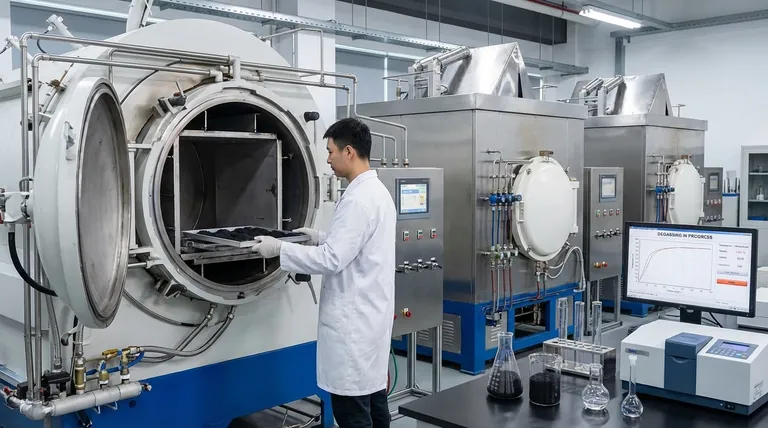
The Role of Degassing in Pore Accessibility
Removing Physical Obstructions
Activated carbon is highly porous and naturally adsorbs atmospheric moisture and trace volatiles from its environment. These molecules act as physical "plugs" that prevent nitrogen gas from entering the micro and mesopores during characterization.
Exposing Active Analysis Sites
A vacuum degassing system applies thermal energy under low pressure to break the van der Waals forces holding these impurities. This process clears the "analysis sites," ensuring that the probe gas can interact directly with the carbon lattice.
Ensuring True Gas Adsorption
If a sample is not properly degassed, the measured adsorption volume will be artificially low. This results in a "false negative" where a high-performance carbon appears to have poor porosity and surface area.
Impact on Quantitative Metrics
Validating BET Surface Area
The Brunauer-Emmett-Teller (BET) theory relies on the formation of a nitrogen monolayer across the entire available surface. If moisture occupies the pores, the monolayer cannot form correctly, leading to inaccurate and non-reproducible surface area calculations.
Accuracy in Pore Size Distribution
Determining the size and volume of pores requires the probe gas to fill the entire pore hierarchy. Residual gases trapped in the structure can create "dead ends," causing the software to miscalculate the distribution of pore diameters.
Consistency in Multi-Sample Comparisons
Standardizing the degassing temperature (often around 250 °C) and vacuum level ensures that results are comparable across different batches or studies. This consistency is vital for quality control and research integrity.
Understanding the Trade-offs and Pitfalls
Thermal Degradation Risks
Applying excessive heat during degassing can inadvertently damage the carbon structure or alter its surface chemistry. While higher temperatures remove impurities faster, they may trigger the collapse of delicate micropores if the material is not thermally stable.
The Challenge of Deep Impurities
Standard degassing at 250 °C may not be sufficient for removing inorganic impurities like silica. In specialized cases, extreme temperatures—up to 1800 °C—and high vacuum levels are required to vaporize these contaminants, though this is typically a purification step rather than standard prep.
Time vs. Accuracy Balance
Inadequate degassing time is a common mistake that leads to "drifting" results during analysis. While thorough degassing takes time, rushing the process results in residual moisture that gradually outgasses during the test, corrupting the vacuum of the analyzer itself.
How to Optimize Your Degassing Protocol
Before beginning your characterization, consider the specific requirements of your carbon sample to select the appropriate parameters.
- If your primary focus is standard BET surface area: Utilize a temperature of 250 °C under vacuum for several hours until the pressure stabilizes, ensuring all atmospheric moisture is removed.
- If your primary focus is high-purity research or desilication: Consider using high-temperature vacuum furnaces to induce phase changes in persistent impurities like silicon dioxide.
- If your primary focus is fragile, chemically modified carbon: Use a lower degassing temperature (e.g., 100-150 °C) for a longer duration to prevent the loss of surface functional groups.
Mastering the degassing process is the most critical step in transforming a raw sample into a reliable data point.
Summary Table:
| Factor | Impact on Characterization | Key Consideration |
|---|---|---|
| Moisture/Air Removal | Clears physical "plugs" in micropores | Ensures full nitrogen accessibility |
| Surface Cleanliness | Exposes true active analysis sites | Prevents underestimation of surface area |
| Standard Temp (250°C) | Removes atmospheric contaminants | Maintains result reproducibility |
| High Temp (Up to 1800°C) | Vaporizes inorganic impurities (e.g. silica) | Requires high-temp vacuum furnaces |
| Protocol Stability | Prevents "drifting" results during test | Balances time vs. material integrity |
Maximize Your Material Insights with KINTEK
Don't let residual impurities compromise your research data. KINTEK provides high-performance thermal solutions designed for precision. Backed by expert R&D and manufacturing, we offer Muffle, Tube, Rotary, Vacuum, and CVD systems, as well as specialized lab high-temp furnaces—all fully customizable to meet your unique degassing and characterization needs.
Ready to achieve superior accuracy in your lab? Contact KINTEK today to discuss your custom furnace requirements!
References
- Joanna Sreńscek-Nazzal, Beata Michalkiewicz. Chemical Activation of Banana Peel Waste-Derived Biochar Using KOH and Urea for CO2 Capture. DOI: 10.3390/ma17040872
This article is also based on technical information from Kintek Furnace Knowledge Base .
Related Products
- Vacuum Induction Melting Furnace
- Custom Made Versatile CVD Tube Furnace Chemical Vapor Deposition CVD Equipment Machine
- Cylindrical Resonator MPCVD Machine System for Lab Diamond Growth
- Slide PECVD Tube Furnace with Liquid Gasifier PECVD Machine
- Vacuum Heat Treat Sintering and Brazing Furnace
People Also Ask
- What are the core functions of the High Vacuum Induction Melting (VIM) furnace? Optimize DD5 Superalloy Purification
- Why is a Vacuum Induction Melting furnace (VIM) used for Cu-Zn-Al-Sn alloys? Achieve Precision Composition Control
- What are the technical advantages of using a Vacuum Induction Melting furnace in the development of advanced packaging steel?
- What role does a Vacuum Induction Melting furnace play in the production of high-aluminum nickel-based superalloys?
- What are the advantages of using a VIM furnace to control residual oxygen pressure? Achieve Superior Metal Uniformity