
In modern manufacturing, continuous vacuum furnaces are indispensable because they uniquely combine high-throughput efficiency with the pristine, controlled environment necessary for producing superior metal components. They solve the dual challenge of achieving exceptional metallurgical quality at a large industrial scale, something traditional methods cannot easily replicate.
The primary value of a continuous vacuum furnace lies in its ability to eliminate atmospheric contamination during heat treatment while operating uninterruptedly. This results in metallurgically superior parts and significantly higher production efficiency compared to traditional batch processing.
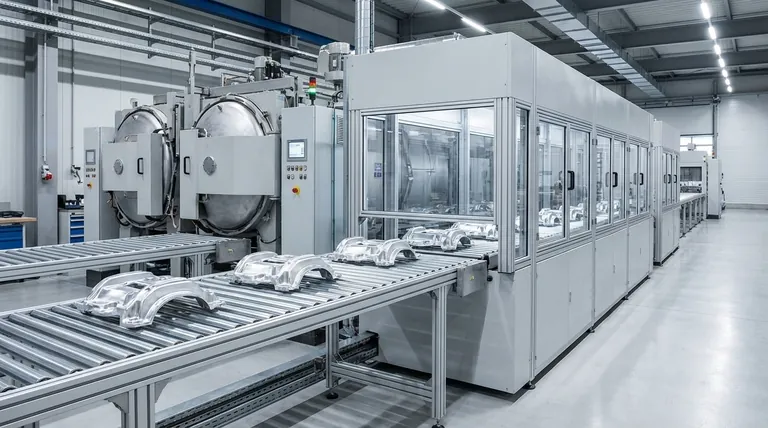
The Core Advantages of Continuous Vacuum Processing
The "continuous" aspect of these furnaces is what drives their efficiency, while the "vacuum" is what guarantees quality. The combination of these two elements creates a powerful manufacturing tool.
Unmatched Material Quality and Purity
By removing air and other reactive gases, a vacuum furnace prevents oxidation, carburization, and other unwanted chemical reactions on the metal's surface, even at extreme temperatures.
This results in bright, clean parts with superior mechanical performance and surface finish, eliminating the need for costly and time-consuming post-processing or cleaning steps.
Superior Process Consistency and Repeatability
The vacuum environment ensures extremely uniform heating and cooling. With no air to create hot or cold spots, every part within a load experiences the exact same thermal profile.
This high degree of control guarantees consistent, repeatable results from the first part to the last, which is critical for industries with strict quality standards like aerospace and medical devices.
Significant Gains in Production Efficiency
Unlike batch furnaces that must be cooled, unloaded, reloaded, and reheated, a continuous furnace operates without interruption. Parts move steadily through heating and cooling zones.
This eliminates thermal cycling of the furnace itself, saving enormous amounts of energy and time. The result is a dramatic increase in throughput and a lower cost per part for large-scale production runs.
How the Vacuum Environment Transforms Heat Treatment
Understanding the physics of the vacuum is key to appreciating why these furnaces are so effective. It fundamentally changes the conditions under which heat treatment occurs.
Preventing Oxidation and Surface Reactions
At high temperatures, the oxygen in the air aggressively reacts with most metals, forming a brittle oxide layer (scale) that degrades the surface and can compromise the part's integrity.
A vacuum furnace removes the oxygen, creating an inert environment where the metal can be heated without this damaging reaction.
Ensuring Uniform Temperature Distribution
Heat transfer in a vacuum occurs primarily through radiation. Without air currents (convection) to cause uneven heating, thermal energy radiates uniformly from the heating elements to the parts.
This ensures that complex geometries and dense loads heat at the same rate, preventing distortion and ensuring consistent metallurgical properties throughout the component.
Understanding the Trade-offs and Limitations
While powerful, continuous vacuum furnaces are not a universal solution. Their benefits come with specific operational considerations that make them unsuitable for certain applications.
High Initial Capital Investment
These are complex, large-scale systems that represent a significant upfront investment compared to smaller batch furnaces or traditional atmosphere furnaces. Their cost is only justified by high-volume production.
Reduced Flexibility for Varied Batches
Continuous furnaces are optimized to run the same or very similar parts and heat treatment cycles for extended periods. They lack the flexibility to efficiently process a wide mix of small, diverse batches with different requirements.
Complexity and Maintenance Requirements
The systems required to maintain a continuous vacuum, along with the automated material handling, are inherently more complex than batch systems. They demand rigorous maintenance protocols and specialized technical expertise to operate reliably.
Key Applications in High-Stakes Industries
The unique benefits of continuous vacuum furnaces make them essential for processes where quality and performance are non-negotiable.
Vacuum Brazing and Welding
In aerospace and electronics, joining complex components with a brazing alloy requires an absolutely clean surface for the alloy to flow and form a strong, leak-proof bond. A vacuum provides the ideal environment for these critical joints.
Vacuum Sintering
Sintering is the process of turning compacted metal powder into a solid, dense object through heat. Performing this in a vacuum prevents oxidation of the fine powder particles and results in a stronger, higher-purity final component.
Hardening and Annealing
For industries like automotive manufacturing, producing millions of gears, bearings, or structural components requires absolute consistency. Continuous vacuum hardening and annealing ensure every single part meets precise specifications for strength and durability.
Making the Right Choice for Your Operation
Selecting the right furnace technology depends entirely on your production goals, part mix, and quality requirements.
- If your primary focus is high-volume, standardized production: A continuous vacuum furnace is the clear choice for maximizing throughput and ensuring part-to-part consistency.
- If your primary focus is processing diverse, smaller batches: A batch-style vacuum furnace offers greater flexibility to handle varied parts and treatment cycles without the high overhead of a continuous system.
- If your primary focus is ultra-high-purity joining or densification: Specialized systems like vacuum brazing or Hot Isostatic Pressing (HIP) furnaces are necessary to meet the most demanding specifications.
Ultimately, integrating a continuous vacuum furnace is a strategic decision to elevate both the quality of your product and the efficiency of your entire production line.
Summary Table:
| Advantage | Description |
|---|---|
| Unmatched Material Quality | Eliminates oxidation and contamination for bright, clean parts with superior mechanical properties. |
| Superior Process Consistency | Ensures uniform heating and cooling for repeatable results, critical for strict quality standards. |
| High Production Efficiency | Operates continuously without interruption, reducing energy use and cost per part in large-scale runs. |
| Ideal for High-Stakes Applications | Essential for vacuum brazing, sintering, and hardening in aerospace, medical, and automotive industries. |
Elevate your metal heat treatment with KINTEK's advanced solutions! Leveraging exceptional R&D and in-house manufacturing, we provide diverse laboratories with high-temperature furnace systems, including Muffle, Tube, Rotary, Vacuum & Atmosphere Furnaces, and CVD/PECVD Systems. Our strong deep customization capability ensures we precisely meet your unique experimental needs, delivering superior quality and efficiency. Contact us today to discuss how our tailored furnace solutions can transform your production line!
Visual Guide

Related Products
- Vacuum Sealed Continuous Working Rotary Tube Furnace Rotating Tube Furnace
- Electric Rotary Kiln Continuous Working Small Rotary Furnace Kiln for Pyrolysis Plant Heating
- Vacuum Heat Treat Sintering Furnace with Pressure for Vacuum Sintering
- Vacuum Heat Treat Sintering Furnace Molybdenum Wire Vacuum Sintering Furnace
- Vacuum Hot Press Furnace Machine Heated Vacuum Press Tube Furnace
People Also Ask
- What is the purpose of rotary tube furnaces? Achieve Uniform Heat Treatment for Powders and Granules
- What are the key advantages of using a rotary tube furnace? Achieve Dynamic, Uniform Heating for Powders
- How does the amount of material processed vary between batch and continuous rotary tube furnaces? Scale Your Production Efficiently
- What are the advantages of rotary tube furnaces in fuel compatibility? Boost Efficiency and Cut Costs
- What is the temperature range of some rotary tube furnaces? Achieve Uniform Heating Up to 1200°C



















