
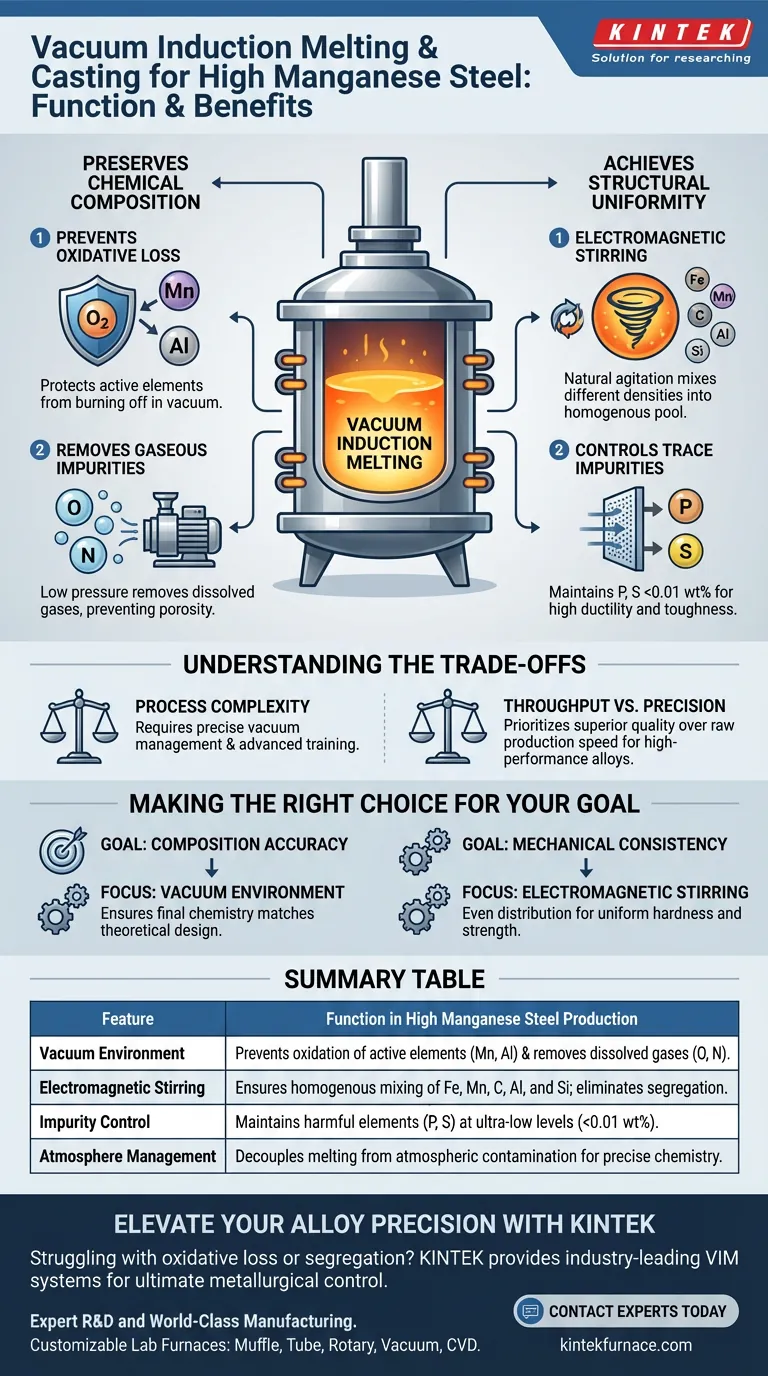
Vacuum induction melting and casting equipment functions primarily to create a controlled environment that protects reactive alloying elements while ensuring the chemical uniformity of the molten metal. By operating in a vacuum, the equipment prevents the oxidative loss of active elements like manganese and aluminum at high temperatures, while simultaneously using electromagnetic stirring to mix iron, manganese, carbon, aluminum, and silicon into a homogenous pool.
The core value of this equipment is its ability to decouple the melting process from atmospheric contamination. It safeguards the alloy's precise chemical formula by preventing oxidation and mechanically stirring the melt to ensure structural consistency throughout the ingot.

Preserving Chemical Composition
Prevention of Oxidative Loss
High manganese steel relies on specific concentrations of active elements, particularly manganese and aluminum. These elements are highly reactive and prone to "burning off" (oxidizing) when exposed to air at melting temperatures. The vacuum environment eliminates oxygen from the chamber, ensuring these critical elements remain within the alloy rather than forming slag.
Removal of Gaseous Impurities
Beyond preventing oxidation, the vacuum actively refines the molten steel. The low-pressure environment facilitates the removal of dissolved gases, such as oxygen and nitrogen, from the liquid metal. This purification is essential for preventing porosity and brittleness in the final cast product.
Achieving Structural Uniformity
The Role of Electromagnetic Stirring
A key advantage of induction technology is the generation of electromagnetic stirring forces. As the induction current heats the metal, it naturally agitates the molten pool. This ensures that elements with different densities—iron, manganese, carbon, aluminum, and silicon—are thoroughly mixed rather than settling into layers.
Controlling Trace Impurities
The precision of this equipment allows for the strict management of harmful trace elements. It creates the conditions necessary to maintain impurities like phosphorus and sulfur at extremely low levels, typically below 0.01 wt%. This low impurity baseline is critical for maximizing the ductility and toughness of the steel.
Understanding the Trade-offs
Process Complexity
While vacuum induction melting yields superior quality, it introduces significant operational complexity. Operators must precisely manage vacuum pressures and, in some cases, introduce inert atmospheres to fine-tune the melt, requiring more advanced training than standard open-air induction furnaces.
Throughput vs. Precision
This method prioritizes material quality over raw production speed. The time required to establish a vacuum and the limits on batch sizes mean this process is best reserved for high-performance alloys where chemical segregation or inclusions would cause catastrophic failure.
Making the Right Choice for Your Goal
To maximize the utility of vacuum induction melting in your production line, consider your specific metallurgical targets:
- If your primary focus is composition accuracy: Rely on the vacuum environment to prevent the evaporative loss of volatile elements like Manganese and Aluminum, ensuring the final chemistry matches your theoretical design.
- If your primary focus is mechanical consistency: Leverage the electromagnetic stirring effect to eliminate segregation, ensuring that Iron, Carbon, and Silicon are distributed evenly for uniform hardness and strength.
By effectively managing both oxidation and homogenization, this equipment transforms raw inputs into a high-purity, high-performance foundation for advanced steel manufacturing.
Summary Table:
| Feature | Function in High Manganese Steel Production |
|---|---|
| Vacuum Environment | Prevents oxidation of active elements (Mn, Al) and removes dissolved gases (O, N). |
| Electromagnetic Stirring | Ensures homogenous mixing of Fe, Mn, C, Al, and Si; eliminates segregation. |
| Impurity Control | Maintains harmful elements (P, S) at ultra-low levels (<0.01 wt%). |
| Atmosphere Management | Decouples the melting process from atmospheric contamination for precise chemistry. |
Elevate Your Alloy Precision with KINTEK
Are you struggling with oxidative loss or chemical segregation in your high-performance alloys? KINTEK provides industry-leading Vacuum Induction Melting (VIM) systems designed to deliver the ultimate control over your metallurgical outcomes.
Backed by expert R&D and world-class manufacturing, we offer a comprehensive range of lab high-temp furnaces—including Muffle, Tube, Rotary, Vacuum, and CVD systems—all fully customizable to meet your unique preparation requirements. Whether you are refining high manganese steel or developing next-generation materials, our equipment ensures the chemical purity and structural uniformity your research demands.
Ready to optimize your melting process? Contact our technical experts today to find the perfect customized solution for your laboratory or production line.
Visual Guide
References
- Lu, Shao-Lun, Max-Planck-Institut für Nachhaltige Materialien. Making High Mn Steel by Sustainable Ferromanganese Pre-alloy for Cryogenic Applications. DOI: 10.5281/zenodo.17520990
This article is also based on technical information from Kintek Furnace Knowledge Base .
Related Products
- Vacuum Induction Melting Furnace
- 600T Vacuum Induction Hot Press Vacuum Heat Treat and Sintering Furnace
- Vacuum Hot Press Furnace Machine for Lamination and Heating
- Vacuum Heat Treat Sintering and Brazing Furnace
- Vacuum Heat Treat Sintering Furnace Molybdenum Wire Vacuum Sintering Furnace
People Also Ask
- What are the core functions of the High Vacuum Induction Melting (VIM) furnace? Optimize DD5 Superalloy Purification
- What are the advantages of using a VIM furnace to control residual oxygen pressure? Achieve Superior Metal Uniformity
- What role does a Vacuum Induction Melting furnace play in the production of high-aluminum nickel-based superalloys?
- What is the role of VIM and directional solidification in aero-engine blade substrates? Engineering Extreme Durability
- What are the technical advantages of using a Vacuum Induction Melting furnace in the development of advanced packaging steel?



















