
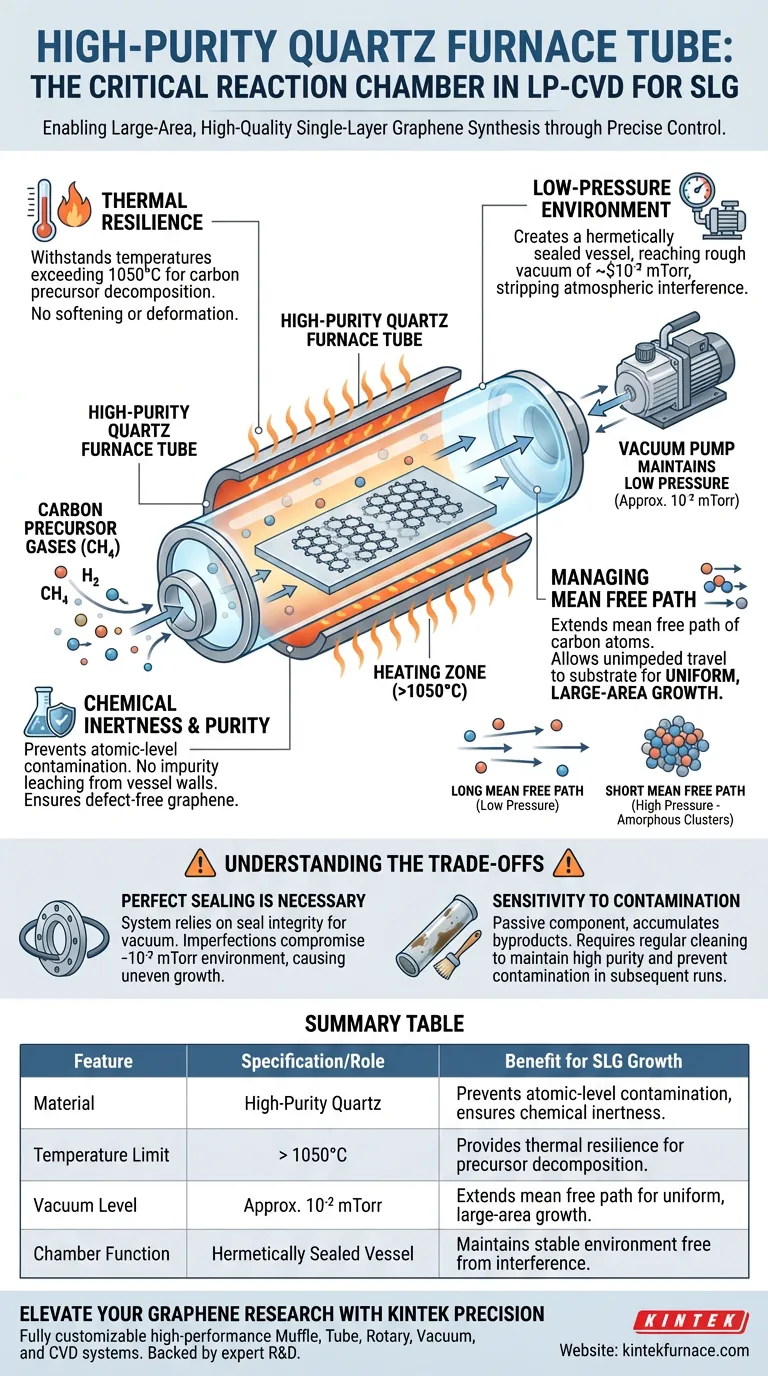
The high-purity quartz furnace tube acts as the critical reaction chamber in Low-Pressure Chemical Vapor Deposition (LP-CVD) systems, specifically engineered to withstand the rigorous conditions required for Single-Layer Graphene (SLG) synthesis. It serves as a hermetically sealed vessel that sustains temperatures exceeding 1050°C while maintaining a chemically inert environment. By integrating seamlessly with vacuum pump sets, it holds the system at a vacuum level of approximately $10^{-2}$ mTorr. This precise control over temperature and pressure is the deciding factor in achieving large-area, high-quality graphene growth.
The quartz tube is not merely a container; it is an active enabler of purity and gas dynamics. Its ability to maintain high vacuum at extreme heat allows for the manipulation of the carbon source's mean free path, ensuring the graphene grows uniformly rather than forming amorphous clusters.
The Critical Role of Material Properties
Thermal Resilience at Extreme Temperatures
The synthesis of Single-Layer Graphene requires high energy to break down carbon precursor gases and rearrange them into a hexagonal lattice. The quartz tube provides the necessary thermal stability to operate safely at temperatures exceeding 1050°C. Standard glass or lower-grade ceramics would soften, deform, or outgas under these conditions.
Chemical Inertness and Purity
The "high-purity" designation of the quartz is functional, not just descriptive. At the atomic level, graphene is incredibly sensitive to contamination. The quartz tube offers excellent chemical stability, ensuring that no impurities from the vessel walls leach into the reaction zone to create defects in the graphene sheet.
Enabling the Physics of Growth
Creating the Low-Pressure Environment
To grow a single, uniform layer of atoms, the density of gas molecules must be strictly controlled. The quartz tube's superior sealing performance is vital when paired with vacuum pump sets. It allows the system to reach and maintain a rough vacuum of approximately $10^{-2}$ mTorr, stripping away atmospheric interference.
Managing the Mean Free Path
The vacuum environment created by the tube directly influences the "mean free path"—the average distance a gas molecule travels before colliding with another. By maintaining low pressure, the quartz tube extends this mean free path. This allows carbon atoms to travel unimpeded to the substrate, facilitating the large-area, uniform growth characteristic of high-quality SLG.
Understanding the Trade-offs
The Necessity of Perfect Sealing
While the tube itself is robust, the system is only as effective as its integration with the vacuum pumps. Relying on the tube for vacuum integrity means that any imperfection in the seals or flanges will compromise the $10^{-2}$ mTorr environment. A loss of pressure control immediately reduces the mean free path, leading to uneven or multi-layer growth.
Sensitivity to Contamination Accumulation
Although the quartz is chemically stable, it is a passive component that cannot actively clean itself during a run. Over time, reaction byproducts can accumulate on the inner walls. Because the process relies on such high purity, even minor residual buildup on the quartz surface can alter the thermal profile or introduce contaminants in subsequent runs.
Making the Right Choice for Your Goal
To maximize the effectiveness of your LP-CVD system for graphene preparation, you must align your equipment maintenance with your specific output goals.
- If your primary focus is Atomic Purity: Prioritize the regular cleaning and inspection of the quartz tube's inner surface to ensure the chemical stability prevents any impurity contamination at 1050°C.
- If your primary focus is Large-Area Uniformity: Focus heavily on the tube's sealing interfaces and vacuum pump performance to rigorously maintain the $10^{-2}$ mTorr pressure required to control the mean free path.
The quartz furnace tube is the foundational hardware that translates theoretical growth parameters into physical, high-quality Single-Layer Graphene.
Summary Table:
| Feature | Specification/Role | Benefit for SLG Growth |
|---|---|---|
| Material | High-Purity Quartz | Prevents atomic-level contamination and ensures chemical inertness. |
| Temperature Limit | > 1050°C | Provides thermal resilience for carbon precursor decomposition. |
| Vacuum Level | Approx. $10^{-2}$ mTorr | Extends the mean free path for uniform, large-area growth. |
| Chamber Function | Hermetically Sealed Vessel | Maintains a stable environment free from atmospheric interference. |
Elevate Your Graphene Research with KINTEK Precision
Achieving perfect Single-Layer Graphene requires equipment that never compromises on purity or pressure control. Backed by expert R&D and manufacturing, KINTEK offers high-performance Muffle, Tube, Rotary, Vacuum, and CVD systems—all fully customizable to meet your specific laboratory requirements.
Whether you are scaling up SLG production or perfecting atomic purity, our high-purity quartz solutions and advanced furnace systems provide the thermal stability and vacuum integrity your research demands.
Ready to optimize your LP-CVD process? Contact our technical experts today to find the ideal high-temperature furnace for your unique needs.
Visual Guide
References
- Songsong Yao, Tongxiang Fan. Effect of Copper Surface Roughness on the High-Temperature Structural Stability of Single-Layer-Graphene. DOI: 10.3390/ma17071648
This article is also based on technical information from Kintek Furnace Knowledge Base .
Related Products
- High Pressure Laboratory Vacuum Tube Furnace
- Vertical Laboratory Quartz Tube Furnace Tubular Furnace
- 1200℃ Split Tube Furnace Laboratory Quartz Tube Furnace with Quartz Tube
- Multi Zone Laboratory Quartz Tube Furnace Tubular Furnace
- Custom Made Versatile CVD Tube Furnace Chemical Vapor Deposition CVD Equipment Machine
People Also Ask
- What role does a high vacuum tube furnace play in Co-Al sintering? Master High-Purity Porous Material Synthesis
- What are the different types of tube furnaces available? Find the Perfect Fit for Your Lab's Needs
- What are the main advantages of vacuum tube furnaces in the market? Achieve Purity and Precision in Material Processing
- What is the role of a vacuum tube furnace during the final thermal treatment stage of Fe3O4@CSAC catalysts?
- What conditions does a tube furnace provide for post-ion-implantation? Achieve Precise Microstructural Repair



















