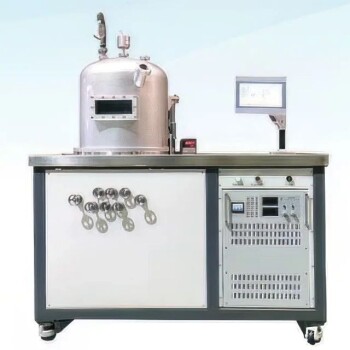
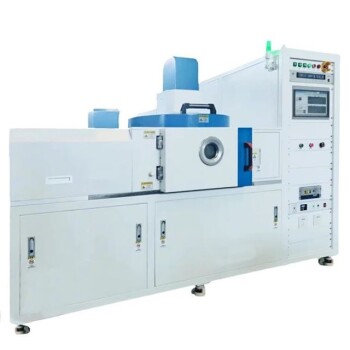
The vacuum pumping system creates a pristine baseline by evacuating the chamber to a high vacuum state to remove ambient impurities, while the high-purity argon gas input device supplies the necessary working gas to sustain plasma discharge. Together, these systems control the atmospheric conditions required for the magnetron sputtering process.
Achieving a high-performance coating is impossible without strict atmospheric control. By eliminating contamination and stabilizing the plasma medium, these two systems enable the formation of high-purity TiN or Cr layers with a critical single-phase structure.
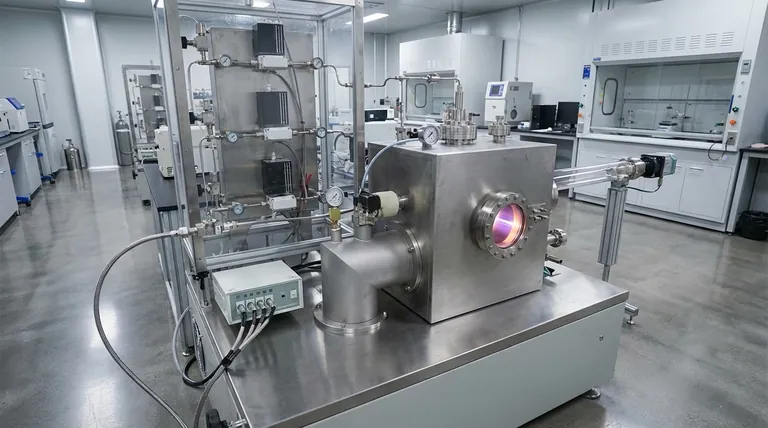
Establishing a Pure Environment
The Role of the Vacuum Pumping System
The primary function of the vacuum pumping system is to evacuate the sputtering chamber to a high vacuum state.
This process is essential to minimize interference from ambient impurity gases.
By removing the air and moisture present in the chamber, the system prevents these contaminants from reacting with the target material or the substrate during deposition.
The Role of the Argon Gas Input
Once the vacuum is established, the high-purity argon gas input device serves as the source of the process working gas.
Argon acts as a stable medium for plasma discharge, which is the mechanism that ejects atoms from the source material (Ti or Cr) to coat the substrate.
The use of high-purity gas ensures that the medium itself does not introduce new contaminants into the controlled environment.
The Impact on Coating Quality
Ensuring Chemical Purity
The combined operation of these systems ensures the magnetron sputtering process occurs in a pure environment.
Without the vacuum system, residual atmospheric gases would oxidize or contaminate the coating.
Without the high-purity argon input, the plasma process would be erratic or chemically compromised.
Achieving Single-Phase Structure
The ultimate goal of this environmental control is to produce TiN (Titanium Nitride) or Cr (Chromium) protective layers with a single-phase structure.
A single-phase structure implies a uniform crystalline arrangement, which is vital for the mechanical performance and durability of the coating.
Any impurities introduced by a poor vacuum or low-quality gas would disrupt this structure, leading to defects or multi-phase layers that weaken the coating.
Understanding the Risks
Consequences of Vacuum Failure
If the vacuum pumping system fails to achieve a sufficient high vacuum state, impurity gases remain in the chamber.
These impurities compete with the coating atoms, leading to inclusions that degrade the coating's hardness and adhesion.
Instability in Gas Delivery
If the argon gas input device cannot maintain a stable flow, the plasma discharge becomes unstable.
This instability causes fluctuations in the deposition rate, resulting in uneven coating thickness and inconsistent structural properties.
Optimizing for Coating Quality
To ensure the successful deposition of TiN and Cr coatings, you must prioritize the synergy between evacuation and gas injection.
- If your primary focus is material purity: Ensure your vacuum pumping system is capable of reaching and maintaining a high vacuum state to eliminate all ambient gas interference.
- If your primary focus is structural uniformity: Verify that your argon gas input device provides a strictly controlled, high-purity flow to maintain a stable plasma discharge for single-phase formation.
Strict control over the vacuum and gas input is the non-negotiable foundation of high-quality magnetron sputtering.
Summary Table:
| System Component | Primary Role | Impact on Coating Quality |
|---|---|---|
| Vacuum Pumping | Evacuates chamber to high vacuum; removes ambient impurities | Prevents oxidation; ensures high chemical purity and adhesion |
| Argon Gas Input | Supplies high-purity working gas for plasma discharge | Stabilizes deposition rate; enables uniform single-phase structure |
Elevate Your Coating Precision with KINTEK
Don't let atmospheric contamination compromise your research or production. KINTEK provides industry-leading laboratory high-temperature furnaces—including Vacuum, CVD, and Muffle systems—designed to deliver the strict environmental control required for high-performance TiN and Cr deposition.
Backed by expert R&D and precision manufacturing, our equipment is fully customizable to meet your unique thin-film requirements. Contact us today to discuss how our advanced vacuum and thermal solutions can optimize your material performance.
Visual Guide

References
- Yuxin Tang, Dewen Tang. High-Temperature Oxidation Behavior of TiN-, Cr-, and TiN–Cr PVD-Coated Zircaloy 4 Alloy at 1200 °C. DOI: 10.3390/ma18081692
This article is also based on technical information from Kintek Furnace Knowledge Base .
Related Products
- HFCVD Machine System Equipment for Drawing Die Nano Diamond Coating
- Vacuum Induction Melting Furnace
- Vacuum Hot Press Furnace Machine for Lamination and Heating
- Magnesium Extraction and Purification Condensing Tube Furnace
- Cylindrical Resonator MPCVD Machine System for Lab Diamond Growth
People Also Ask
- What is Hot-filament Chemical Vapor Deposition (HFCVD)? Achieve High-Quality Thin Films with Precision Control
- What are the equipment for chemical vapor deposition? A Guide to the 5 Essential Components
- What is the significance of the vacuum pressure control system in the CVD coating process for powders?
- What is the function of high-purity Argon (Ar) gas during CVD? Optimize Your Thin Film Uniformity and Purity
- What are the advantages of using Chemical Vapor Deposition (CVD) for coating turbine blades? Enhance Life & Performance