
The primary function of laboratory high-temperature box furnaces in this context is to create a precise, uniform thermal environment—typically maintained at 535°C—that forces magnesium-containing phases to dissolve into the aluminum matrix. This heating process transforms the uneven as-cast structure into a uniform supersaturated solid solution. By effectively eliminating chemical composition inhomogeneities, the furnace prepares the recycled aluminum alloy for the subsequent strengthening achieved during the aging stage of T6 treatment.
The furnace acts as a critical vessel for metallurgical homogenization, utilizing controlled heat to dissolve solute atoms back into the primary lattice, which is the absolute prerequisite for precipitation hardening.
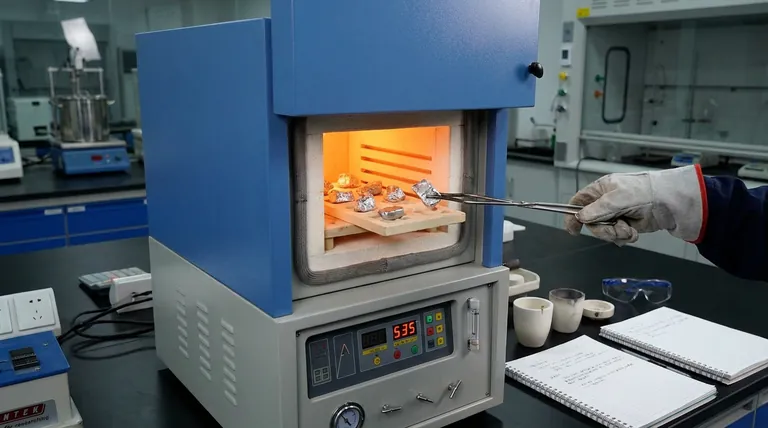
The Mechanics of Solution Treatment
Dissolution of Second Phases
The central objective of this furnace operation is the management of phases such as Mg2Si (magnesium silicide).
Under precise heat (535°C), these magnesium-containing phases destabilize and dissolve fully into the alpha-Al (aluminum) matrix.
Creating a Supersaturated Solid Solution
Once the phases dissolve, the furnace environment holds the material in a state where solute atoms are randomly distributed.
This creates a "supersaturated" condition, meaning the aluminum lattice holds more dissolved solute than it typically would at room temperature.
Eliminating As-Cast Inconsistencies
Recycled aluminum alloys in their "as-cast" state often suffer from chemical composition inhomogeneities.
The high-temperature soak allows these elements to diffuse evenly, smoothing out variations and standardizing the material's internal structure.
The Role of Thermal Precision
Why Uniformity Matters
The "box" design of these furnaces is intended to provide a stable thermal field, ensuring every part of the sample experiences the exact same temperature.
Without this uniformity, parts of the alloy might fail to dissolve the Mg2Si phases, leading to weak spots in the final material.
Enabling Future Hardness
This process is not about hardening the material immediately; it is about potential.
By ensuring a fully dissolved, uniform matrix now, the furnace ensures that subsequent "aging" treatments can effectively precipitate fine particles that strengthen the alloy.
Understanding the Trade-offs
Temperature Sensitivity
The specific temperature of 535°C is not a suggestion; it is a critical threshold for these specific alloys.
If the temperature is too low, the Mg2Si phases will not dissolve completely, rendering the subsequent aging process ineffective.
If the temperature fluctuates too high, you risk overheating the matrix or causing incipient melting, which permanently damages the alloy's structural integrity.
The Impact of Soaking Time
While temperature is key, the duration the alloy remains in the furnace (soaking time) is equally important.
As indicated by similar high-precision electric furnace processes, soaking times can range significantly (e.g., 4 to 24 hours) depending on the specific alloy composition.
Insufficient time prevents full diffusion, while excessive time yields diminishing returns and increases energy consumption.
Making the Right Choice for Your Goal
To maximize the utility of your solution treatment process, consider your specific objectives:
- If your primary focus is mechanical strengthening: Ensure the furnace maintains 535°C strictly to guarantee full dissolution of Mg2Si, as undissolved phases will act as defects rather than reinforcement.
- If your primary focus is material research: Use the precise control of the box furnace to isolate variables, testing how exact temperature increments impact the homogeneity of the alpha-Al matrix.
Success in T6 treatment relies entirely on the box furnace's ability to hold a distinct thermal plateau, converting a segregated mixture into a uniform canvas for hardening.
Summary Table:
| Feature | Function in T6 Treatment | Impact on Aluminum Alloy |
|---|---|---|
| Temperature Control | Sustains precise 535°C plateau | Ensures complete dissolution of Mg2Si phases |
| Thermal Uniformity | Eliminates cold/hot spots in chamber | Prevents chemical inhomogeneities and weak spots |
| Controlled Soaking | Facilitates long-duration diffusion | Transforms as-cast structure to supersaturated solution |
| Box Design | Provides stable thermal field | Protects material integrity and prevents incipient melting |
Maximize Your Material Strength with KINTEK Precision
High-performance T6 treatment starts with absolute thermal control. Backed by expert R&D and manufacturing, KINTEK offers high-precision Muffle, Tube, Rotary, Vacuum, and CVD systems, all customizable to meet your unique metallurgical needs. Whether you are processing recycled aluminum or developing advanced alloys, our laboratory high-temp furnaces provide the uniformity and reliability required for superior precipitation hardening.
Ready to elevate your lab's thermal processing capabilities? Contact KINTEK today for a tailored solution!
References
- Heat Treatment Analysis and Mechanical Characterization of a Recycled Gravity Die Cast EN 42000 Alloy. DOI: 10.3390/met15070726
This article is also based on technical information from Kintek Furnace Knowledge Base .
Related Products
- 1700℃ High Temperature Laboratory Tube Furnace with Alumina Tube
- 1400℃ High Temperature Laboratory Tube Furnace with Alumina Tube
- 1700℃ High Temperature Muffle Oven Furnace for Laboratory
- 1800℃ High Temperature Muffle Oven Furnace for Laboratory
- High Temperature Muffle Oven Furnace for Laboratory Debinding and Pre Sintering
People Also Ask
- How does zone-melting in tube furnaces synthesize bismuth micro-wires? Master Single-Crystal Thermoelectric Growth
- How are high-temp tube furnaces used to measure diffusion coefficients per Fick's law? Master Precision Annealing
- How are high-temperature laboratory tube furnaces applied in long-term vacuum homogenization heat treatments for intermetallic samples?
- How do high-temperature laboratory tube furnaces ensure environmental stability? Precision Thermal Reduction Tips
- How are high-temperature tube furnaces applied in testing ceramic-supported alloy membranes? Insights



















