
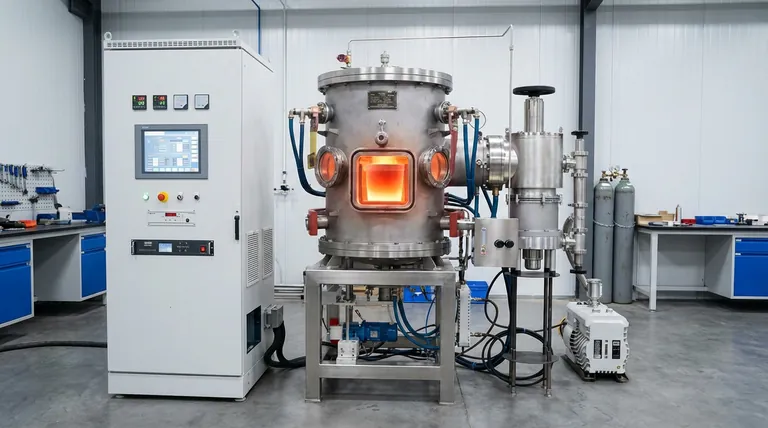
The primary function of a vacuum induction melting (VIM) furnace in the production of AlCoCrFeNi2.1 is to synthesize the alloy in a highly controlled environment that eliminates atmospheric contamination.
Specifically, it uses electromagnetic induction to generate heat within a high-vacuum chamber. This serves two critical roles: it prevents the oxidation of reactive elements—specifically Aluminum (Al) and Chromium (Cr)—and generates an electromagnetic stirring effect to ensure the complex mixture of five elements becomes chemically uniform.
Core Takeaway Producing High-Entropy Alloys (HEAs) like AlCoCrFeNi2.1 requires precise stoichiometric control that standard melting cannot provide. The VIM furnace is essential because it decouples heating from contamination, using a vacuum to protect reactive metals and magnetic fields to force-mix the alloy into a homogeneous state.
Preserving Chemical Integrity
The AlCoCrFeNi2.1 alloy relies on a specific balance of five different elements. The VIM furnace ensures this balance is maintained during the transition from raw material to liquid melt.
Preventing Oxidative Loss
The most immediate risk in melting this specific alloy is the reactivity of its components. Aluminum (Al) and Chromium (Cr) are highly active elements that readily react with oxygen at high temperatures.
If melted in open air, these elements would oxidize, turning into slag rather than integrating into the alloy. The VIM furnace operates in a high-vacuum environment to remove air and oxygen. This ensures that the reactive Al and Cr are retained within the metal matrix, preserving the alloy's intended chemical composition.
Eliminating Impurities
Beyond preventing oxidation, the vacuum environment actively purifies the material.
By maintaining low pressure, the furnace facilitates the removal of dissolved gases and volatile impurities from the raw materials. This results in a cleaner, higher-quality ingot with fewer non-metallic inclusions, which is critical for the material's final mechanical performance.
Ensuring Structural Homogeneity
High-entropy alloys derive their properties from the randomized, uniform distribution of their constituent elements. Achieving this mixture is physically difficult due to the varying melting points and densities of the raw metals.
The Mechanism of Electromagnetic Stirring
The VIM furnace does not rely on mechanical paddles to mix the metal. Instead, the induction heating process creates strong electromagnetic fields around the melt pool.
These fields induce currents that generate a vigorous stirring motion within the liquid metal. This is known as the electromagnetic stirring effect.
Achieving Uniform Distribution
For AlCoCrFeNi2.1, this stirring is non-negotiable. It forces the different molten elements to mix thoroughly, preventing segregation where heavier or lighter elements might otherwise separate.
This ensures that the chemical composition is uniform throughout the entire ingot. Without this continuous mixing, the final solid material would have inconsistent properties, leading to weak spots or unpredictable behavior in application.
Understanding the Trade-offs
While VIM is the superior choice for high-quality HEA production, it requires careful management of physical principles.
Volatility vs. Vacuum
While the vacuum prevents oxidation, extremely low pressure can inadvertently cause the evaporation of elements with high vapor pressures (such as Manganese, if present in other variations).
Operators must balance the vacuum level or introduce a partial pressure of inert gas (like argon) to suppress evaporation while still blocking oxygen.
Complexity of Process Control
VIM is not a "set it and forget it" method. It allows for the customization of the melting process (temperature profiles, vacuum levels, inert gas back-filling), but this requires precise control.
If the electromagnetic stirring is too aggressive, it can potentially erode the crucible lining, introducing new impurities. If it is too weak, the alloy remains inhomogeneous.
Making the Right Choice for Your Goal
To maximize the quality of your AlCoCrFeNi2.1 production, align your furnace parameters with your specific material requirements.
- If your primary focus is Compositional Accuracy: Prioritize high-vacuum protocols to strictly prevent the loss of Aluminum and Chromium to oxidation.
- If your primary focus is Mechanical Consistency: Optimize the frequency and power of the induction coil to maximize electromagnetic stirring, ensuring the alloy is perfectly homogeneous before casting.
The VIM furnace is not just a heat source; it is a chemical reaction vessel that locks in the precise elemental ratio required for advanced high-entropy alloys.
Summary Table:
| Feature | Function in HEA Production | Benefit for AlCoCrFeNi2.1 |
|---|---|---|
| High-Vacuum Chamber | Eliminates atmospheric oxygen | Prevents oxidation of reactive Aluminum (Al) and Chromium (Cr) |
| Induction Heating | Targeted electromagnetic heat | Decouples heating from contamination sources |
| Electromagnetic Stirring | Vigorous liquid metal mixing | Ensures uniform distribution of all five elements (homogeneity) |
| Pressure Control | Degassing and volatile removal | Eliminates impurities and dissolved gases for cleaner ingots |
Elevate Your Material Research with KINTEK Precision
Producing complex High-Entropy Alloys like AlCoCrFeNi2.1 demands equipment that offers absolute control over atmosphere and homogeneity. KINTEK provides industry-leading Vacuum Induction Melting (VIM) systems, Muffle, Tube, Rotary, and CVD furnaces, all backed by expert R&D and manufacturing. Our systems are fully customizable to meet your unique lab or production requirements, ensuring your reactive metals are protected and your alloys are perfectly mixed.
Ready to optimize your alloy synthesis? Contact KINTEK today to discuss your custom furnace needs!
References
- Ján RONČÁK, Martin Zobač. Thermal stability of electron beam welded AlCoCrFeNi<sub>2.1</sub> alloy. DOI: 10.1088/2053-1591/ad7ccc
This article is also based on technical information from Kintek Furnace Knowledge Base .
Related Products
- Vacuum Induction Melting Furnace
- 600T Vacuum Induction Hot Press Vacuum Heat Treat and Sintering Furnace
- Vacuum Heat Treat Sintering and Brazing Furnace
- Small Vacuum Heat Treat and Tungsten Wire Sintering Furnace
- Vacuum Heat Treat Sintering Furnace Molybdenum Wire Vacuum Sintering Furnace
People Also Ask
- What are the core functions of the High Vacuum Induction Melting (VIM) furnace? Optimize DD5 Superalloy Purification
- What is the role of VIM and directional solidification in aero-engine blade substrates? Engineering Extreme Durability
- What are the advantages of using a VIM furnace to control residual oxygen pressure? Achieve Superior Metal Uniformity
- What are the technical advantages of using a Vacuum Induction Melting furnace in the development of advanced packaging steel?
- What role does a Vacuum Induction Melting furnace play in the production of high-aluminum nickel-based superalloys?



















