
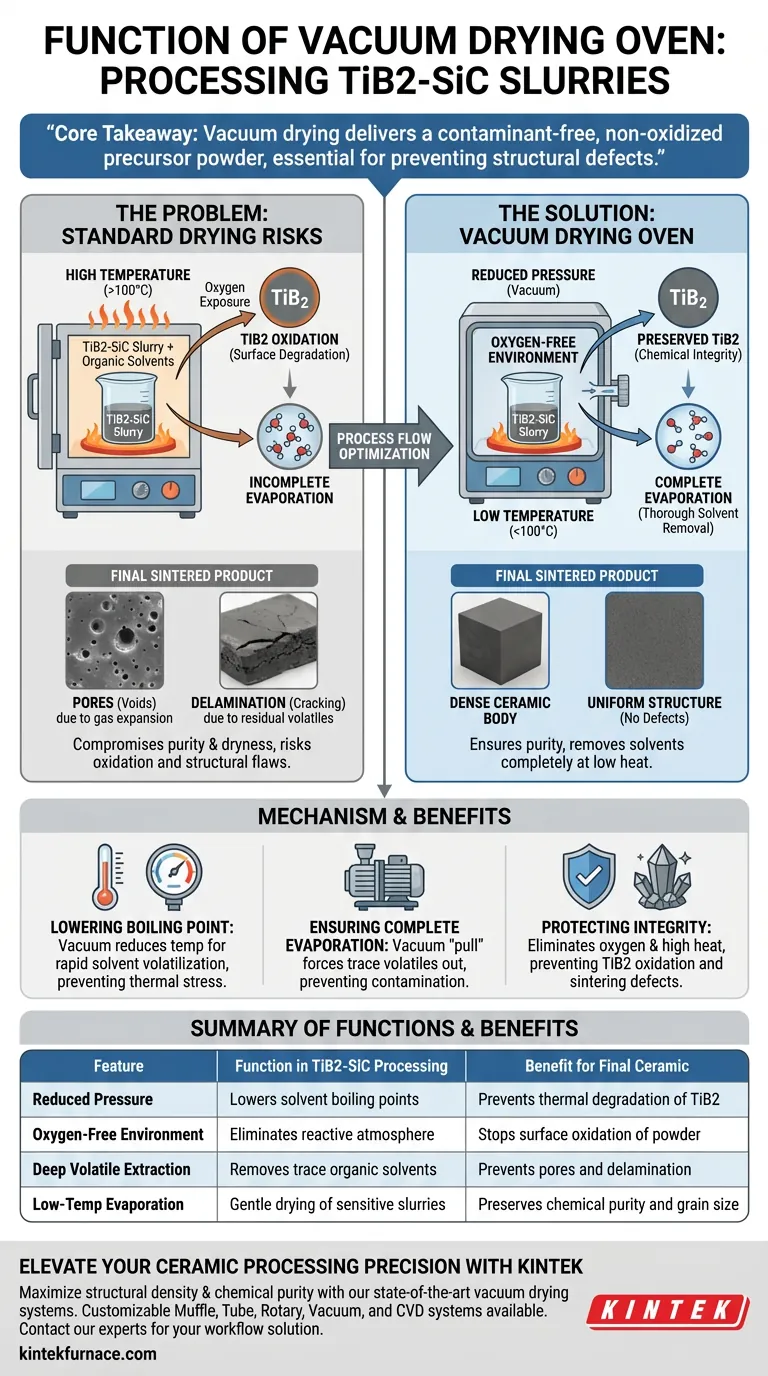
A vacuum drying oven is primarily used to remove organic solvents from mixed TiB2-SiC slurries at reduced temperatures to preserve the chemical integrity of the powder. By operating under negative pressure, the oven lowers the boiling point of the solvents, enabling efficient evaporation without exposing the sensitive Titanium Diboride (TiB2) to oxidation-inducing heat levels.
Core Takeaway Vacuum drying solves the conflict between needing to remove solvents completely and needing to avoid high temperatures. Its main function is to deliver a contaminant-free, non-oxidized precursor powder, which is the absolute prerequisite for preventing structural defects like pores and delamination during the final sintering process.

The Mechanism of Solvent Removal
Lowering the Boiling Point
The fundamental advantage of this equipment is the manipulation of atmospheric pressure. By creating a vacuum, the oven significantly reduces the temperature required for organic solvents to boil and volatilize.
This allows the slurry to dry rapidly at temperatures well below the standard boiling point of the solvent. It creates a gentle drying environment that protects the material components from thermal stress.
Ensuring Complete Evaporation
Simple air drying often leaves trace amounts of solvent trapped deep within the powder mixture. A vacuum drying oven exerts a "pull" that forces these volatiles out of the slurry.
This thorough removal is critical because any residual organic solvent left in the mixture will become a contaminant in later processing stages.
Protecting Chemical and Structural Integrity
Preventing TiB2 Oxidation
Titanium Diboride (TiB2) is prone to oxidation and degradation when exposed to high temperatures in the presence of oxygen. Standard drying methods often require heat levels that trigger these chemical changes.
The vacuum drying oven mitigates this risk entirely. By removing the oxygen environment and lowering the required heat, it ensures the TiB2 powder retains its purity and intended chemical composition.
Preventing Sintering Defects
The quality of the drying phase dictates the success of the subsequent sintering stage. If solvents remain in the powder, they will vaporize violently when the material is eventually fired at high temperatures.
This gas expansion causes pores (voids) inside the dense ceramic body. In layered or compacted structures, it causes delamination (cracking/separation). Vacuum drying eliminates the root cause of these defects.
Understanding the Trade-offs
The Risk of Standard Drying
Attempting to bypass vacuum drying often leads to a compromise between purity and dryness. If you use a standard oven at low temperatures, you risk incomplete solvent removal.
If you raise the temperature in a standard oven to force the solvent out, you accelerate surface oxidation of the TiB2. This oxidation creates a surface layer that inhibits grain growth and densification, ultimately weakening the final composite material.
Making the Right Choice for Your Goal
To maximize the effectiveness of your TiB2-SiC processing, align your drying parameters with your specific material requirements.
- If your primary focus is Chemical Purity: Prioritize high-vacuum levels to allow for the lowest possible temperature settings, minimizing any chance of TiB2 surface oxidation.
- If your primary focus is Structural Density: Ensure the drying cycle is sufficiently long to guarantee absolute solvent removal, as even trace volatiles will create porosity during sintering.
Precision in the drying phase is the invisible foundation of high-performance ceramics.
Summary Table:
| Feature | Function in TiB2-SiC Processing | Benefit for Final Ceramic |
|---|---|---|
| Reduced Pressure | Lowers solvent boiling points | Prevents thermal degradation of TiB2 |
| Oxygen-Free Environment | Eliminates reactive atmosphere | Stops surface oxidation of powder |
| Deep Volatile Extraction | Removes trace organic solvents | Prevents pores and delamination |
| Low-Temp Evaporation | Gentle drying of sensitive slurries | Preserves chemical purity and grain size |
Elevate Your Ceramic Processing Precision
Maximize the structural density and chemical purity of your advanced materials with KINTEK. Our state-of-the-art vacuum drying and high-temperature systems are engineered to prevent oxidation and eliminate porosity in sensitive precursors like TiB2-SiC.
Backed by expert R&D and manufacturing, KINTEK offers a comprehensive range of Muffle, Tube, Rotary, Vacuum, and CVD systems, all fully customizable to meet your unique lab requirements. Don't let residual solvents compromise your sintering results—contact our experts today to find the perfect drying solution for your workflow!
Visual Guide
References
- German Alberto Barragán De Los Rios, Patricia Fernández‐Morales. Numerical Simulation of Aluminum Foams by Space Holder Infiltration. DOI: 10.1007/s40962-024-01287-8
This article is also based on technical information from Kintek Furnace Knowledge Base .
Related Products
- Vacuum Heat Treat Sintering and Brazing Furnace
- Vacuum Heat Treat Sintering Furnace Molybdenum Wire Vacuum Sintering Furnace
- Dental Porcelain Zirconia Sintering Ceramic Vacuum Press Furnace
- Molybdenum Vacuum Heat Treat Furnace
- Vacuum Hot Press Furnace Machine Heated Vacuum Press
People Also Ask
- What are the benefits of using vacuum heat treating furnaces for metal alloys? Achieve Superior Metal Properties and Performance
- How does vacuum heat treating affect the grain structure of metal alloys? Achieve Precise Microstructure Control
- What is one of the most important uses of vacuum heat treating furnaces in aerospace? Achieve Superior Strength in Aircraft Alloys
- What is the temperature of a vacuum furnace brazing? Optimize Your Joint Strength and Cleanliness
- What are the steps involved in a typical vacuum brazing treatment? Master the Process for Strong, Clean Joints












