
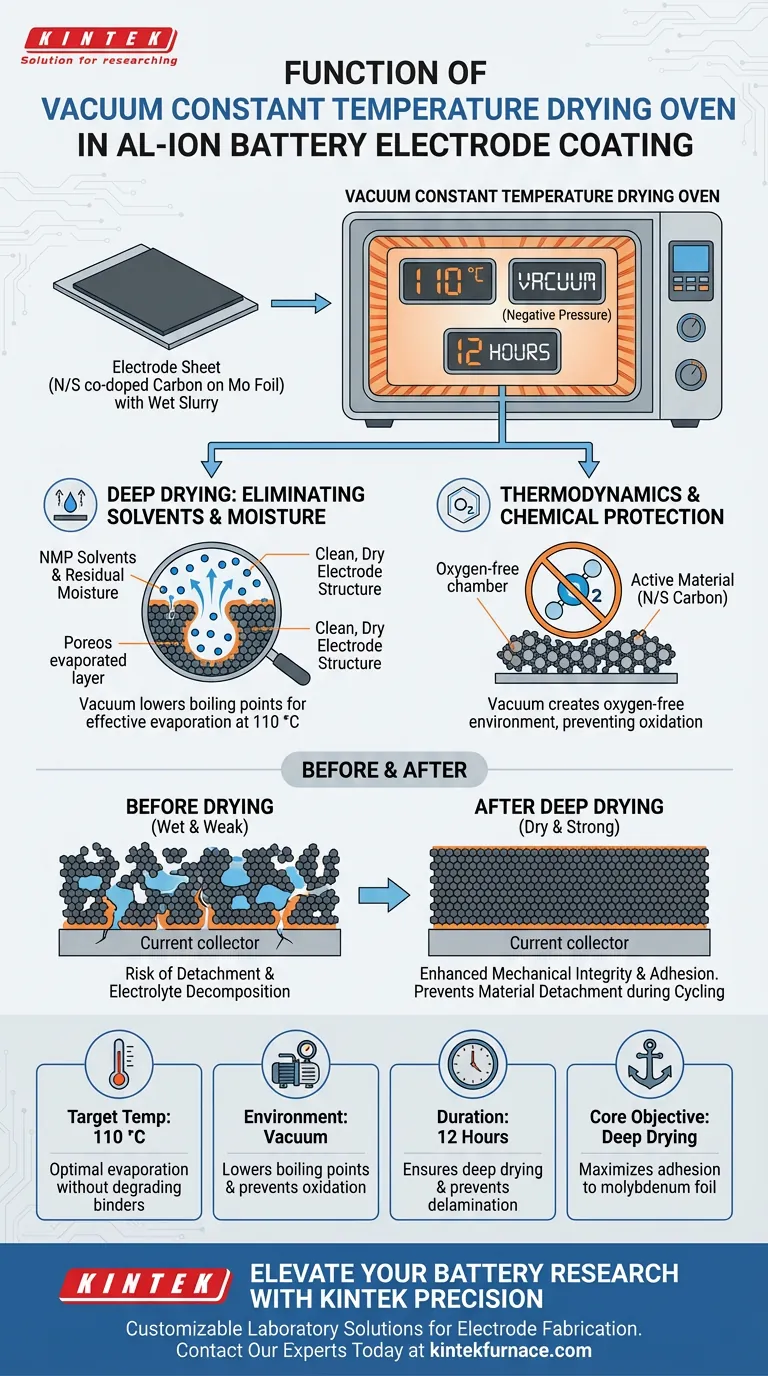
The primary function of a vacuum constant temperature drying oven in the electrode coating process for aluminum-ion batteries is to achieve deep drying of the cathode material, specifically nitrogen and sulfur co-doped carbon coatings applied to molybdenum foil.
By maintaining a consistent temperature of 110 °C under vacuum for 12 hours, this equipment ensures the complete removal of NMP (N-methyl-pyrrolidone) solvents and residual moisture. This specific thermal treatment is vital for enhancing the mechanical integrity of the electrode and ensuring the coating remains bonded to the current collector.
Core Takeaway: The vacuum drying oven acts as a critical stabilization stage. By thoroughly eliminating solvents and moisture without inducing oxidation, it maximizes the adhesion between the active material and the current collector, directly preventing material detachment during the rigorous charge-discharge cycles of the battery.

The Critical Role of Deep Drying
Eliminating Solvents and Moisture
The primary operational goal is the thorough removal of volatile components. In the context of aluminum-ion batteries using N/S co-doped carbon cathodes, the coating slurry contains NMP solvents which must be fully evaporated.
Standard drying is often insufficient to remove trapped solvent molecules from deep within the porous coating. The vacuum oven addresses this by creating a negative pressure environment that facilitates the evaporation of these stubborn residues.
Enhancing Mechanical Stability
The physical durability of the electrode is determined during this drying phase. If solvents or moisture remain, they compromise the interface between the active material and the molybdenum foil current collector.
By drying at 110 °C for an extended period (12 hours), the oven ensures the binder cures correctly. This strengthens the adhesion of the active layer, preventing the common failure mode where active substances detach or delaminate during battery cycling.
Operational Principles
The Vacuum Advantage
The use of vacuum is not merely about removing air; it is about thermodynamics and chemical protection.
First, the vacuum environment lowers the boiling point of solvents like NMP. This allows for effective evaporation at temperatures (like 110 °C) that are high enough to dry the material but controlled enough to preserve the electrode's microstructure.
Second, the vacuum creates an oxygen-free environment. While the primary reference focuses on solvent removal, supplementary data indicates that vacuum conditions prevent oxidation reactions between the active materials and air, ensuring chemical purity.
Precision Temperature Control
Uniformity is key to consistent battery performance. The "constant temperature" aspect ensures that the entire electrode sheet experiences the exact same thermal history.
For this specific application, 110 °C is the optimal set point. It provides enough thermal energy to drive out moisture and solvents without thermally degrading the active nitrogen and sulfur co-doped carbon material or the binder.
Understanding the Trade-offs
While vacuum drying is essential, it introduces specific constraints that must be managed:
Process Bottlenecks
The requisite drying time is significant. The specific protocol requires 12 hours of continuous drying. This makes the vacuum drying stage a potential bottleneck in high-throughput manufacturing compared to rapid, continuous drying methods.
Thermal Sensitivity
There is a delicate balance between drying speed and material integrity. Increasing the temperature above 110 °C might speed up solvent removal but runs the risk of damaging the binder or altering the doping structure of the carbon cathode. Conversely, lowering the temperature may leave residual NMP, leading to electrolyte decomposition or side reactions later.
Making the Right Choice for Your Goal
To optimize your electrode preparation process, align your drying parameters with your specific performance targets:
- If your primary focus is Cycle Life: Strictly adhere to the 12-hour duration at 110 °C to maximize adhesion and prevent the detachment of active substances during repeated cycling.
- If your primary focus is Chemical Purity: Ensure the vacuum seal is robust to prevent oxygen ingress, as this protects the N/S co-doped materials and prevents moisture-induced side reactions with the electrolyte.
Success in aluminum-ion battery fabrication relies not just on the materials chosen, but on the patience and precision applied during the drying phase to secure the electrode's structural foundation.
Summary Table:
| Parameter | Specification | Function/Benefit |
|---|---|---|
| Target Temp | 110 °C | Optimal evaporation of NMP without degrading binders |
| Environment | Vacuum (Negative Pressure) | Lowers solvent boiling points & prevents oxidation |
| Duration | 12 Hours | Ensures deep drying and prevents material delamination |
| Core Objective | Deep Drying | Maximizes mechanical adhesion to molybdenum foil |
Elevate Your Battery Research with KINTEK Precision
Precise thermal processing is the foundation of high-performance aluminum-ion batteries. At KINTEK, we specialize in providing advanced laboratory solutions tailored to your specific electrode fabrication needs.
Backed by expert R&D and manufacturing, KINTEK offers Muffle, Tube, Rotary, Vacuum, and CVD systems, along with other specialized lab high-temp furnaces. Our vacuum constant temperature ovens are fully customizable to meet your unique drying protocols, ensuring your active materials remain pure and securely bonded to their current collectors.
Ready to eliminate solvent residues and boost cycle life?
Contact Our Experts Today to discuss your custom furnace requirements.
Visual Guide
References
- Jiahui Li, Shaobo Tu. Pseudocapacitive Heteroatom‐Doped Carbon Cathode for Aluminum‐Ion Batteries with Ultrahigh Reversible Stability. DOI: 10.1002/eem2.12733
This article is also based on technical information from Kintek Furnace Knowledge Base .
Related Products
- Vacuum Heat Treat Sintering Furnace Molybdenum Wire Vacuum Sintering Furnace
- Molybdenum Vacuum Heat Treat Furnace
- Vacuum Heat Treat Sintering and Brazing Furnace
- 2200 ℃ Tungsten Vacuum Heat Treat and Sintering Furnace
- 1700℃ High Temperature Muffle Oven Furnace for Laboratory
People Also Ask
- What are the main structural components of a vacuum sintering furnace? Unlock Precision in High-Temperature Processing
- What are the key components of a vacuum sintering furnace? Essential Parts for Precision Material Processing
- How does vacuum sintering improve dimensional tolerances? Achieve Uniform Shrinkage and Precision
- What is the purpose of setting a mid-temperature dwell stage? Eliminate Defects in Vacuum Sintering
- How does vacuum sintering contribute to cost reduction in material processing? Lower Expenses with Superior Parts










