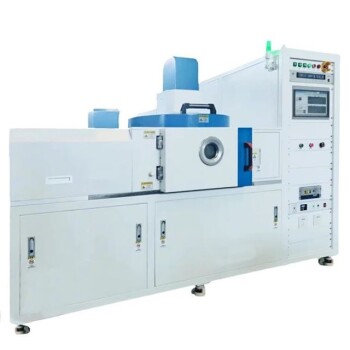
Spark Plasma Sintering (SPS) dominates traditional resistance furnaces primarily through its internal heating mechanism. Unlike conventional methods that rely on external radiation to slowly heat a sample, SPS passes pulsed electric current directly through the mold or material. This generates immediate Joule heat combined with axial pressure, enabling rapid densification at significantly lower temperatures.
Core Takeaway: By utilizing pulsed current for direct internal heating and simultaneous pressure, SPS bypasses the thermal transfer limits of traditional furnaces. This achieves near-theoretical density while preserving fine grain structures, resulting in ceramics with superior hardness and fracture toughness.
The Mechanism of Rapid Densification
Internal vs. External Heating
Traditional resistance furnaces operate on an external heating principle. Heat must radiate from the heating elements to the mold surface and then slowly conduct into the core of the sample.
In contrast, SPS employs an internal heating mechanism. Pulsed electric currents flow directly through the graphite mold and the powder sample itself. This generates internal Joule heat instantly, allowing for heating rates of several hundred degrees per minute.
The Plasma Activation Effect
Beyond simple heating, the pulsed current creates a unique phenomenon known as plasma activation. This effect occurs at the contact points between powder particles.
The activation significantly accelerates atomic diffusion within the grain boundaries. This allows materials to overcome high lattice energy barriers more efficiently than thermal energy alone could achieve.
The Role of Axial Pressure
SPS does not rely on heat alone; it utilizes a synchronized axial pressure mechanism (often around 50 MPa).
Applying high pressure during the heating phase physically assists in particle rearrangement. This mechanical force works in tandem with the thermal energy to close pores and achieve high relative densities (often exceeding 98%) much faster than pressureless sintering.
Impact on Microstructure and Material Properties
Inhibition of Grain Growth
One of the critical flaws of traditional sintering is the long "dwell time" required at high temperatures, which allows grains to grow large and uncontrolled.
SPS dramatically shortens this holding time due to its rapid heating rates. By minimizing the time the material spends at peak temperature, SPS inhibits anisotropic grain growth, effectively freezing the microstructure in a fine-grained state.
Superior Physical Properties
The combination of high density and fine grain structure directly correlates to improved mechanical performance.
Because the grains remain small and uniform, the resulting ceramics exhibit superior hardness and fracture toughness. This is particularly vital for high-performance materials like Silicon Carbide (SiC) or Titanium Diboride (TiB2), where coarsening significantly degrades performance.
Understanding the Operational Trade-offs
Complexity of Process Control
While traditional furnaces are relatively passive, SPS requires the precise synchronization of multiple variables.
Operators must strictly control the pulsed current intensity, vacuum environment, and mechanical pressure simultaneously. A failure to synchronize the pressure application with the thermal expansion and softening of the material can lead to defects or mold failure.
Material Conductivity Requirements
The efficiency of the Joule heating mechanism relies heavily on the electrical path.
The pulsed current must flow through the mold and, ideally, the sample. This makes the process highly dependent on the electrical conductivity of the tooling (usually graphite) and the powder compact. Non-conductive samples rely more heavily on heat transfer from the mold, slightly altering the heating dynamics compared to conductive ceramics.
Making the Right Choice for Your Goal
When deciding between SPS and traditional sintering for your project, consider your specific material targets:
- If your primary focus is Maximum Hardness: Prioritize SPS to utilize rapid thermal cycles that inhibit grain growth and maintain a fine, hard microstructure.
- If your primary focus is Densifying Difficult Materials: Use SPS to leverage plasma activation and pressure, which overcome the low diffusion rates inherent in high-entropy or covalent ceramics.
- If your primary focus is Process Efficiency: Adopt SPS to reduce cycle times from hours to minutes, significantly lowering energy consumption per run.
Ultimately, SPS is not just a faster furnace; it is a kinetic tool that forces densification before the microstructure has time to degrade.
Summary Table:
| Feature | Traditional Resistance Furnace | Spark Plasma Sintering (SPS) |
|---|---|---|
| Heating Mechanism | External radiation & conduction | Internal Joule heating (Pulsed current) |
| Heating Rate | Slow (typically 5-20°C/min) | Ultra-fast (up to several 100°C/min) |
| Sintering Time | Several hours | Minutes |
| Microstructure | Coarse grains due to long dwell | Fine grain structure (inhibits growth) |
| Pressure | Usually pressureless | Simultaneous axial pressure |
| Material Density | Standard density | Near-theoretical density (>98%) |
Unlock Advanced Material Performance with KINTEK
Ready to transition from slow, traditional heating to the precision of Spark Plasma Sintering? At KINTEK, we bridge the gap between complex R&D requirements and industrial manufacturing. Our specialized systems are designed to help you achieve maximum hardness and density in high-performance ceramics while drastically reducing cycle times.
Why choose KINTEK?
- Expert R&D & Manufacturing: Precision-engineered Muffle, Tube, Rotary, Vacuum, and CVD systems.
- Customizable Solutions: Tailored furnace configurations to meet your specific material conductivity and pressure needs.
- Superior Efficiency: Reduce energy consumption and preserve fine grain structures with our cutting-edge thermal technology.
Elevate your lab's capabilities and master the kinetics of densification. Contact our experts today to find your custom solution!
References
- Beatriz Monteiro, Sónia Simões. Microstructure and Mechanical Properties of Ti6Al4V to Al2O3 Brazed Joints Using Ti-Ag/Cu-Ti Thin Films. DOI: 10.3390/met14020146
This article is also based on technical information from Kintek Furnace Knowledge Base .
Related Products
- Spark Plasma Sintering SPS Furnace
- Chairside Dental Porcelain Zirconia Sintering Furnace with Transformer for Ceramic Restorations
- 600T Vacuum Induction Hot Press Vacuum Heat Treat and Sintering Furnace
- 9MPa Air Pressure Vacuum Heat Treat and Sintering Furnace
- Dental Porcelain Zirconia Sintering Ceramic Vacuum Press Furnace
People Also Ask
- Why is it necessary to maintain a high vacuum environment during the SPS of SiC? Key to High-Density Ceramics
- How does the heating mechanism of Spark Plasma Sintering (SPS) function? Enhance TiC/SiC Composite Fabrication
- What are the technical advantages of using an SPS sintering furnace? Elevate Al2O3-TiC Material Performance
- What are the steps in the discharge plasma sintering process? Master Fast, High-Density Material Consolidation
- What are the advantages of spark plasma sintering (SPS) over traditional forging? Precision Microstructural Control