
At its core, a vacuum annealing furnace is an integrated system composed of several primary components working in concert. These are the furnace chamber, a vacuum system to remove atmosphere, a heating system to apply thermal energy, a cooling system to control the final microstructure, and an electrical control system to orchestrate the entire process.
The design of a vacuum annealing furnace is a direct response to a fundamental materials science challenge: how to heat-treat reactive metals without introducing impurities like oxides. Each component works in a precise sequence to create a highly controlled, inert environment, ensuring the material's properties are improved, not compromised.
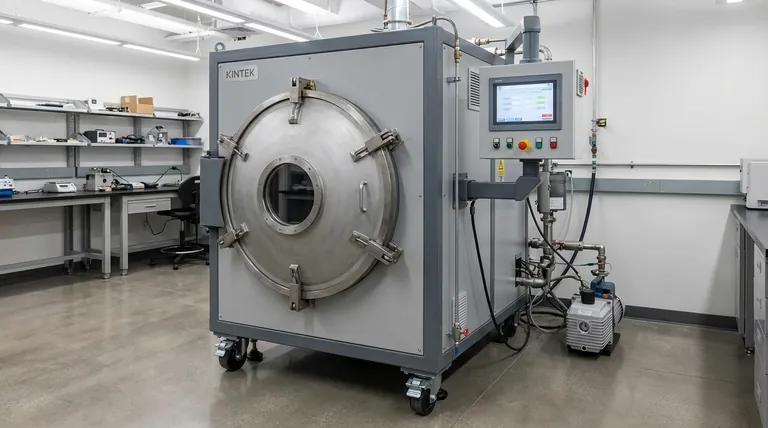
The Anatomy of a Vacuum Furnace: A Component-by-Component Breakdown
To understand the furnace, you must understand how each part contributes to creating and maintaining the ideal treatment environment.
The Furnace Chamber (or Body)
This is the sealed, double-walled vessel that contains the workpiece and the heating elements. Its primary job is to withstand both high vacuum and high temperatures.
The outer walls are typically made of steel and often feature a water-cooling jacket to keep the exterior safe to touch and protect seals from heat damage.
The interior "hot zone," or furnace liner, is constructed from materials like graphite, molybdenum, or ceramic fiber insulation to reflect heat and protect the chamber walls.
The Vacuum System
The vacuum system is what makes the furnace a "vacuum furnace." Its purpose is to remove air and other gases, primarily oxygen, that would cause oxidation and contamination at high temperatures.
This is usually a multi-stage system. A mechanical pump (or "roughing pump") removes the bulk of the air to create a low vacuum. Then, a diffusion pump or turbomolecular pump takes over to achieve the high vacuum level required for the process.
The Heating System
This system is responsible for raising the workpiece to the precise annealing temperature. In most modern furnaces, this is accomplished via electric resistance heating elements.
These elements are made of materials suited for high-temperature, vacuum operation, such as high-purity graphite, molybdenum strips (MoSi2), or silicon carbide (SiC). The choice of material depends on the maximum required temperature and chemical compatibility with the workpiece.
The Cooling System
After the heating and soaking stage, the workpiece must be cooled in a controlled manner to lock in the desired metallurgical properties.
This is achieved either through natural cooling (simply turning off the heaters) or, more commonly, a forced cooling system. This system rapidly backfills the chamber with a high-purity inert gas (like argon or nitrogen) and uses a powerful fan to circulate it, quickly and evenly extracting heat from the workpiece.
The Electrical Control System
This is the brain of the operation. Modern furnaces use a Programmable Logic Controller (PLC) or Proportional-Integral-Derivative (PID) controller to automate the entire cycle.
The control system manages the vacuum pumps, precisely regulates the heating rate and soaking temperature, controls the holding time, and activates the cooling system according to a pre-programmed recipe. This ensures process repeatability and reliability.
Understanding the Trade-offs
Choosing a vacuum furnace involves balancing performance, cost, and material compatibility. The configuration of its core components dictates its capabilities.
Hot Zone Material: Graphite vs. All-Metal
Graphite is a common, cost-effective material for heating elements and insulation. However, it can release carbon particles ("dusting"), which may be unacceptable when treating certain sensitive alloys.
All-metal hot zones, using molybdenum or tungsten, provide an exceptionally clean environment ideal for medical-grade titanium or electronic components. This cleanliness comes at a significantly higher initial cost and with limitations on operating in non-vacuum atmospheres.
Pumping System: Diffusion vs. Turbo
Diffusion pumps are a proven, robust technology that can create high vacuums at a lower cost. Their primary drawback is their use of oil, which can potentially backstream and contaminate the furnace chamber if not properly trapped.
Turbomolecular ("turbo") and cryogenic pumps are "dry" or oil-free pumps. They provide a cleaner vacuum and can reach higher vacuum levels, but they are more expensive and can be more sensitive to operational errors.
Cooling Rate: Gas Quenching vs. Natural Cooling
A powerful forced gas quenching system allows for very rapid cooling, which is essential for certain alloys and drastically reduces overall cycle time. However, the high-pressure gas and powerful fan add complexity and cost to the furnace.
Simpler furnaces that rely on natural cooling or gentle gas circulation are less expensive but have much longer cycle times, making them less suitable for high-volume production.
Making the Right Choice for Your Application
The ideal furnace configuration is directly tied to the materials you are processing and your operational goals.
- If your primary focus is general-purpose annealing of steels: A furnace with a robust graphite hot zone and a reliable diffusion pump system often provides the best balance of cost and performance.
- If your primary focus is treating highly reactive or sensitive materials (e.g., titanium, medical implants): An all-metal hot zone (molybdenum) and a clean, oil-free vacuum system (turbomolecular pumps) are critical to prevent any contamination.
- If your primary focus is maximizing throughput and process flexibility: A furnace equipped with a powerful, high-pressure forced gas quenching system is essential for achieving rapid, controlled cooling across a wide range of alloys.
Ultimately, understanding how these components interact is the key to mastering the vacuum annealing process and achieving consistent, high-quality results.
Summary Table:
| Component | Key Function | Common Materials/Technologies |
|---|---|---|
| Furnace Chamber | Sealed vessel for workpiece and heating | Steel, graphite, molybdenum, ceramic fiber |
| Vacuum System | Removes air to prevent contamination | Mechanical pump, diffusion pump, turbomolecular pump |
| Heating System | Applies thermal energy for annealing | Graphite, molybdenum strips, silicon carbide |
| Cooling System | Controls cooling for microstructure | Natural cooling, forced gas quenching with inert gases |
| Electrical Control System | Automates and monitors the process | PLC, PID controller |
Ready to optimize your vacuum annealing process? KINTEK leverages exceptional R&D and in-house manufacturing to provide advanced high-temperature furnace solutions, including Muffle, Tube, Rotary Furnaces, Vacuum & Atmosphere Furnaces, and CVD/PECVD Systems. With strong deep customization capabilities, we precisely meet the unique experimental requirements of laboratories handling reactive metals, medical implants, and high-volume production. Contact us today to discuss how our tailored solutions can enhance your material processing efficiency and quality!
Visual Guide

Related Products
- Small Vacuum Heat Treat and Tungsten Wire Sintering Furnace
- Vacuum Heat Treat Sintering and Brazing Furnace
- Vacuum Heat Treat Sintering Furnace Molybdenum Wire Vacuum Sintering Furnace
- Vacuum Heat Treat Sintering Furnace with Pressure for Vacuum Sintering
- Vacuum Sealed Continuous Working Rotary Tube Furnace Rotating Tube Furnace
People Also Ask
- How does vacuum sintering improve dimensional tolerances? Achieve Uniform Shrinkage and Precision
- What are the key components of a vacuum sintering furnace? Essential Parts for Precision Material Processing
- What is the purpose of setting a mid-temperature dwell stage? Eliminate Defects in Vacuum Sintering
- What are the main structural components of a vacuum sintering furnace? Unlock Precision in High-Temperature Processing
- What are the main types of sintering furnaces? Find the Perfect Match for Your Materials



















