
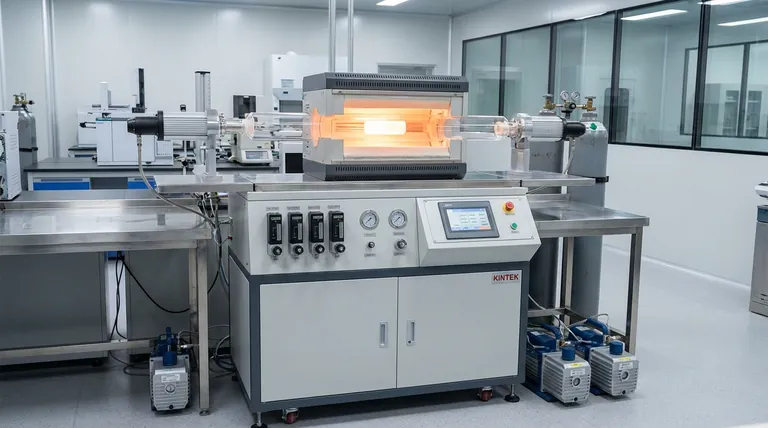
The tube resistance furnace functions as the primary thermal driver within a Chemical Vapor Deposition (CVD) system. Its critical role is to generate a controlled, long-range constant temperature zone that heats reaction precursors to their specific decomposition temperatures, thereby initiating the chemical deposition process.
The furnace does more than simply heat the system; it establishes the thermodynamic environment required for reaction kinetics. By maintaining a precise thermal profile, it allows for the exact control of thin film properties, including crystal orientation, morphology, and thickness.
The Mechanics of Thermal Activation
Creating the Constant Temperature Zone
The defining feature of a tube resistance furnace in this context is its ability to create a "flat" thermal profile.
Unlike a point heat source, this furnace maintains a uniform temperature over a specific length of the tube.
This long-range stability ensures that the substrate and the gas phase are exposed to consistent thermal energy, eliminating gradients that could cause uneven deposition.
Triggering Precursor Decomposition
CVD relies on chemical reactions, not just physical coating.
The furnace heats the incoming precursor gases (and the substrate) to the precise point where chemical bonds break or rearrange.
This thermal energy triggers decomposition or reaction, transforming volatile gas components into the solid materials that eventually adhere to the substrate.
Impact on Deposition Quality
Defining Crystal Orientation and Morphology
The structural quality of the deposited film is directly tied to thermal precision.
By integrating with high-precision mass flow controllers, the furnace enables the operator to manipulate how the material nucleates and grows.
Accurate temperature control dictates the crystal orientation and surface morphology, distinguishing a high-quality semiconductor film from a defective one.
Ensuring Uniform Thickness
Uniformity is the gold standard in thin film deposition.
Because the furnace provides a stable thermal zone, the reaction rate remains constant across the targeted area of the substrate.
This allows gas-phase components to deposit evenly, resulting in a film with consistent thickness across the entire surface of the part or wafer.
Understanding the Trade-offs
Thermal Inertia
Resistance furnaces are robust, but they typically have high thermal mass.
This means they heat up and cool down relatively slowly compared to lamp-based (rapid thermal processing) systems.
This high inertia provides excellent stability but makes rapid temperature cycling difficult, limiting their use in processes requiring fast thermal changes.
The Limits of the "Constant" Zone
While the furnace is designed for a long-range constant zone, this zone is finite.
Operators must precisely position the substrate within the "sweet spot" of the tube.
Placing the substrate too near the tube ends, where the temperature rolls off, will result in incomplete decomposition and poor film uniformity.
Making the Right Choice for Your Goal
To maximize the effectiveness of a tube resistance furnace in your CVD process, align your operational parameters with your specific output requirements.
- If your primary focus is Crystal Quality: Prioritize thermal stability over ramp speed to ensure the thermodynamic conditions favor specific crystal orientations.
- If your primary focus is Uniformity: Ensure your substrate size fits strictly within the measured constant temperature zone of the furnace, avoiding the thermal gradients at the tube ends.
Precision in the thermal profile is the difference between a functional coating and a failed experiment.
Summary Table:
| Feature | Function in CVD Process | Impact on Quality |
|---|---|---|
| Constant Temp Zone | Maintains uniform thermal energy over the substrate | Ensures consistent film thickness |
| Thermal Activation | Heats precursors to decomposition temperatures | Triggers chemical reactions & bonding |
| Precise Control | Manages thermodynamic environment and kinetics | Defines crystal orientation & morphology |
| High Thermal Inertia | Provides extreme stability during deposition | Eliminates temperature fluctuations |
Elevate Your CVD Precision with KINTEK
Unlock the full potential of your Chemical Vapor Deposition processes with KINTEK’s advanced heating solutions. Backed by expert R&D and manufacturing, KINTEK offers high-performance Tube, Muffle, Rotary, Vacuum, and CVD systems, all customizable to your specific research or production needs.
Our furnaces are engineered to provide the precise thermal profiles and long-range constant temperature zones required for flawless crystal growth and uniform thin-film deposition. Whether you are developing next-generation semiconductors or advanced functional coatings, we provide the reliable thermal drivers you need to succeed.
Ready to optimize your deposition quality? Contact us today to discuss your unique project requirements!
References
- Salokhiddin Absattarov, Jamshed Avliyokulov. Dependence establishment of mass transfer coefficient in third kind boundary condition on temperature during vacuum carburizing of steels. DOI: 10.1063/5.0266787
This article is also based on technical information from Kintek Furnace Knowledge Base .
Related Products
- Split Chamber CVD Tube Furnace with Vacuum Station CVD Machine
- Custom Made Versatile CVD Tube Furnace Chemical Vapor Deposition CVD Equipment Machine
- Multi Heating Zones CVD Tube Furnace Machine for Chemical Vapor Deposition Equipment
- Slide PECVD Tube Furnace with Liquid Gasifier PECVD Machine
- Inclined Rotary Plasma Enhanced Chemical Deposition PECVD Tube Furnace Machine
People Also Ask
- What role does a Tube Furnace play in the CVD growth of carbon nanotubes? Achieve High-Purity CNT Synthesis
- What are the operational and maintenance requirements for a CVD tube furnace? Ensure Precision for Thin Film Deposition
- How does a CVD tube furnace achieve high purity in gate media preparation? Master Precision Control for Flawless Films
- What are the advantages of using a CVD tube furnace for preparing gate dielectrics? Achieve High-Quality Thin Films for Transistors
- What is a CVD tube furnace and what is its primary function? Discover Precision Thin-Film Deposition



















