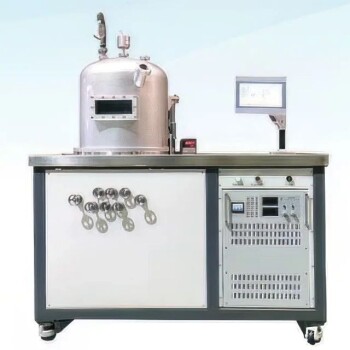
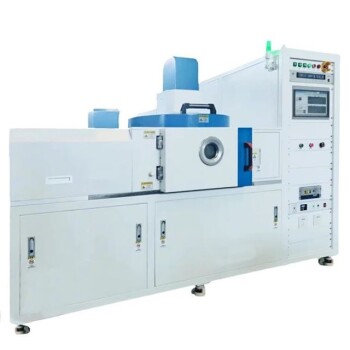
The high-purity quartz tube functions as the primary reaction vessel in a Chemical Vapor Deposition (CVD) system, designed to create a chemically inert and thermally stable environment essential for bilayer graphene synthesis. It facilitates the precise flow of precursor gases while withstanding temperatures up to 1300 K to ensure the controlled decomposition of carbon sources onto a copper substrate.
By isolating the reaction from external contaminants and enduring extreme heat without reacting with precursors, the quartz tube enables the controlled decomposition of carbon sources required for high-quality, structurally uniform bilayer graphene.
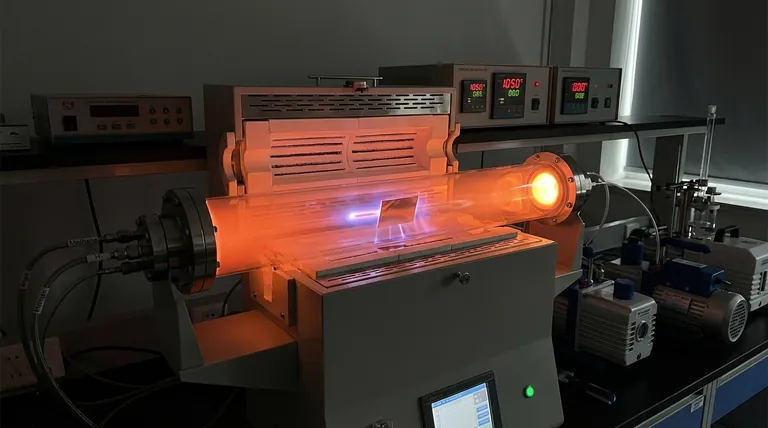
Creating the Optimal Growth Environment
To synthesize bilayer graphene, the reaction chamber must satisfy strict thermodynamic and chemical requirements. The high-purity quartz tube is selected specifically to meet these demands.
Thermal Stability at Extreme Temperatures
Bilayer graphene synthesis requires high thermal energy to activate the carbon precursors. The quartz tube is capable of withstanding temperatures up to 1300 K (approximately 1027 °C).
This high thermal tolerance allows the system to reach the necessary processing temperatures—often around 1050 °C for specific applications—without the tube deforming or failing. This stability ensures a consistent thermodynamic zone where the reaction kinetics can be precisely predicted.
Chemical Inertness and Purity
The atomic structure of graphene is highly sensitive to impurities. The quartz tube provides a chemically inert barrier that prevents external contamination from entering the reaction zone.
Unlike metal chambers that might off-gas or react with precursors at high heat, high-purity quartz resists chemical erosion. This ensures that the only elements interacting with the copper foil are the intended process gases.
Facilitating Precise Process Control
Beyond acting as a container, the geometry and material properties of the tube play an active role in the deposition process.
Managing Gas Dynamics
The tube serves as a channel for the controlled flow of process gases, specifically methane, hydrogen, and argon.
By confining these gases within a specific volume, the tube helps maintain the correct partial pressures and flow ratios. This control is critical for regulating the carbon supply, which dictates whether the graphene forms as a single layer, a bilayer, or a multilayer film.
Enabling Epitaxial Growth
The ultimate goal of the system is the epitaxial growth of graphene on copper foil.
The quartz tube maintains the environment necessary for the carbon source (methane) to decompose efficiently. This allows carbon atoms to settle onto the copper catalyst in a uniform manner, resulting in the production of structurally uniform bilayer graphene.
Understanding the Trade-offs
While high-purity quartz is the standard for this application, it is not without limitations that must be managed.
Thermal Limits and Devitrification
Although quartz handles high heat well, operating near or above its maximum threshold for extended periods can lead to devitrification.
This process causes the quartz to crystallize, turning it cloudy and brittle. Once devitrification begins, the tube's structural integrity is compromised, increasing the risk of cracks or vacuum leaks during thermal cycling.
Fragility and Handling
Quartz is a ceramic material and is inherently brittle.
It does not deform plastically under stress; it shatters. Consequently, loading the copper substrate or cleaning the tube requires extreme care to avoid mechanical shock that could destroy the vacuum seal integrity.
Making the Right Choice for Your Goal
To maximize the effectiveness of your CVD system for bilayer graphene, consider how you manage the quartz reaction chamber.
- If your primary focus is Structural Uniformity: strictly monitor the furnace temperature to stay within the tube's 1300 K limit, ensuring a stable thermodynamic environment for consistent growth.
- If your primary focus is Chemical Purity: ensure the tube is regularly inspected for devitrification or erosion to prevent microscopic leaks that could introduce ambient contaminants.
The quartz tube is not just a passive container; it is an active component that defines the purity and thermal boundaries of your entire synthesis process.
Summary Table:
| Feature | Function in CVD System | Benefit for Graphene Synthesis |
|---|---|---|
| High Thermal Stability | Withstands up to 1300 K | Enables consistent decomposition of carbon sources. |
| Chemical Inertness | Resists reaction with precursors | Prevents contamination for high-quality structural uniformity. |
| Gas Flow Control | Channels CH4, H2, and Ar gases | Regulates carbon supply for precise bilayer formation. |
| Mechanical Isolation | Acts as primary reaction vessel | Maintains a controlled vacuum environment for epitaxial growth. |
Elevate Your Graphene Research with KINTEK
Precision in bilayer graphene synthesis starts with the right reaction environment. Backed by expert R&D and manufacturing, KINTEK offers high-performance Muffle, Tube, Rotary, Vacuum, and CVD systems—all fully customizable to meet your unique laboratory requirements.
Whether you need superior thermal stability or a contamination-free growth zone, our high-purity quartz solutions and advanced furnace systems provide the reliability your research demands.
Ready to optimize your deposition process? Contact KINTEK today to discuss your custom furnace needs!
References
- Shunsuke Kawabata, Tomonori Ohba. Degradation of Graphene in High- and Low-Humidity Air, and Vacuum Conditions at 300–500 K. DOI: 10.3390/nano14020166
This article is also based on technical information from Kintek Furnace Knowledge Base .
Related Products
- Split Chamber CVD Tube Furnace with Vacuum Station CVD Machine
- Slide PECVD Tube Furnace with Liquid Gasifier PECVD Machine
- Custom Made Versatile CVD Tube Furnace Chemical Vapor Deposition CVD Equipment Machine
- HFCVD Machine System Equipment for Drawing Die Nano Diamond Coating
- MPCVD Machine System Reactor Bell-jar Resonator for Lab and Diamond Growth
People Also Ask
- What role does a Tube Furnace play in the CVD growth of carbon nanotubes? Achieve High-Purity CNT Synthesis
- What are the advantages of using a CVD tube furnace for preparing gate dielectrics? Achieve High-Quality Thin Films for Transistors
- How does a CVD tube furnace achieve high purity in gate media preparation? Master Precision Control for Flawless Films
- What are the operational and maintenance requirements for a CVD tube furnace? Ensure Precision for Thin Film Deposition
- Why are CVD tube furnace sintering systems indispensable for 2D material research and production? Unlock Atomic-Scale Precision